〜とき: why 行くとき and 行ったとき are two different moments〜とき: 「行くとき」と「行ったとき」はちがう時間
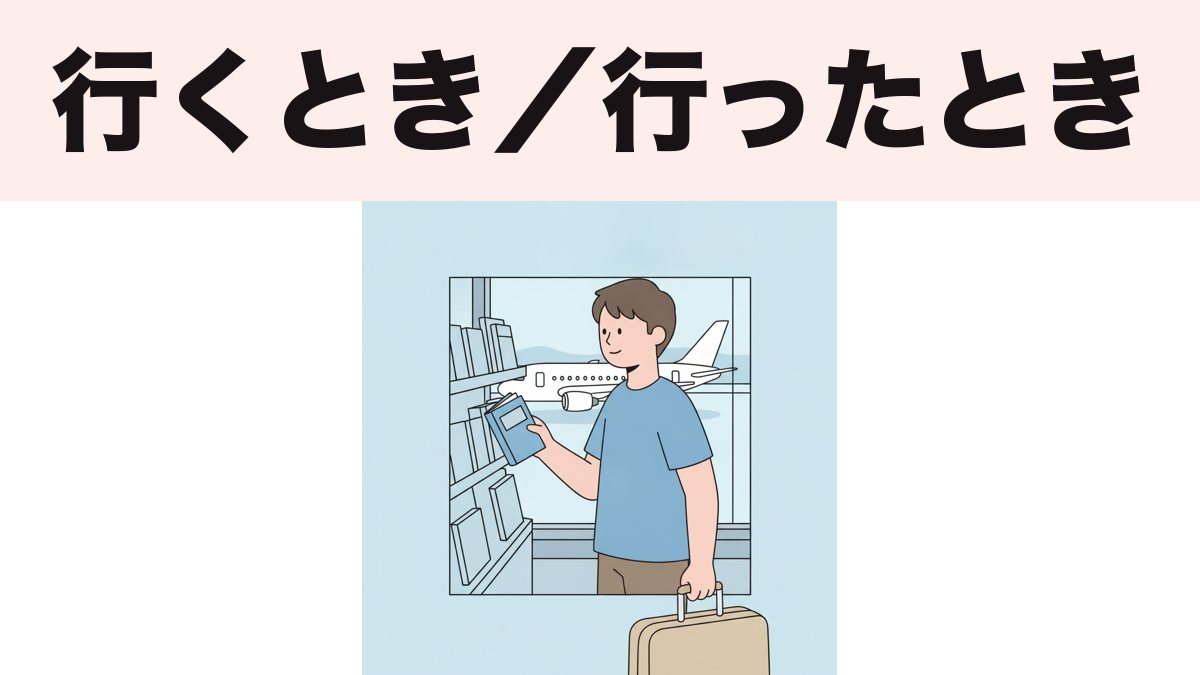
〜とき means "when," and the tense of the verb in front of it does not tell you when the sentence happened — it tells you whether that action was finished at the moment you're describing. 日本に行くとき is on the way; 日本に行ったとき is after arriving.
「〜とき」は「when」です。でも、前の動詞のかたちは、文がいつのことかを言っていません。「その時、その動作はもう終わっていたか」だけを言っています。「日本に行くとき」はまだ着いていません。「日本に行ったとき」はもう着いています。
This is the single feature of とき that textbooks bury in a footnote and learners then get wrong for years. The word itself is easy. The tense in front of it follows a rule English does not have.
The basics
What connects to とき?
とき is a noun — it literally means "time" or "moment" — so everything in front of it has to be in the shape that can modify a noun.
| Word type | Form before とき | Example |
|---|---|---|
| Verb | plain form (present or past) | 食べるとき / 食べたとき |
| い-adjective | plain form | 忙しいとき / 忙しかったとき |
| な-adjective | な | 暇なとき |
| Noun | の | 子どものとき |
子どものとき、よくアニメを見ました。 — When I was a child, I watched a lot of anime. (noun + の) 暇なとき、何をしますか。 — What do you do when you're free? (な-adjective + な)
The な and の are the two pieces learners drop. 暇とき and 子どもとき are both broken. If you know the の that links two nouns, this is the same の doing the same job.
The tense rule
Here is the whole point of this article. The verb before とき is not in the tense of the sentence. It answers one question: at the moment described, was that action already complete?
- Plain present (行く) → the action was not yet finished at that moment
- Plain past (行った) → the action was already finished at that moment
日本に行くとき、空港で本を買いました。 — On my way to Japan, I bought a book at the airport. (not yet in Japan — the buying happens before arrival) 日本に行ったとき、友達に会いました。 — When I went to Japan, I met a friend. (already in Japan — the meeting happens after arrival)
Both sentences are in the past. The main verb 買いました / 会いました carries that. The verb before とき is doing something else entirely.
One more pair, because this is the whole grammar point
寝るとき、電気を消します。 — I turn off the light when I go to bed. (before sleeping — you're still awake to reach the switch) 寝たとき、電気がついていました。 — When I fell asleep, the light was on. (sleeping already happened)
If you use 寝たとき for the first sentence you have described turning off a light while unconscious. Native speakers will understand you from context, but the sentence says something absurd, and this is exactly the kind of error that never gets corrected because everyone politely moves on.
Beyond the basics
Does に change anything?
〜ときに pins the sentence to a single point in time. 〜とき alone is slightly broader, more like "in the period when."
地震があったときに、外にいました。 — I was outside at the moment the earthquake hit. (に — one pinpointed moment)
In most sentences it's optional and native speakers drop it freely. Use it when the sharpness matters, especially with sudden events.
とき vs たら vs と
All three can translate as "when," and choosing between them is the real skill:
| Form | What it says | Example |
|---|---|---|
| 〜とき | When (a time, neutral) | 家に帰るとき、電話します |
| 〜たら | When/if (once A happens, then B) | 家に帰ったら、電話します |
| 〜と | Whenever A, B automatically follows | 家に帰ると、猫が待っています |
とき is the neutral one — it just names a moment. たら carries "once that condition is met," which is why it dominates plans and promises. と states a reliable rule of the world. For the full set, see the four Japanese conditionals.
Can the two clauses have different subjects?
Yes, and this is where the tense rule earns its keep:
母が来たとき、私は寝ていました。 — When my mother arrived, I was asleep. (her arriving was complete; my sleeping was ongoing)
Two subjects, two different states, and the とき clause tells you the arrival was already done. The が in the とき clause is normal — は generally can't live inside a subordinate clause, which is why 母は来たとき sounds wrong to a native ear.
The frozen forms you'll hear in anime
あのとき ("that time," "back then") and そのとき ("at that moment") are fixed expressions and extremely common in dramatic dialogue:
あのとき、何も言えなかった。 — Back then, I couldn't say anything. (casual, regretful — a very common anime line)
You will also hear ときどき ("sometimes"), which is とき doubled, and 〜たときは with は for contrast ("when that happened, at least...").
〜ているとき for overlapping actions
If you want "while," not "at the moment when," the teiru form does that:
ご飯を食べているとき、電話が鳴りました。 — The phone rang while I was eating. (ongoing action interrupted)
食べるとき、電話が鳴りました would mean the phone rang just before you started eating. The teiru form is what stretches the moment out.
Common mistakes
- Using the past because the sentence is past. 日本に行ったとき、飛行機で映画を見ました is wrong if you watched the film on the plane — you weren't in Japan yet. It has to be 行くとき.
- Dropping な and の. 暇とき, 子どもとき, 学生とき are all broken. Use 暇なとき, 子どものとき, 学生のとき.
- Using は inside the とき clause. 母は来たとき is unnatural; use 母が来たとき.
- Reaching for とき when たら is meant. 家に帰るとき電話します means "I'll call on my way home." 家に帰ったら電話します means "I'll call once I'm home." Learners usually mean the second and say the first.
- Treating ときどき as related. It means "sometimes" and is a plain adverb — no grammar attached.
Practice
Answers are hidden — build yours first, then open. Questions 1 and 2 are a pair, and so are 5 and 6: the only thing moving is the tense before とき.
1. Say "I bought a book at the airport on my way to Japan."
Show answer
日本に行くとき、空港で本を買いました — 行く, not 行った. At the moment of buying, the going was not finished.
2. Say "When I went to Japan, I met a friend."
Show answer
日本に行ったとき、友達に会いました — 行った, because the arrival was already complete when you met them. This is the pair to question 1: same sentence shape, opposite tense.
3. Something is wrong here: 暇とき、映画を見ます。
Show answer
暇なとき — とき is a noun, so a な-adjective needs its な to modify it.
4. Something is wrong here: 子どもとき、よく泣きました。
Show answer
子どものとき — a noun needs の before another noun. Same rule as 私の本.
5. Say "I turn off the light when I go to bed."
Show answer
寝るとき、電気を消します — 寝る, because you have to be awake to reach the switch.
6. What does 寝たとき、電気がついていました mean?
Show answer
"When I fell asleep, the light was on" — 寝た says the sleeping was already complete. Compare question 5: one syllable changes who is conscious.
7. Say "The phone rang while I was eating."
Show answer
ご飯を食べているとき、電話が鳴りました — the teiru form stretches the moment into a duration, which is what "while" needs.
8. Something is wrong here: 母は来たとき、私は寝ていました。
Show answer
母が来たとき — は does not sit inside a とき clause. Subordinate clauses take が.
9. Which is right for "I'll call you once I get home" — 帰るとき電話します or 帰ったら電話します?
Show answer
帰ったら電話します — たら means "once that happens." 帰るとき would mean you call on the way home, from the train.
10. Translate: あのとき、何も言えなかった。
Show answer
"Back then, I couldn't say anything" — あのとき is a frozen expression for a remembered moment, and 何も + negative is how Japanese builds "anything" in a negative sentence.
FAQ
Is 時 written in kanji or kana? Both appear. 時 in kanji is common in writing; とき in kana is very common when it is grammatical rather than meaning a literal clock time. Either is correct.
Does とき work with the polite form? Not directly in front of とき — use the plain form there (行くとき, not 行きますとき). Politeness lives on the final verb of the sentence.
Can とき mean "if"? Loosely, in sentences like 分からないとき、聞いてください ("when/if you don't understand, please ask"). For a real conditional, たら or ば is clearer.
What is the difference between とき and 場合? 場合 means "in the case that" and is more formal and more hypothetical — common in rules and instructions. とき is the everyday word.
Why do I hear 〜たときには? That is とき + に + は, adding contrast: "at the time when that happened, at least..." It marks that moment off against other moments.
Is 〜ときは different from 〜とき? は adds contrast or topic-marking: 忙しいときは、行きません ("when I'm busy — as opposed to other times — I don't go").
Vocabulary from this article
Tap the block to select all of it, then copy. In Anki: File → Import, note type Basic, separator Tab — the first column becomes the front, the second the back.
時	とき — time, moment
子ども	こども — child
暇	ひま — free time
忙しい	いそがしい — busy
空港	くうこう — airport
本	ほん — book
友達	ともだち — friend
寝る	ねる — to sleep, to go to bed
電気	でんき — light, electricity
消す	けす — to turn off
地震	じしん — earthquake
帰る	かえる — to go home
電話	でんわ — telephone, phone call
鳴る	なる — to ring
母	はは — mother
猫	ねこ — cat
学生	がくせい — student
場合	ばあい — case, situation
泣く	なく — to cry
I'm Yuuki, a Japanese teacher based in Tokyo. I've taught on italki as a Top 1% teacher and watched over 1,500 anime. Learners reach N4, use とき confidently, and put the wrong tense in front of it every single time — because English has no equivalent rule to transfer. It is a five-minute fix that most people never get told about.
Sources: the author's own lessons and standard reference grammars.
教科書は小さく書くだけなので、みんな何年も間違えます。ことば自体はかんたんです。でも、前のかたちのルールが英語にはありません。
基本
「とき」の前のかたち
「とき」は名詞です。「time」「moment」という意味です。だから前に来るものは、名詞につけられるかたちにします。
| しゅるい | 「とき」の前 | れい |
|---|---|---|
| 動詞 | ふつうの形(今・かこ) | 食べるとき / 食べたとき |
| い形容詞 | ふつうの形 | 忙しいとき |
| な形容詞 | な | 暇なとき |
| 名詞 | の | 子どものとき |
子どものとき、よくアニメを見ました。 — When I was a child, I watched a lot of anime. 暇なとき、何をしますか。 — What do you do when you're free?
「な」と「の」を落とす人がとても多いです。「暇とき」「子どもとき」は間違いです。
かたちのルール
ここがこの記事のいちばん大事なところです。「とき」の前の動詞は、文のじかんを言いません。その時、その動作はもう終わっていたかだけを言います。
- ふつうの形(行く) → その時、まだ終わっていない
- かこの形(行った) → その時、もう終わっている
日本に行くとき、空港で本を買いました。 — On my way to Japan, I bought a book at the airport. 日本に行ったとき、友達に会いました。 — When I went to Japan, I met a friend.
2つとも、かこの文です。かこは「買いました」「会いました」が言っています。「とき」の前の動詞は、べつのことを言っています。
もう1つの組
寝るとき、電気を消します。 — I turn off the light when I go to bed. 寝たとき、電気がついていました。 — When I fell asleep, the light was on.
1つ目で「寝たとき」を使うと、ねむってから電気を消すことになります。みんな分かってくれますが、文の意味はへんです。そして、だれも直してくれません。
もう少しくわしく
「に」をつけると?
「〜ときに」は、1つの点をさします。「〜とき」だけだと、少しはばがあります。
地震があったときに、外にいました。 — I was outside at the moment the earthquake hit.
ほとんどの文では、あってもなくてもいいです。急なできごとの時に使うと、はっきりします。
「とき」「たら」「と」
3つとも「when」になります。えらび方が本当のちからです。
| 形 | 何を言うか | れい |
|---|---|---|
| 〜とき | 時間を言うだけ | 家に帰るとき、電話します |
| 〜たら | Aが終わったら、B | 家に帰ったら、電話します |
| 〜と | Aすると、いつもB | 家に帰ると、猫が待っています |
しゅごが2つでもいい
母が来たとき、私は寝ていました。 — When my mother arrived, I was asleep.
「来た」は終わっています。「寝ていました」はつづいています。「とき」の中は「は」ではなく「が」を使います。
アニメでよく聞く形
「あのとき」「そのとき」は、かたまりの言い方です。ドラマチックなせりふによく出ます。
あのとき、何も言えなかった。 — Back then, I couldn't say anything.
「ときどき」(sometimes)もありますが、これは文法ではなく、ただの副詞です。
「〜ているとき」= while
ご飯を食べているとき、電話が鳴りました。 — The phone rang while I was eating.
「食べるとき」だと、食べる前に電話が鳴ったことになります。「ている」が時間をのばします。
よくある間違い
- 文がかこだから、前もかこにする。 飛行機で映画を見たなら「日本に行くとき」です。
- 「な」「の」を落とす。 暇なとき、子どものとき、学生のとき。
- 「とき」の中で「は」を使う。 「母は来たとき」ではなく「母が来たとき」。
- 「たら」を使うところで「とき」を使う。 「家に帰るとき電話します」は、電車の中から電話することになります。
練習
答えはかくれています。まず自分で作ってから開いてください。1番と2番、5番と6番が対です。動くのは「とき」の前のかたちだけです。
1. 「日本に行くとちゅう、空港で本を買いました」を言ってください。
答えを見る
日本に行くとき、空港で本を買いました — 「行った」ではありません。買った時、まだ着いていません。
2. 「日本に行って、友達に会いました」を「とき」で言ってください。
答えを見る
日本に行ったとき、友達に会いました — 会った時、もう着いています。1番と対です。かたちだけがちがいます。
3. 直してください: 暇とき、映画を見ます。
答えを見る
暇なとき — 「とき」は名詞なので、な形容詞は「な」がいります。
4. 直してください: 子どもとき、よく泣きました。
答えを見る
子どものとき — 名詞の後には「の」がいります。「私の本」と同じです。
5. 「ねる前に電気を消します」を「とき」で言ってください。
答えを見る
寝るとき、電気を消します — 電気を消すには起きていないといけません。
6. 「寝たとき、電気がついていました」はどういう意味ですか。
答えを見る
ねむった時、電気がついていた — 「寝た」はもう終わっています。5番と1音しかちがいませんが、意味が大きく変わります。
7. 「食べている間に電話が鳴りました」を「とき」で言ってください。
答えを見る
ご飯を食べているとき、電話が鳴りました — 「ている」が時間をのばします。
8. 直してください: 母は来たとき、私は寝ていました。
答えを見る
母が来たとき — 「とき」の中では「が」を使います。
9. 「家に着いてから電話します」は、「帰るとき電話します」と「帰ったら電話します」のどちらですか。
答えを見る
帰ったら電話します — 「帰るとき」だと、電車の中から電話することになります。
10. 「あのとき、何も言えなかった」はどういう意味ですか。
答えを見る
あの時、何も言えませんでした — 「あのとき」はかたまりの言い方です。「何も」+うちけしもいっしょに入っています。
この記事に出た単語
ブロックをタップすると全部選べます。そのままコピーしてください。Anki では ファイル → 読み込み、ノートタイプ 基本、区切り タブ。1列目が表、2列目が裏になります。
時	とき — time, moment
子ども	こども — child
暇	ひま — free time
忙しい	いそがしい — busy
空港	くうこう — airport
本	ほん — book
友達	ともだち — friend
寝る	ねる — to sleep, to go to bed
電気	でんき — light, electricity
消す	けす — to turn off
地震	じしん — earthquake
帰る	かえる — to go home
電話	でんわ — telephone, phone call
鳴る	なる — to ring
母	はは — mother
猫	ねこ — cat
学生	がくせい — student
泣く	なく — to cry
副詞	ふくし — adverb
私はユウキです。東京で日本語を教えています。 italki の Top 1% の先生で、アニメは1,500本以上見ました。N4まで来て「とき」を自信をもって使う人が、前のかたちだけをいつも間違えます。英語に同じルールがないからです。5分で直りますが、だれも教えてくれません。
More drills like the ones above, plus a timed JLPT-style mock test: Practice · N4上のような練習問題と、時間つきのJLPT形式のもぎ試験: 練習ページ · N4
Want to try this in a real conversation?
本当の会話で、ためしてみませんか?
30-minute trial lesson, $13. Times shown in your own timezone.
30分の体験レッスン、$13。時間はあなたのタイムゾーンで表示されます。
Book a trial lesson · $13