How do you say "remember" in Japanese? 覚える, 覚えている and 思い出す「remember」を日本語で: 覚える・覚えている・思い出す
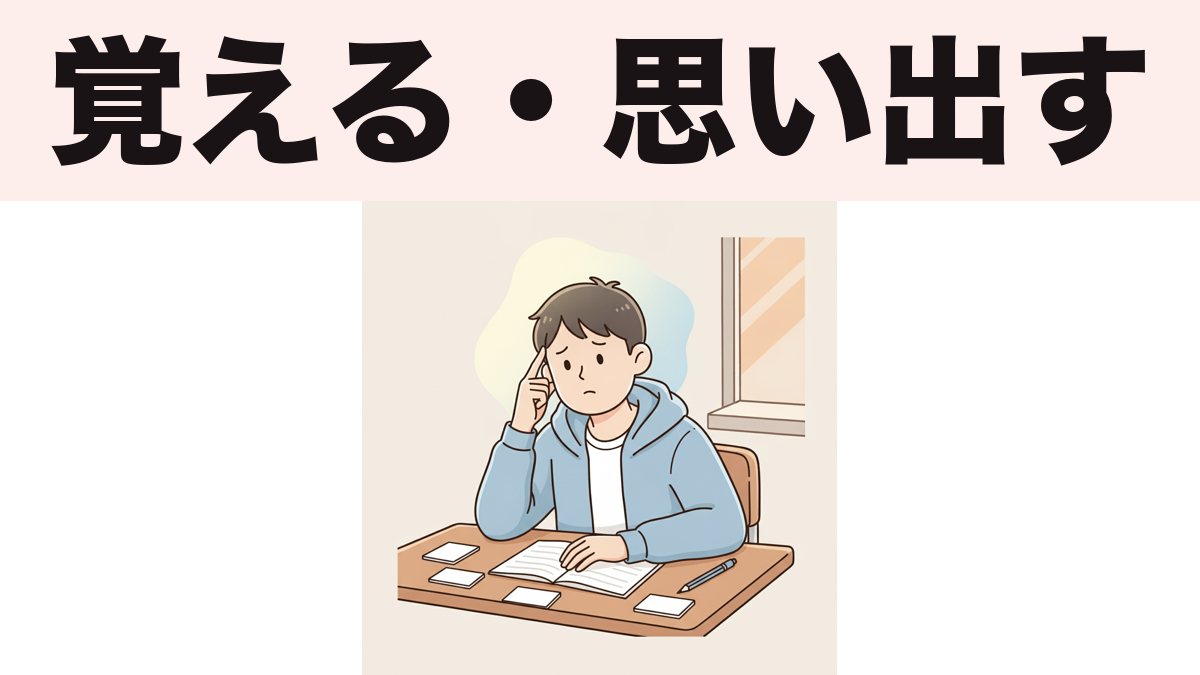
English "remember" covers three different moments, and Japanese gives each its own verb: 覚える is putting something into memory, 覚えている is still having it there, and 思い出す is pulling it back out after it slipped away. 単語を覚える (learn the words), 名前を覚えている (I remember the name), 名前を思い出した (the name came back to me).
英語の remember は3つのちがう時を1つのことばで言います。日本語は3つの動詞に分けます。覚えるは、頭に入れること。覚えているは、まだ頭にあること。思い出すは、わすれていたものを取り出すこと。単語を覚える、名前を覚えている、名前を思い出した。
Most learner mistakes here come from translating "I remember" as 覚えます. That actually means "I will memorize it," which is rarely what you meant.
The basics
What does 覚える mean?
覚える (おぼえる) is the act of getting something into your head: to memorize, to learn, to pick up. It is an action with a beginning and an end.
毎日、漢字を五つ覚えます。 — I learn five kanji every day. (memorizing as a routine) 新しい仕事を早く覚えたい。 — I want to learn the new job quickly. (picking up how to do it) この歌、すぐ覚えちゃった。 — I picked up this song straight away. (casual)
The plain present 覚える / 覚えます is therefore future or habit: "I will memorize" or "I memorize (regularly)."
What does 覚えている mean?
覚えている is "I remember" in the sense English speakers usually mean: the memory is there right now. It is the ている form of 覚える — "having memorized, and still in that state."
あの日のこと、よく覚えている。 — I remember that day well. (the memory is still there) 私の名前、覚えてる? — Do you remember my name? (casual) すみません、覚えていません。 — Sorry, I don't remember. (polite)
This is the form to reach for when someone asks "do you remember…?" It works exactly like other state verbs in ている; the ている form covers why.
What does 思い出す mean?
思い出す (おもいだす) is "to recall": the moment something you had forgotten comes back. 思い ("thought") + 出す ("take out") — you pull the memory out.
やっと彼の名前を思い出した。 — I finally remembered his name. (it came back) この曲を聞くと、子どもの頃を思い出す。 — This song reminds me of my childhood. (triggered memory) パスワードが思い出せない。 — I can't remember my password. (can't bring it back)
The last example is the useful one: "I can't remember" in the sense of "it won't come to me" is 思い出せない, the potential form of 思い出す.
Side by side
| Verb | Moment | English | Example |
|---|---|---|---|
| 覚える | Putting it in | memorize, learn | 単語を覚える |
| 覚えている | Having it there | remember (still) | 名前を覚えている |
| 覚えていない | Not having it | don't remember (at all) | 何も覚えていない |
| 思い出す | Pulling it back out | recall, come back to you | やっと思い出した |
| 思い出せない | Can't pull it out | can't remember right now | 名前が思い出せない |
Beyond the basics
What is the difference between 覚えていない and 思い出せない?
Both translate as "I don't remember," but they mean different things. 覚えていない says the memory is not there — you may never have stored it. 思い出せない says it is in there somewhere and will not come out.
子どもの頃のことは、あまり覚えていない。 — I don't remember much from when I was little. (not stored, or long gone) 顔は覚えているけど、名前が思い出せない。 — I remember the face, but the name won't come. (on the tip of your tongue)
The second sentence uses both verbs, and it is exactly the situation where English would say "I remember his face but I can't remember his name."
How do you say "remind"?
Japanese has no single verb for "remind." The usual pattern is the thing + を思い出す, or 思い出させる (to make someone recall).
この写真を見ると、旅行を思い出す。 — This photo reminds me of the trip. (the photo triggers it) 明日、会議があることを思い出させてください。 — Please remind me there's a meeting tomorrow. (ask someone to remind you)
The と in 見ると is the "whenever" conditional, covered in たら, ば, と and なら. For a practical reminder, most people just say 明日教えてください or ask for a message. 思い出させる sounds a little formal in daily speech.
How do you say "don't forget" and "remember to"?
"Remember to…" is usually said the other way round in Japanese: "don't forget to…," with 忘れる.
傘を持っていくのを忘れないでね。 — Remember to take an umbrella. (literally: don't forget) 忘れずに連絡してください。 — Please remember to get in touch. (polite, a little formal)
Trying to build this with 覚える sounds odd: 傘を覚えて would mean "memorize the umbrella."
How does it sound in anime?
覚えてろ! is the classic villain's parting line — "You'll remember this!" or "You haven't seen the last of me!" It is the rough command form of 覚えている, literally "keep this in memory." 思い出した! is the other favourite: the moment a character recovers a lost memory, usually right before a flashback.
In casual speech, 覚えている shrinks to 覚えてる, and 思い出した often becomes a quick あ、思い出した — "oh, right, now I remember."
Common mistakes
- Saying 覚えます for "I remember." It means "I will memorize." For "I remember," say 覚えています.
- Saying 覚えない for "I don't remember." It means "I won't memorize" or "I can't learn it." Use 覚えていない or 思い出せない.
- Using 覚える for "remind." Use 〜を思い出す or 思い出させる.
- Using 思い出す for learning. 単語を思い出す is recalling words you once knew; learning new words is 覚える.
- Building "remember to" with 覚える. Japanese says "don't forget": 忘れないで.
- Mixing 覚えていない and 思い出せない. One is "not there," the other is "won't come out." Pick by whether you think the memory exists.
Practice
Answers are hidden — build yours first, then open. Questions 1 to 3 are a set: the same name at three moments.
1. You are learning a new colleague's name. Say "I'll remember (learn) your name."
Show answer
お名前を覚えます — putting it into memory is 覚える. The present form is a promise about the future.
2. A week later: "I remember your name."
Show answer
お名前を覚えています — the memory is still there, so 覚えている.
3. A year later, it takes a moment: "Ah, I remember your name now!"
Show answer
あ、お名前を思い出しました — it slipped and came back, so 思い出す.
4. Say "I can't remember my password."
Show answer
パスワードが思い出せない — it is somewhere in your head but will not come out: the potential form of 思い出す.
5. Say "I don't remember anything about that night."
Show answer
その夜のことは何も覚えていない — the memory is not there at all, so 覚えていない.
6. Say "This song reminds me of summer."
Show answer
この曲を聞くと、夏を思い出す — "remind" becomes "when I hear it, I recall."
7. Tell a friend, casually: "Remember to bring your passport."
Show answer
パスポートを持ってくるのを忘れないでね — "remember to" is "don't forget" in Japanese.
8. Fix: 昨日の話、覚えますか? (You mean "Do you remember what we talked about yesterday?")
Show answer
昨日の話、覚えていますか? — 覚えますか would ask if they will memorize it.
9. Say "I remember the face, but the name won't come."
Show answer
顔は覚えているけど、名前が思い出せない — both verbs in one sentence: the face is there, the name won't come out.
FAQ
Is 覚える the same as 学ぶ or 勉強する? No. 勉強する and 学ぶ are studying or learning a subject. 覚える is getting a specific thing into memory: words, a route, a song.
What does 覚えてろ mean? "You'll pay for this" — the villain's command form of 覚えている. Not for polite use.
Can 思い出す be used for the future? Yes: 思い出したら教えて, "tell me if you remember." It refers to the moment of recalling, whenever it happens.
Is there a noun for "memory"? Several. 思い出 (おもいで) is a fond memory, 記憶 (きおく) is memory as a faculty or a record. 楽しい思い出 is a happy memory; 記憶がない is "I have no memory of it."
Is 覚えてる too casual for work? In a meeting or email, use 覚えています. 覚えてる is fine with friends and colleagues you speak casually with.
Why do textbooks teach 覚える as "remember"? Because the dictionary lists both meanings. In practice, "remember" is almost always 覚えている or 思い出す, and 覚える on its own is "memorize."
Vocabulary from this article
Tap the block to select all of it, then copy. In Anki: File → Import, note type Basic, separator Tab — the first column becomes the front, the second the back.
覚える	おぼえる — to memorize, to learn
思い出す	おもいだす — to recall, to remember (something forgotten)
忘れる	わすれる — to forget
漢字	かんじ — kanji
単語	たんご — word, vocabulary item
歌	うた — song
名前	なまえ — name
顔	かお — face
曲	きょく — tune, piece of music
子どもの頃	こどものころ — childhood
写真	しゃしん — photo
旅行	りょこう — trip
会議	かいぎ — meeting
傘	かさ — umbrella
連絡	れんらく — contact, getting in touch
夜	よる — night
思い出	おもいで — (fond) memory
記憶	きおく — memory, recollection
勉強	べんきょう — study
学ぶ	まなぶ — to learn, to study
I'm Yuuki, a Japanese teacher based in Tokyo. I've taught on italki as a Top 1% teacher and watched over 1,500 anime. This one comes up when a student wants to say they would like to get back the grammar they once knew — the verb they need is 思い出す, and the one they reach for is 覚える.
Sources: the author's own lessons and standard reference grammars.
いちばん多いまちがいは、「I remember」を「覚えます」と言うことです。「覚えます」は「これから覚える」という意味になります。
基本
覚えるの意味
覚える(おぼえる)は、頭に入れることです。暗記する、身につける。始まりと終わりがある動きです。
毎日、漢字を五つ覚えます。 — I learn five kanji every day. (memorizing as a routine) 新しい仕事を早く覚えたい。 — I want to learn the new job quickly. (picking up how to do it) この歌、すぐ覚えちゃった。 — I picked up this song straight away. (casual)
だから「覚える/覚えます」は、これからのことか、いつもすることです。
覚えているの意味
「覚えている」が、英語の I remember にいちばん近いです。今、頭の中にあります。「覚える」の「ている」の形で、「覚えて、その状態が続いている」です。
あの日のこと、よく覚えている。 — I remember that day well. (the memory is still there) 私の名前、覚えてる? — Do you remember my name? (casual) すみません、覚えていません。 — Sorry, I don't remember. (polite)
「〜を覚えてる?」と聞かれた時は、この形です。くわしくはているの記事を見てください。
思い出すの意味
思い出す(おもいだす)は、わすれていたものが戻ってくる時です。「思い」を「出す」。記憶を外に取り出します。
やっと彼の名前を思い出した。 — I finally remembered his name. (it came back) この曲を聞くと、子どもの頃を思い出す。 — This song reminds me of my childhood. (triggered memory) パスワードが思い出せない。 — I can't remember my password. (can't bring it back)
最後の文が便利です。「出てこない」という意味の「思い出せない」です。
ならべてみる
| 動詞 | どの時 | 英語 | 例 |
|---|---|---|---|
| 覚える | 入れる時 | memorize, learn | 単語を覚える |
| 覚えている | 入っている | remember (still) | 名前を覚えている |
| 覚えていない | 入っていない | don't remember | 何も覚えていない |
| 思い出す | 取り出す時 | recall | やっと思い出した |
| 思い出せない | 取り出せない | can't remember | 名前が思い出せない |
もう少し先へ
覚えていない と 思い出せない
どちらも「I don't remember」ですが、意味がちがいます。「覚えていない」は、頭の中にない。「思い出せない」は、どこかにあるけれど出てこない。
子どもの頃のことは、あまり覚えていない。 — I don't remember much from when I was little. (not stored, or long gone) 顔は覚えているけど、名前が思い出せない。 — I remember the face, but the name won't come. (on the tip of your tongue)
「remind」はどう言う?
日本語には remind にあたる動詞が1つありません。「〜を思い出す」か「思い出させる」を使います。
この写真を見ると、旅行を思い出す。 — This photo reminds me of the trip. (the photo triggers it) 明日、会議があることを思い出させてください。 — Please remind me there's a meeting tomorrow. (ask someone to remind you)
「見ると」の「と」はたら・ば・と・ならの記事にあります。ふだんは「明日教えてください」と言う人が多いです。「思い出させる」は少しかたいです。
「わすれないで」
英語の remember to は、日本語では「わすれないで」と反対から言います。
傘を持っていくのを忘れないでね。 — Remember to take an umbrella. (literally: don't forget) 忘れずに連絡してください。 — Please remember to get in touch. (polite, a little formal)
「傘を覚えて」だと「傘を暗記して」になってしまいます。
アニメでは
「覚えてろ!」は悪役の決まり文句です。「おぼえていろ」の乱暴な命令形で、「このままでは終わらないぞ」という意味です。「思い出した!」は、なくした記憶が戻る場面でよく聞きます。話しことばでは「覚えている」は「覚えてる」になります。
よくあるまちがい
- 「覚えます」を I remember の意味で使う。 「覚えています」です。
- 「覚えない」を I don't remember の意味で使う。 「覚えていない」か「思い出せない」です。
- remind に「覚える」を使う。 「思い出す」か「思い出させる」です。
- 新しく習うことに「思い出す」を使う。 新しい単語は「覚える」です。
- remember to を「覚える」で作る。 「忘れないで」です。
- 「覚えていない」と「思い出せない」をまぜる。 「ない」のか「出てこない」のかで選びます。
練習
答えはかくしてあります。先に自分で考えてから開けてください。1〜3はセットです。同じ名前の3つの時です。
1. 新しい同僚に「名前を覚えます」と言う。
答えを見る
お名前を覚えます — 頭に入れるので「覚える」。これからのことです。
2. 1週間後:「名前を覚えています」。
答えを見る
お名前を覚えています — まだ頭にあるので「覚えている」。
3. 1年後、少し時間がかかって:「あ、思い出しました!」
答えを見る
あ、お名前を思い出しました — わすれて、戻ってきたので「思い出す」。
4. 「パスワードが出てこない」と言う。
答えを見る
パスワードが思い出せない — どこかにあるけれど出てこない。
5. 「その夜のことは何も覚えていない」と言う。
答えを見る
その夜のことは何も覚えていない — 頭の中にないので「覚えていない」。
6. 「この曲を聞くと夏を思い出す」と言う。
答えを見る
この曲を聞くと、夏を思い出す — remind は「〜と、思い出す」です。
7. 友だちに「パスポートをわすれないで」と言う。
答えを見る
パスポートを持ってくるのを忘れないでね — remember to は「忘れないで」です。
8. 直してください: 昨日の話、覚えますか?
答えを見る
昨日の話、覚えていますか? — 「覚えますか」は「これから暗記しますか」になります。
9. 「顔は覚えているけど、名前が出てこない」と言う。
答えを見る
顔は覚えているけど、名前が思い出せない — 1つの文に両方の動詞があります。
よくある質問
覚えるは「学ぶ」「勉強する」と同じ? ちがいます。「勉強する」「学ぶ」は科目を勉強すること。「覚える」は、単語や道や歌など、1つのものを頭に入れることです。
「覚えてろ」は? 「このままでは終わらないぞ」。悪役のことばなので、ていねいな場面では使いません。
「思い出す」はこれからのことにも使える? 使えます。「思い出したら教えて」。
「memory」は日本語で? 「思い出」は楽しい思い出など、「記憶」は記憶の力や記録です。
「覚えてる」は仕事でくだけすぎ? 会議やメールでは「覚えています」を使ってください。
教科書が覚えるを remember と教えるのはなぜ? 辞書に両方の意味があるからです。でも実際は、remember はほとんど「覚えている」か「思い出す」です。
この記事に出た単語
ブロックをタップして全部を選び、コピーしてください。Anki では File → Import、ノートタイプは Basic、区切りは Tab です。左が表、右が裏になります。
覚える	おぼえる — to memorize, to learn
思い出す	おもいだす — to recall, to remember (something forgotten)
忘れる	わすれる — to forget
漢字	かんじ — kanji
単語	たんご — word, vocabulary item
歌	うた — song
名前	なまえ — name
顔	かお — face
曲	きょく — tune, piece of music
子どもの頃	こどものころ — childhood
写真	しゃしん — photo
旅行	りょこう — trip
会議	かいぎ — meeting
傘	かさ — umbrella
連絡	れんらく — contact, getting in touch
夜	よる — night
思い出	おもいで — (fond) memory
記憶	きおく — memory, recollection
勉強	べんきょう — study
学ぶ	まなぶ — to learn, to study
私はユウキです。東京で日本語を教えています。 italki の Top 1% の先生で、アニメは1,500本以上見ました。レッスンでは、生徒が「前に知っていた文法をもう一度」と言いたい時によく出ます。必要なのは「思い出す」ですが、「覚える」を選んでしまいます。
出典: 著者自身のレッスンと、一般的な文法書。
More drills like the ones above, plus a timed JLPT-style mock test: Practice · N4上のような練習問題と、時間つきのJLPT形式のもぎ試験: 練習ページ · N4
Want to try this in a real conversation?
本当の会話で、ためしてみませんか?
30-minute trial lesson, $13. Times shown in your own timezone.
30分の体験レッスン、$13。時間はあなたのタイムゾーンで表示されます。
Book a trial lesson · $13