〜について vs 〜として: "about" and "as", and why swapping them changes the sentence〜について と 〜として: 入れかえると、文の意味が変わります
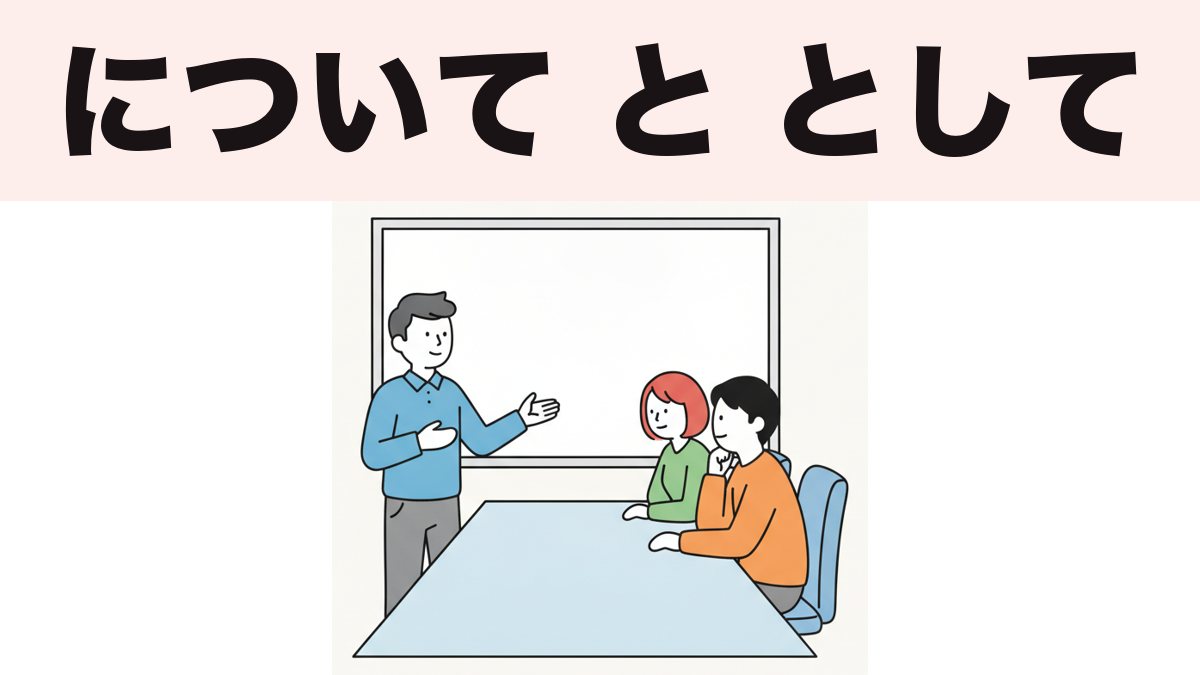
〜について means "about, concerning" — it marks what you are talking about. 〜として means "as, in the capacity of" — it marks the role someone is filling. アイドルについて話す is "to talk about idols"; アイドルとして話す is "to speak as an idol." Same noun, entirely different sentence.
「〜について」は「about」です。何の話をしているかを表します。「〜として」は「as」です。どんな立場で何かをするかを表します。「アイドルについて話す」は「アイドルの話をする」、「アイドルとして話す」は「自分がアイドルとして話す」です。同じことばで、まったくちがう文になります。
These two are taught together because learners reach for the wrong one under pressure, and the error is not a small one — it changes who is doing what.
The basics
〜について: the topic
Attach について directly to a noun. No particle in between.
日本の文化について話しました。 — I talked about Japanese culture. (polite) その問題について考えています。 — I'm thinking about that problem. (polite)
について is built from につく ("to attach to") and means "attached to the matter of." It is the standard way to name a topic when the verb needs one: 話す, 書く, 考える, 質問する, 説明する.
〜として: the capacity
Also attaches directly to a noun, and means "in the role of."
教師として働いています。 — I work as a teacher. (polite) 友達として言いますが… — I'm saying this as a friend, but… (polite — a warning that honesty is coming)
That second one is worth memorizing. 〜として言いますが is the standard preamble for saying something uncomfortable, and the として tells the listener which hat you are wearing.
Side by side
アイドルについて話しました。 — I talked about idols. (polite — idols were the topic) アイドルとして話しました。 — I spoke as an idol. (polite — I was the idol)
The difference is not subtle in meaning, only in form. One syllable apart, and the second sentence claims you are a pop star.
Beyond the basics
についての: modifying a noun
To attach an について phrase to a noun, insert の.
日本についての本を読みました。 — I read a book about Japan. (polite)
日本について本 is missing a piece. The の is required, and this is the same pattern as 〜からの and 〜までの — any adverbial phrase attaching to a noun needs の.
について vs に対して: topic vs target
に対して also translates as "toward" or "with regard to," and the two get confused.
- について — the topic being discussed
- に対して — the target an attitude or action is aimed at
彼について話しました。 — I talked about him. (polite — he was the subject matter) 彼に対して怒っています。 — I'm angry at him. (polite — he is the target of the anger)
The test: can you replace it with "on the subject of"? If yes, について. If the sentence is about an attitude or force directed at someone, に対して.
に対して is also the word for contrast in writing: AAに対してBBは… ("whereas A, B…"), which is a different use worth recognizing separately.
What does にとって mean, and how is it different from について?
にとって marks a viewpoint: "for X", "from X's perspective", "as far as X is concerned". Where について tells you what is being discussed and に対して tells you what an action is aimed at, にとって tells you whose scale a judgement is being measured on.
私にとって、これは大きな決断です。 — For me, this is a big decision. (polite — measured against my own scale) 子どもにとって難しい本です。 — It's a difficult book for a child. (polite — difficult from a child's position)
The clearest way to separate it from について is that にとって almost always sits next to an evaluation — 大事, 難しい, 必要, いい — because a viewpoint only matters when something is being judged. 私について大きな決断です is not a sentence; 私にとって大きな決断です is.
Two things to watch. First, にとって takes a person or a group, not usually a thing: 会社にとって, 日本人にとって, 私にとって. Second, it is not a substitute for は — 私は大変です says I am having a hard time, while 私にとって大変です says the thing is hard by my standards, which leaves open that someone else might find it easy.
The polite written form is にとりまして, which you will meet in business email and speeches: 弊社にとりまして, "for our company".
に関して: the formal について
に関して (にかんして) means the same as について and belongs to business and written Japanese.
その件に関しては、後ほどご連絡します。 — Regarding that matter, I'll be in touch later. (formal, business)
その件に関して is boilerplate in Japanese business email. You do not need to produce it as a learner, but it appears constantly, and recognizing it as "about that" saves you a dictionary look-up every time.
として in its other uses
として also appears in patterns that have drifted from the plain "as."
結果として、うまくいきました。 — As a result, it went well. (polite) 一人として反対しませんでした。 — Not one person objected. (polite — 一人として + negative means "not a single")
That second one is a fixed pattern: 一人として, 一つとして and 一度として all take a negative and mean "not a single one." It reads as emphatic and slightly formal.
とすると and としたら: the conditional cousins
Not the same grammar, but close enough in shape to confuse.
行くとしたら、いつがいいですか。 — If you were to go, when would be good? (polite — hypothetical)
としたら supposes a hypothetical, and it is a conditional rather than a role marker. The として inside it is doing the "treating it as" job, which is why it looks familiar.
Common mistakes
- Using として when you mean について. アイドルとして話す claims you are an idol. The topic version is について.
- Adding a particle before について. 日本についてを話しました is wrong. について already does the particle's job.
- Dropping the の in についての. 日本について本 is incomplete. It is 日本についての本.
- Using について for the target of an emotion. 彼について怒っています is odd. Anger has a target: 彼に対して.
- Using に関して in casual speech. It is correct but reads as a business email out loud. Say について.
- Translating として as "like". として is a role, not a comparison. For "like," you want みたい or のように — see みたい, らしい, ようだ.
について, として and their neighbours
| Japanese | Meaning | Example |
|---|---|---|
| 〜について | About, concerning | 文化について話す |
| 〜についての | About (before a noun) | 文化についての本 |
| 〜に関して | About (formal, written) | その件に関して |
| 〜として | As, in the capacity of | 教師として働く |
| 〜に対して | Toward, aimed at | 彼に対して怒る |
| 〜に対して | Whereas (contrast, written) | AAに対してBBは |
| 〜としたら | If we suppose | 行くとしたら |
Practice
Questions 1 and 2 are the pair: one syllable apart, and the second one makes you a pop star.
1. Say "I talked about idols," politely.
Show answer
アイドルについて話しました。 — について marks the topic.
2. Say "I spoke as an idol," politely.
Show answer
アイドルとして話しました。 — として marks the capacity you were acting in. Very different claim.
3. Say "I work as a teacher," politely.
Show answer
教師として働いています。 — として attaches straight to the noun, no particle.
4. Say "I read a book about Japan," politely.
Show answer
日本についての本を読みました。 — The の is required to attach the phrase to 本.
5. Say "I'm angry at him," politely.
Show answer
彼に対して怒っています。 — Anger has a target, so に対して rather than について.
6. Say "I talked about him," politely.
Show answer
彼について話しました。 — Here he is the subject matter, so について.
7. Preface something uncomfortable: "I'm saying this as a friend, but…"
Show answer
友達として言いますが… — として tells the listener which role you are speaking from. Worth memorizing whole.
8. Write the business version of "regarding that matter."
Show answer
その件に関して — Boilerplate in Japanese business email. Recognize it rather than produce it.
9. Fix this: 日本についてを話しました。
Show answer
日本について話しました。 — について already does the particle's job. No を.
10. Fix this: 日本について本を読みました。
Show answer
日本についての本を読みました。 — Attaching the phrase to a noun requires の.
FAQ
Is について N3 or earlier? It is normally introduced around N3, but it appears in beginner textbooks as a set phrase because it is unavoidable once you want to say what you talked about. Learning it early costs nothing.
What is the difference between について and のこと? のこと is softer and more conversational: 彼のことを話しました ("I talked about him") sounds warmer and less formal than 彼について話しました. In casual speech のこと is more common.
Can について attach to a verb? Not directly. Nominalize first: 行くことについて ("about going"). See こと vs の for which nominalizer to use.
Is として the same as the quotative と? Historically related, but treat them as separate. として is a fixed unit meaning "as." The bare quotative と marks speech and thought.
When would I actually use に対して? Whenever an emotion, action or policy is directed at someone or something: 怒る, 失礼だ, 厳しい, 優しい. Also in written contrast: これに対して ("in contrast to this").
Does 〜として ever mean "even one"? In the fixed pattern 一人として, 一つとして, 一度として plus a negative: 一度として遅れたことがない ("has never once been late"). It is emphatic and slightly formal.
Vocabulary from this article
Tap the block to select all of it, then copy. In Anki: File → Import, note type Basic, separator Tab — the first column becomes the front, the second the back.
について	について — about, concerning
として	として — as, in the capacity of
に関して	にかんして — regarding (formal)
に対して	にたいして — toward, aimed at
文化	ぶんか — culture
問題	もんだい — problem
教師	きょうし — teacher
働く	はたらく — to work
友達	ともだち — friend
怒る	おこる — to get angry
件	けん — matter, case
後ほど	のちほど — later (formal)
連絡	れんらく — contact
結果	けっか — result
反対	はんたい — opposition
説明	せつめい — explanation
質問	しつもん — question
厳しい	きびしい — strict, severe
I'm Yuuki, a Japanese teacher based in Tokyo. I've taught on italki as a Top 1% teacher and watched over 1,500 anime. The について/として swap is the kind of error that is funnier than it is damaging, and it makes the point neatly: として is a claim about who you are, not about what you are discussing.
Sources: the author's own lessons and standard reference grammars.
この2つを一緒に習うのは、あわてると取りちがえるからです。そして、その間違いは小さくありません。だれが何をしているかが変わります。
基本
「〜について」: 話の中身
名詞にそのままつきます。間に助詞は入りません。
日本の文化について話しました。 — I talked about Japanese culture. (polite) その問題について考えています。 — I'm thinking about that problem. (polite)
「話す」「書く」「考える」「質問する」「説明する」と一緒によく使います。
「〜として」: 立場
これも名詞にそのままつきます。「〜の立場で」という意味です。
教師として働いています。 — I work as a teacher. (polite) 友達として言いますが… — I'm saying this as a friend, but… (polite — a warning that honesty is coming)
2つ目は覚えてください。言いにくいことを言う前の、決まった形です。どの立場で話しているかを先に伝えます。
並べてみます
アイドルについて話しました。 — I talked about idols. (polite — idols were the topic) アイドルとして話しました。 — I spoke as an idol. (polite — I was the idol)
形はよく似ていますが、下の文は「自分がアイドルだ」と言っています。
もう少し先へ
「についての」
名詞につける時は「の」がいります。
日本についての本を読みました。 — I read a book about Japan. (polite)
「日本について本」は足りません。「からの」「までの」と同じです。
「について」と「に対して」
「に対して」も「〜に」と訳せるので、まざりやすいです。
- について — 話の中身
- に対して — 気持ちや行動が向かう相手
彼について話しました。 — I talked about him. (polite — he was the subject matter) 彼に対して怒っています。 — I'm angry at him. (polite — he is the target of the anger)
見分け方は「〜の話」と言いかえられるかどうかです。言いかえられるなら「について」です。気持ちが向かう相手なら「に対して」です。
書く時は「AAに対してBBは…」で「くらべると」という意味にもなります。
「に関して」
「について」のかたい形です。仕事の文章に出ます。
その件に関しては、後ほどご連絡します。 — Regarding that matter, I'll be in touch later. (formal, business)
仕事のメールでよく見ます。読めればいいです。
「として」のほかの使い方
結果として、うまくいきました。 — As a result, it went well. (polite) 一人として反対しませんでした。 — Not one person objected. (polite)
下は決まった形です。「一人として」「一つとして」「一度として」+否定で「1つも〜ない」という意味になります。
「としたら」
形が似ていますが、別の文法です。
行くとしたら、いつがいいですか。 — If you were to go, when would be good? (polite — hypothetical)
「もし〜なら」という意味です。
よくある間違い
- 「について」のかわりに「として」を使う。 「アイドルとして話す」は「自分がアイドル」です。
- 「について」の前に助詞を入れる。 「日本についてを話しました」は間違いです。
- 「についての」の「の」を落とす。 「日本についての本」です。
- 気持ちの相手に「について」を使う。 「彼に対して怒っています」です。
- 話す時に「に関して」を使う。 メールを読んでいるように聞こえます。
- 「として」を「like」だと思う。 「みたい」「のように」が「like」です。
まとめ
| 日本語 | 意味 | 例 |
|---|---|---|
| 〜について | 〜の話 | 文化について話す |
| 〜についての | 〜の話の(名詞の前) | 文化についての本 |
| 〜に関して | 〜について(かたい) | その件に関して |
| 〜として | 〜の立場で | 教師として働く |
| 〜に対して | 〜に向かって | 彼に対して怒る |
| 〜に対して | 〜とくらべて(文章) | AAに対してBBは |
| 〜としたら | もし〜なら | 行くとしたら |
練習
1番と2番が組です。1文字ちがいで、意味が大きく変わります。
1. 「アイドルについて話しました」と言ってください。
答えを見る
アイドルについて話しました。 — 話の中身です。
2. 「アイドルとして話しました」と言ってください。
答えを見る
アイドルとして話しました。 — 自分がアイドルだ、という意味になります。
3. 「教師として働いています」と言ってください。
答えを見る
教師として働いています。 — 名詞にそのままつきます。
4. 「日本についての本を読みました」と言ってください。
答えを見る
日本についての本を読みました。 — 「の」がいります。
5. 「彼に対して怒っています」と言ってください。
答えを見る
彼に対して怒っています。 — 気持ちが向かう相手なので「に対して」です。
6. 「彼について話しました」と言ってください。
答えを見る
彼について話しました。 — 話の中身なので「について」です。
7. 言いにくいことの前に「友達として言いますが…」と言ってください。
答えを見る
友達として言いますが… — どの立場で話すかを先に伝えます。
8. 仕事のメールで「その件について」を、かたく書いてください。
答えを見る
その件に関して — メールでよく見る形です。
9. 直してください: 日本についてを話しました。
答えを見る
日本について話しました。 — 「を」はいりません。
10. 直してください: 日本について本を読みました。
答えを見る
日本についての本を読みました。 — 名詞につける時は「の」です。
よくある質問
「について」はN3ですか。 ふつうはN3で習います。でも、初級の教科書にも決まった形として出ます。早く覚えても損はありません。
「について」と「のこと」はちがいますか。 「のこと」のほうがやわらかいです。「彼のことを話しました」は、あたたかい感じになります。
動詞につけられますか。 そのままではつけられません。「行くことについて」のように、名詞にしてからです。
「として」は引用の「と」と同じですか。 もとは関係がありますが、別のものとして覚えてください。
「に対して」はいつ使いますか。 気持ち・行動・決まりが、だれかに向かう時です。「怒る」「失礼だ」「厳しい」「優しい」などです。
「一人として」は何ですか。 「1人も〜ない」という決まった形です。「一度として遅れたことがない」のように使います。
この記事に出た単語
このブロックを長く押して全部選び、コピーしてください。Ankiでは ファイル → 読み込み、ノートタイプは 基本、区切りは タブ にします。左が表、右が裏になります。
について	について — about, concerning
として	として — as, in the capacity of
に関して	にかんして — regarding (formal)
に対して	にたいして — toward, aimed at
文化	ぶんか — culture
問題	もんだい — problem
教師	きょうし — teacher
働く	はたらく — to work
友達	ともだち — friend
怒る	おこる — to get angry
件	けん — matter, case
後ほど	のちほど — later (formal)
連絡	れんらく — contact
結果	けっか — result
反対	はんたい — opposition
説明	せつめい — explanation
質問	しつもん — question
厳しい	きびしい — strict, severe
日本語教師のユウキです。東京にいます。 italkiで Top 1% の教師をしています。アニメは1,500本以上見ました。「について」と「として」の取りちがえは、こわい間違いではなく、おもしろい間違いです。でも「として」が「自分がどういう立場か」を言うことばだと、よく分かります。
More drills like the ones above, plus a timed JLPT-style mock test: Practice · N3上のような練習問題と、時間つきのJLPT形式のもぎ試験: 練習ページ · N3
Want to try this in a real conversation?
本当の会話で、ためしてみませんか?
30-minute trial lesson, $13. Times shown in your own timezone.
30分の体験レッスン、$13。時間はあなたのタイムゾーンで表示されます。
Book a trial lesson · $13