もったいない: the word for "what a waste", and why it is bigger than thatもったいない: 「what a waste」と、その先にある広い意味
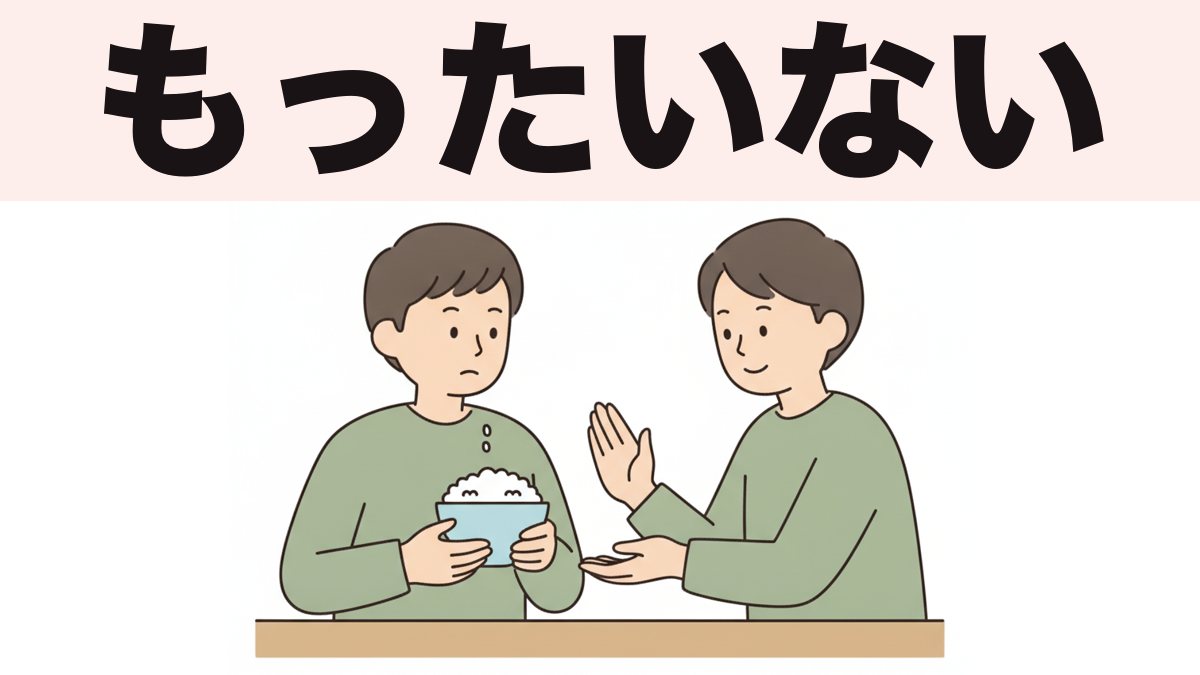
もったいない means "what a waste" — but it stretches across food, money, time, talent and opportunity, and in one very common use it is how someone deflects a compliment they think is too generous.
「もったいない」は「what a waste」です。でも、食べ物だけの言葉ではありません。お金・時間・才能・チャンスにも使います。そして、ほめられたときに、ことわる言い方にもなります。
Most learners meet it attached to leftover food and file it as "wasteful." That is one corner of the word. A Japanese speaker can say もったいない about an unused gym membership, a promising student who quit, a beautiful day spent indoors, and a compliment that was too kind — and they are not stretching the metaphor. They are using its actual range.
The basics
What does もったいない literally mean?
It is an i-adjective, and its core sense is that something of value is not being used as it deserves. The feeling underneath is closer to regret about waste than to disapproval of the person wasting it.
もったいない。 — What a waste. (casual; a complete sentence on its own) 捨てるのはもったいないです。 — It's a waste to throw it away. (polite)
Like many emotional words in Japanese, it works as a one-word utterance. You do not need a sentence around it, and a full sentence often sounds heavier than the moment deserves.
How do you build sentences with it?
It is an ordinary i-adjective, so it conjugates like 高い or 楽しい: もったいなかった, もったいなくない, もったいなさそう.
時間がもったいないです。 — It's a waste of time. (polite; が marks what is being wasted) もったいなかったですね。 — That was a shame, wasn't it. (polite, past)
The particle is が for the thing wasted, and the の nominaliser turns an action into the wasted thing: 捨てるのはもったいない, "throwing it away is wasteful." If that の still feels odd, こと and の is the mechanism underneath it.
The four things it is usually about
- Food. The classic. Leaving rice in the bowl is the first place children hear it.
- Money and objects. Buying something you will not use, or discarding something still good.
- Time. 時間がもったいない is an everyday complaint about queues, meetings and detours.
- Potential. This is the one learners miss. 才能がもったいない — "a waste of talent" — is said about a person, and it is sympathetic rather than critical.
彼女、辞めたの?もったいない。 — She quit? What a waste. (casual; about potential, and it is a compliment to her)
Beyond the basics
How it refuses a compliment
Here is the use that surprises people. When someone praises you in a way you feel is too much, もったいない — usually as もったいないお言葉です — says the praise is more than you deserve.
もったいないお言葉です。 — Your words are too kind. (formal; declining a compliment)
The logic is consistent with the rest of the word: something valuable (the praise) is being spent on something unworthy (you, modestly speaking). It is formal, and you will hear it in speeches, interviews and business settings far more than among friends.
This sits inside the wider habit of deflecting compliments rather than accepting them, which runs through honne and tatemae — the gap between what is felt and what is appropriate to say.
もったいない and the environmental slogan
The word travelled internationally as an environmental slogan, and you may have met it in that context first. Inside Japan it is not primarily an environmental term — it is everyday emotional vocabulary that happens to be about waste. Using it in an ordinary sentence will not sound like you are quoting a campaign, any more than "what a shame" sounds like a charity poster in English.
もったいない, 惜しい, 残念 — three near-neighbours
They overlap in English translation and separate cleanly in use.
- もったいない — value is going unused. The thing deserved better.
- 惜しい (おしい) — so close. Used for near misses: a shot that hit the post, an answer one character off.
- 残念 (ざんねん) — disappointing, unfortunate. The general-purpose word for bad news.
惜しい! — So close! (casual; a near miss) 残念ですが、行けません。 — Unfortunately, I can't come. (polite; the standard way to decline)
残念ですが is the polite opening for declining an invitation, which makes it worth having ready. Note that all three can appear about the same event from different angles: missing a train you ran for is 惜しい, missing the event at the other end is 残念, and having bought a ticket you now cannot use is もったいない.
The stronger forms
もったいない has an intensified adverbial use that sounds dramatic and is usually half-joking.
もったいなくて食べられない。 — It's too good to eat. (casual; said about beautiful food or a gift)
もったいなくて〜ない is a genuinely common frame: "it's so [wasteful to use] that I can't." People say it about nice stationery, expensive tea, and clothes kept for an occasion that never comes.
When not to use it
もったいない about someone else's spending can read as criticism of their judgement, especially if they have just bought the thing. Among friends this is normal banter; to a colleague or a host it is not. The safer move with someone you do not know well is to admire the thing rather than price it — commenting on cost at all is closer to rude than it is in English, and how to talk about price stays firmly on the practical side of that line for a reason.
Common mistakes
- Treating it as a noun. It is an i-adjective. もったいないです, not もったいないだです, and the past is もったいなかった.
- Using it only for food. The talent and opportunity senses are just as common, and missing them means missing half the conversations the word appears in.
- Confusing it with 残念. 残念 is "that's disappointing." もったいない is "that value is going unused." A cancelled trip is 残念; the non-refundable ticket is もったいない.
- Saying it about a gift in front of the giver. もったいない about a present can imply it was excessive. The intended-as-praise version is もったいないくらい素敵です ("almost too lovely"), which is a different, safer shape.
- Reaching for もったいないお言葉です with friends. It is formal to the point of ceremonial. With a friend, ありがとう and a small laugh is the whole response.
The three words, side by side
| Word | Reading | Core feeling | Typical line |
|---|---|---|---|
| もったいない | もったいない | Value going unused | 捨てるのはもったいない |
| 惜しい | おしい | So close, a near miss | 惜しい!あと一問でした |
| 残念 | ざんねん | Disappointing, unfortunate | 残念ですが、行けません |
| 無駄 | むだ | Pointless, futile, waste of effort | 無駄な会議 |
無駄 (むだ) belongs on this list as the cold version: 無駄 is waste as inefficiency, with no affection in it. A pointless meeting is 無駄. Leftover food is もったいない. Using 無駄 where もったいない belongs sounds harsh.
FAQ
Is もったいない a difficult word to translate? Genuinely, yes. English splits it across "what a waste," "such a shame," "too good to use" and "you're too kind." That is why it survives untranslated in English-language writing about Japan more than most words do.
Can I say it about my own things? Yes, constantly. 買ったのに使ってない、もったいない — "I bought it and never used it, what a waste" — is completely ordinary self-directed use.
Is it rude? Not in itself. It becomes pointed when aimed at someone else's decision, especially a recent purchase or a resignation. Aimed at a situation rather than a person, it is safe.
What is the もったいない for a person's talent? 才能がもったいない, or just もったいない with the context doing the work. It reads as sympathetic and is often said to the person as encouragement to reconsider.
Is the environmental usage wrong? Not wrong, just narrower than the word. Japanese speakers will understand you perfectly; you are simply using one sense of several.
How do I answer when someone says もったいない to me? If it is about your food, 食べます ("I'll eat it") with a laugh works. If it is about a decision, そうですね ("you're right") or a short explanation is normal. It is rarely an accusation and does not need a defence.
Practice
Build each answer before opening it. Questions 4 and 5 are a pair — the difference is where the regret is pointing.
1. Say "It's a waste to throw it away."
Show answer
捨てるのはもったいないです — の turns 捨てる into the thing being wasted, and は makes it the topic.
2. Say "It's a waste of time."
Show answer
時間がもったいないです — が marks what is being wasted. This is one of the most common uses of the word.
3. Put it in the past: "That was a waste, wasn't it."
Show answer
もったいなかったですね — it is an i-adjective, so the past is 〜かった, not でした.
4. Your friend missed the winning shot by an inch. Which word?
Show answer
惜しい — a near miss. 惜しい! on its own is the natural thing to shout. This is the pair to question 5.
5. The event was cancelled and you were looking forward to it. Which word?
Show answer
残念 — disappointing news. 残念ですね. This is the pair to question 4.
6. Politely decline an invitation.
Show answer
残念ですが、行けません — 残念ですが is the standard softening opener for a refusal.
7. Say "It's too good to eat."
Show answer
もったいなくて食べられない — the もったいなくて〜ない frame: it would be such a waste that I can't.
8. Someone praises you far too generously in a formal setting. What do you say?
Show answer
もったいないお言葉です — "your words are too kind." Formal only; with friends it would sound like a speech.
9. Which word for a pointless two-hour meeting: もったいない or 無駄?
Show answer
無駄 — 無駄な会議. 無駄 is waste as pointlessness. もったいない would suggest the meeting had value that went unused.
10. Your friend quit a job they were good at. Say "what a waste" about their talent.
Show answer
才能がもったいない — this sense is sympathetic, closer to a compliment than a criticism.
Vocabulary from this article
Tap the block to select all of it, then copy. In Anki: File → Import, note type Basic, separator Tab — the first column becomes the front, the second the back.
もったいない	もったいない — what a waste; too good to use
惜しい	おしい — so close, a near miss
残念	ざんねん — disappointing, unfortunate
無駄	むだ — pointless, futile waste
捨てる	すてる — to throw away
時間	じかん — time
才能	さいのう — talent
言葉	ことば — words, language
会議	かいぎ — meeting
辞める	やめる — to quit
使う	つかう — to use
買う	かう — to buy
食べる	たべる — to eat
素敵	すてき — lovely, wonderful
一問	いちもん — one question
彼女	かのじょ — she; girlfriend
I'm Yuuki, a Japanese teacher based in Tokyo. I've taught on italki as a Top 1% teacher and watched over 1,500 anime. もったいない is the word I hear learners use correctly about rice and never about people — and the day a student first says 才能がもったいない about a character they are annoyed with is usually the day their Japanese starts sounding like a person's rather than a textbook's.
Sources: the author's own lessons and standard reference grammars.
多くの学習者は、のこったご飯といっしょにこの言葉をおぼえます。それは一つの使い方です。日本語を話す人は、使っていないジム、やめてしまった生徒、家の中で終わった晴れの日、そして「ほめすぎ」の言葉にも「もったいない」と言います。
基本
意味
「もったいない」はい形容詞です。中心にあるのは、「ねうちのあるものが、そのねうちのとおりに使われていない」という気もちです。人をせめる言葉ではなく、ざんねんに思う言葉です。
もったいない。 — What a waste. (casual; a complete sentence on its own) 捨てるのはもったいないです。 — It's a waste to throw it away. (polite)
一語だけでも文になります。長い文にすると、かえって重くなります。
文の作り方
い形容詞なので、「高い」「楽しい」と同じように変わります。「もったいなかった」「もったいなくない」。
時間がもったいないです。 — It's a waste of time. (polite; が marks what is being wasted) もったいなかったですね。 — That was a shame, wasn't it. (polite, past)
むだになるものには「が」をつけます。動作を言うときは「の」でまとめます。「捨てるのはもったいない」。
よく使う4つ
- 食べ物。 いちばん有名です。
- お金・もの。 使わないのに買う。まだ使えるのに捨てる。
- 時間。 「時間がもったいない」は毎日使います。
- 才能・チャンス。 ここを知らない人が多いです。「才能がもったいない」は、人について言います。悪口ではありません。
彼女、辞めたの?もったいない。 — She quit? What a waste. (casual; about potential, and it is a compliment to her)
もう少し先へ
ほめられたときの「もったいない」
ほめすぎだと思ったとき、「もったいないお言葉です」と言います。
もったいないお言葉です。 — Your words are too kind. (formal; declining a compliment)
考え方は同じです。ねうちのあるもの(ほめ言葉)が、そうでないもの(自分)に使われている、という形です。かたい言い方なので、スピーチや仕事の場で聞きます。
世界に広まった「MOTTAINAI」
かんきょうの言葉として世界に広まりました。でも日本の中では、まず毎日の気もちの言葉です。ふつうの文で使っても、スローガンには聞こえません。
「もったいない」「惜しい」「残念」
- もったいない — ねうちが使われていない。
- 惜しい(おしい) — あと少しだった。
- 残念(ざんねん) — ざんねんな知らせ。
惜しい! — So close! (casual; a near miss) 残念ですが、行けません。 — Unfortunately, I can't come. (polite; the standard way to decline)
「残念ですが」は、さそいをことわるときの決まった形です。
同じできごとでも、見る角度でちがいます。電車にあと少しで乗れなかったのは「惜しい」。その先の会に行けないのは「残念」。買ったきっぷが使えないのは「もったいない」。
強い形
もったいなくて食べられない。 — It's too good to eat. (casual; said about beautiful food or a gift)
「もったいなくて〜ない」はよく使う形です。きれいな文ぼう具や、高いお茶にも言います。
使わないほうがいい場面
人が買ったばかりのものに「もったいない」と言うと、その人の考えを悪く言っているように聞こえます。友だちならいいですが、仕事の相手には言いません。ねだんの話をすること自体、日本ではあまりしません。
よくあるまちがい
- 名詞のように使う。 い形容詞です。「もったいないです」「もったいなかった」。
- 食べ物だけに使う。 才能やチャンスにも使います。
- 「残念」とまぜる。 中止は「残念」、使えないきっぷは「もったいない」。
- もらった物に本人の前で言う。 「高すぎる」と聞こえます。ほめたいときは「もったいないくらい素敵です」。
- 友だちに「もったいないお言葉です」と言う。 かたすぎます。「ありがとう」で十分です。
4つの言葉
| 言葉 | 読み | 気もち | 例 |
|---|---|---|---|
| もったいない | もったいない | ねうちが使われていない | 捨てるのはもったいない |
| 惜しい | おしい | あと少しだった | 惜しい!あと一問でした |
| 残念 | ざんねん | ざんねんな知らせ | 残念ですが、行けません |
| 無駄 | むだ | 意味がない | 無駄な会議 |
「無駄(むだ)」はつめたい言葉です。意味のない会議は「無駄」。のこったご飯は「もったいない」。ここを入れかえると、きつく聞こえます。
FAQ
「もったいない」は英語にしにくいですか。 はい。「what a waste」「such a shame」「too good to use」「you're too kind」に分かれます。だから英語の文章でも、そのまま MOTTAINAI と書かれます。
自分のものにも使えますか。 使えます。「買ったのに使ってない、もったいない」はふつうの言い方です。
失礼になりますか。 言葉自体は失礼ではありません。人の決めたことに言うと、きつく聞こえます。
人の才能に使うときは? 「才能がもったいない」。本人に言うことも多く、応えんの意味になります。
かんきょうの意味で使うのはまちがいですか。 まちがいではありません。意味がせまくなるだけです。
言われたら何と答えますか。 食べ物なら「食べます」と笑って言えば十分です。決めたことなら「そうですね」でいいです。せめられているわけではありません。
練習
答えを見る前に、自分で作ってください。4と5は組です。
1. 「捨てるのはもったいないです」と言ってください。
答えを見る
捨てるのはもったいないです — 「の」で動作をまとめ、「は」でテーマにします。
2. 「時間がもったいないです」と言ってください。
答えを見る
時間がもったいないです — むだになるものに「が」をつけます。いちばんよく使う形のひとつです。
3. 過去の形にしてください。「もったいなかったですね」。
答えを見る
もったいなかったですね — い形容詞なので「〜かった」です。「でした」ではありません。
4. 友だちがあと少しで入るシュートを外しました。どの言葉ですか。
答えを見る
惜しい — あと少しでした。「惜しい!」だけで言います。5と組です。
5. 楽しみにしていた会が中止になりました。どの言葉ですか。
答えを見る
残念 — ざんねんな知らせです。「残念ですね」。4と組です。
6. さそいをていねいにことわってください。
答えを見る
残念ですが、行けません — 「残念ですが」で、やわらかくことわります。
7. 「きれいすぎて食べられない」と言ってください。
答えを見る
もったいなくて食べられない — 「もったいなくて〜ない」の形です。
8. かたい場で、ほめすぎだと思ったときは何と言いますか。
答えを見る
もったいないお言葉です — 「ほめ言葉が自分には多すぎます」という意味です。友だちには使いません。
9. 意味のない2時間の会議は「もったいない」ですか、「無駄」ですか。
答えを見る
無駄 — 「無駄な会議」。「もったいない」だと、ねうちがあったのに使われなかった、という意味になります。
10. 上手だった友だちが仕事をやめました。才能について言ってください。
答えを見る
才能がもったいない — この使い方は悪口ではなく、ほめ言葉に近いです。
この記事に出た単語
ブロックをタップして全部を選んでから、コピーしてください。Anki では ファイル → 読み込み、ノートタイプは 基本、区切りは タブ です。左が表、右が裏になります。
もったいない	もったいない — what a waste; too good to use
惜しい	おしい — so close, a near miss
残念	ざんねん — disappointing, unfortunate
無駄	むだ — pointless, futile waste
捨てる	すてる — to throw away
時間	じかん — time
才能	さいのう — talent
言葉	ことば — words, language
会議	かいぎ — meeting
辞める	やめる — to quit
使う	つかう — to use
買う	かう — to buy
食べる	たべる — to eat
素敵	すてき — lovely, wonderful
一問	いちもん — one question
彼女	かのじょ — she; girlfriend
私はユウキです。東京で日本語を教えています。 italki の Top 1% の先生で、アニメは1,500本以上見ました。「もったいない」を、ご飯には正しく使うのに、人には使わない生徒が多いです。キャラクターについて「才能がもったいない」と言えた日から、その人の日本語は教科書の日本語ではなくなります。
More drills like the ones above, plus a timed JLPT-style mock test: Practice · N4上のような練習問題と、時間つきのJLPT形式のもぎ試験: 練習ページ · N4
Want to try this in a real conversation?
本当の会話で、ためしてみませんか?
30-minute trial lesson, $13. Times shown in your own timezone.
30分の体験レッスン、$13。時間はあなたのタイムゾーンで表示されます。
Book a trial lesson · $13