Japanese words for tired: 疲れた, 眠い, だるい, へとへと and which one to useつかれた・ねむい・だるい・へとへと: 「tired」の日本語の使い分け
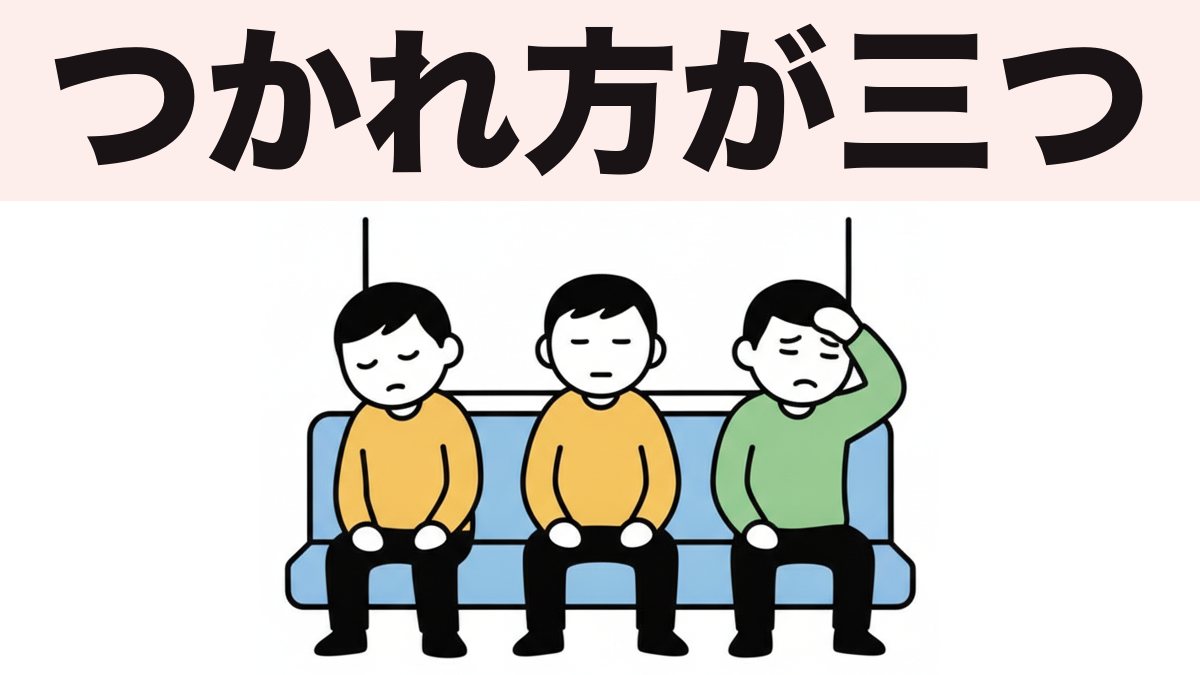
疲れた means tired from doing something, 眠い means sleepy, だるい means heavy and sluggish in a way that hints at being unwell, and へとへと means completely wiped out. English uses "tired" for all four, and Japanese does not.
「疲れた」は何かをしてつかれたときです。「眠い」はねむりたいときです。「だるい」は体が重くて、少し具合が悪いときです。「へとへと」は力がぜんぜんないときです。英語はぜんぶ「tired」ですが、日本語はちがいます。
This matters more than most vocabulary sets, because these are words you will want on days when you do not have the energy to search for the right one. Getting them apart once, properly, means the correct word arrives on its own when you need it.
The basics
疲れた — tired from effort
The default. It is the past tense of 疲れる, "to become tired", and Japanese uses the past form for the current state — you became tired, so now you are.
今日は疲れた。 — I'm tired today. (casual) 仕事で疲れました。 — I got tired from work. (polite)
Saying 疲れている is also correct and slightly different: it describes the ongoing state rather than the change into it. In practice 疲れた is what people say.
眠い — sleepy
Not the same thing at all. 眠い is specifically wanting to sleep, which can happen while you are perfectly rested.
眠くなってきた。 — I'm getting sleepy. (casual) 朝は眠いです。 — I'm sleepy in the mornings. (polite)
眠たい is a common variant with the same meaning and a slightly softer feel. Both are い-adjectives, so they conjugate as adjectives: 眠くない, 眠かった.
だるい — heavy, sluggish
The one learners are usually missing. だるい describes a body that feels heavy and uncooperative, and it carries a hint of being slightly unwell — the word you use when a fever is coming.
なんか体がだるい。 — My body feels heavy somehow. (casual) 熱があってだるいです。 — I have a fever and feel sluggish. (polite) 疲れたから、今日は休む。明日は元気になるよ。 — I'm tired, so I'm resting today. I'll be fine tomorrow. (casual)
Because of that association, だるい is the word to use if you want someone to understand you might actually be ill rather than merely tired. The rest of the vocabulary for that conversation is in how to say you're sick in Japanese.
Beyond the basics
へとへと and くたくた — the wiped-out pair
Both are onomatopoeic and both mean exhausted, and they are extremely common in speech.
もうへとへとだ。 — I'm completely wiped out. (casual) 一日歩いてくたくたです。 — I'm worn out from walking all day. (polite)
くたくた leans physical — legs, a long day on your feet. へとへと covers physical and mental both. Neither is slang; they are ordinary adult vocabulary, and they belong to the wider onomatopoeia system covered in Japanese onomatopoeia.
疲れる vs 飽きる — tired of, not tired out
A trap that produces real misunderstandings. "I'm tired of this" is not 疲れた; it is 飽きた, "I've had enough of it".
この曲、飽きた。 — I'm sick of this song. (casual) この曲を聞いて疲れた。 — Listening to this song wore me out. (casual — a different claim)
飽きる is about boredom and saturation; 疲れる is about energy. Saying 疲れた about a person is not a subtle way of saying they bore you — it says they exhausted you, which is its own accusation.
お疲れさま is not "you look tired"
This is the single most common confusion in the set. お疲れさま uses the same kanji but is a greeting, not an observation about someone's condition.
お疲れさまです。 — (a standard greeting to a colleague, at any time of day) (polite)
It acknowledges that the other person has been working, which is why it functions as both hello and goodbye in a workplace. It is not something you say because someone looks worn out — and the full picture of how it is used, including 疲れ様でした at the end of a shift, is in お疲れさま.
The mental versions
Tiredness of the mind has its own vocabulary, and using the physical words for it sounds slightly off.
- 疲れた works for both, and is the safe general choice.
- しんどい — hard going, tough. Common in Kansai and spreading nationally.
- やる気が出ない — no motivation, can't get going.
- 面倒くさい — can't be bothered. Not tiredness, but it occupies the same conversational slot.
最近しんどい。 — Things have been rough lately. (casual) やる気が出ない。 — I can't get myself going. (casual)
Common mistakes
- Using 疲れた when you mean 眠い. They are different states. Being sleepy in a morning meeting is 眠い, not 疲れた.
- Saying 疲れています to explain you are tired right now. Correct but unusual; 疲れました or 疲れた is what people say.
- Reading お疲れさま as "you seem tired". It is a greeting acknowledging work, not a comment on appearance.
- Using 疲れた for "tired of". That is 飽きた. The two are not interchangeable in either direction.
- Treating だるい as plain tiredness. It suggests something is physically off, which is useful when true and misleading when not.
The set at a glance
| Word | Means | Use when |
|---|---|---|
| 疲れた | Tired from effort | The general default |
| 眠い | Sleepy | You want to sleep |
| だるい | Heavy, sluggish, off-colour | You might be getting ill |
| へとへと | Completely wiped out | Body and mind both |
| くたくた | Worn out | Mostly physical |
| しんどい | Tough, hard going | Ongoing strain |
| 飽きた | Tired of something | Boredom, not energy |
FAQ
What do I say if I'm just sleepy in a lesson? 眠いです. It is honest and completely normal to say — teachers hear it constantly and it is more useful than pretending.
Is だるい rude? No, it is ordinary spoken Japanese. It does carry a hint of being unwell, so it may prompt someone to ask if you are okay.
Is しんどい only used in Kansai? It started there and is now widely understood and used nationally, though it still sounds a little Kansai-flavoured to some speakers.
Why is 疲れた in the past tense? Because 疲れる means "to become tired", so the completed change is what describes your current state. Japanese does this with several verbs of change — 分かった, 疲れた, お腹が空いた.
How do I say "I'm tired of studying"? 勉強に飽きた for boredom, or 勉強で疲れた if studying genuinely drained you. They say different things.
What is the polite way to say I'm exhausted at work? 疲れました is fine with colleagues. With a client or a superior, downplaying is safer — 少し疲れました, or simply not mentioning it.
Practice
Build each answer before opening it. Questions 1 and 2 are a pair — two states English calls the same thing.
1. You worked all day and have no energy. What do you say?
Show answer
疲れた — tired from effort. This is the pair to question 2.
2. You slept badly and want to sleep now. What do you say?
Show answer
眠い — sleepy, not tired. This is the pair to question 1.
3. Your body feels heavy and you might be getting a fever.
Show answer
体がだるい — だるい hints that something is physically off.
4. Say "I'm sick of this song."
Show answer
この曲、飽きた — 飽きる is boredom. 疲れた would claim the song drained you.
5. Something is wrong here: お疲れさまです。(said because someone looks worn out)
Show answer
It is a greeting, not an observation — お疲れさまです acknowledges that someone has been working. It is not a comment on how they look.
6. Say you're completely wiped out, casually.
Show answer
もうへとへとだ — へとへと covers body and mind both.
7. Say you're worn out from walking all day, politely.
Show answer
一日歩いてくたくたです — くたくた leans physical, which fits walking.
8. Why is 疲れた in the past tense?
Show answer
疲れる means "to become tired" — so the completed change describes the current state. 分かった works the same way.
9. Say "I can't get myself going."
Show answer
やる気が出ない — motivation, not energy.
10. You are sleepy in a lesson. Tell your teacher politely.
Show answer
眠いです — honest and completely normal. 疲れました would claim something different.
Vocabulary from this article
Tap the block to select all of it, then copy. In Anki: File → Import, note type Basic, separator Tab — the first column becomes the front, the second the back.
疲れる	つかれる — to get tired
眠い	ねむい — sleepy
だるい	だるい — sluggish, heavy, off-colour
へとへと	へとへと — completely worn out
くたくた	くたくた — worn out (physically)
しんどい	しんどい — tough, hard going
飽きる	あきる — to get tired of, to lose interest
熱	ねつ — fever
体	からだ — body
仕事	しごと — work
元気	げんき — energy, good health
休む	やすむ — to rest
眠る	ねむる — to sleep
やる気	やるき — motivation
面倒	めんどう — bother, trouble
曲	きょく — song, piece of music
I'm Yuuki, a Japanese teacher based in Tokyo. I've taught on italki as a Top 1% teacher and watched over 1,500 anime. だるい is the word I most often have to give students, because it is the one they need on the day they are too worn out to look it up.
Sources: the author's own lessons and standard reference grammars.
このセットは大事です。つかれている日に、言葉をさがす元気はありません。一度きちんと分けておくと、必要なときに自然に出てきます。
基本
疲れた
きほんの形です。「疲れる」の過去形です。日本語では、今のじょうたいを過去の形で言います。「つかれた状態になった」からです。
今日は疲れた。 — I'm tired today. (casual) 仕事で疲れました。 — I got tired from work. (polite)
「疲れている」も正しいです。でも、ふだんは「疲れた」と言います。
眠い
これはちがうじょうたいです。「ねむりたい」という意味です。元気でも眠いことはあります。
眠くなってきた。 — I'm getting sleepy. (casual) 朝は眠いです。 — I'm sleepy in the mornings. (polite)
「眠たい」も同じ意味です。「い」の形容詞なので「眠くない」「眠かった」になります。
だるい
学ぶ人がもっていないことが多い言葉です。体が重くて、思うように動かないときです。少し具合が悪い感じが入ります。
なんか体がだるい。 — My body feels heavy somehow. (casual) 熱があってだるいです。 — I have a fever and feel sluggish. (polite)
だから、「ただつかれた」ではなく「具合が悪いかもしれない」と伝えたいときに使います。→ 具合が悪いときの言い方
もう少しくわしく
へとへと・くたくた
どちらも音からできた言葉で、「力がぜんぜんない」という意味です。会話でとてもよく使います。
もうへとへとだ。 — I'm completely wiped out. (casual) 一日歩いてくたくたです。 — I'm worn out from walking all day. (polite)
「くたくた」は体の方です。「へとへと」は体も心も入ります。スラングではありません。→ 日本語のオノマトペ
「疲れる」と「飽きる」
ここはまちがえると、意味が大きくかわります。「もういやだ」は「疲れた」ではなく「飽きた」です。
この曲、飽きた。 — I'm sick of this song. (casual) この曲を聞いて疲れた。 — Listening to this song wore me out. (casual — a different claim)
「飽きる」はあきること、「疲れる」は元気がなくなることです。人に「疲れた」と言うと、「あなたのせいで元気がなくなった」という意味になります。
「お疲れさま」は「つかれて見える」ではない
これがいちばん多いかんちがいです。漢字は同じですが、あいさつの言葉です。
お疲れさまです。 — (a standard greeting to a colleague, at any time of day) (polite)
「はたらいていますね」というあいさつです。しごと場では「こんにちは」にも「さようなら」にもなります。→ お疲れさま
心の方の言葉
心のつかれには、べつの言葉があります。
- 疲れた — 体も心も使えます。安全なきほんの形です。
- しんどい — つらい。関西から広がった言葉です。
- やる気が出ない — 気もちが動かない。
- 面倒くさい — やりたくない。つかれとはちがいますが、同じ場面で出ます。
最近しんどい。 — Things have been rough lately. (casual) やる気が出ない。 — I can't get myself going. (casual)
よくあるまちがい
- 「眠い」のときに「疲れた」と言う。 べつのじょうたいです。
- 「今つかれている」を「疲れています」と言う。 正しいですが、ふつうは「疲れました」です。
- 「お疲れさま」を「つかれて見えますね」だと思う。 あいさつです。
- 「もういやだ」に「疲れた」を使う。 それは「飽きた」です。
- 「だるい」をただのつかれだと思う。 具合が悪い感じが入ります。
ひとめで見る表
| 言葉 | 意味 | 使う時 |
|---|---|---|
| 疲れた | 何かをしてつかれた | きほんの形 |
| 眠い | ねむりたい | ねむいとき |
| だるい | 体が重い・具合が悪そう | 熱が出そうなとき |
| へとへと | 力がぜんぜんない | 体も心も |
| くたくた | つかれ切った | おもに体 |
| しんどい | つらい | ずっと続くとき |
| 飽きた | あきた | 元気ではなく、気もち |
よくある質問
レッスンでねむいときは? 「眠いです」でいいです。先生はよく聞きます。がまんするより役に立ちます。
「だるい」は失礼? いいえ、ふつうの言葉です。ただ、「だいじょうぶ?」と聞かれるかもしれません。
「しんどい」は関西だけ? はじまりは関西ですが、今は全国で通じます。
なぜ「疲れた」は過去形? 「疲れる」は「つかれた状態になる」だからです。「分かった」「お腹が空いた」も同じです。
「勉強にあきた」はどう言う? 「勉強に飽きた」です。「勉強で疲れた」は、べつの意味になります。
しごとで丁寧に言うには? 同りょうには「疲れました」でいいです。お客さまや上の人には、言わないか「少し疲れました」です。
練習
答えを見る前に、自分で作ってください。1番と2番はペアです。
1. 一日はたらいて元気がありません。何と言う?
答えを見る
疲れた — 何かをしてつかれたときです。2番とペアです。
2. ねむりたいです。何と言う?
答えを見る
眠い — つかれとはちがいます。1番とペアです。
3. 体が重くて、熱が出そうです。
答えを見る
体がだるい — 具合が悪い感じが入ります。
4. 「この曲はもういやだ」と言う。
答えを見る
この曲、飽きた — 「疲れた」だと「曲のせいで元気がなくなった」になります。
5. まちがいをなおす: つかれて見える人に「お疲れさまです」と言う。
答えを見る
「お疲れさま」はあいさつです — 見た目についての言葉ではありません。
6. カジュアルに「力がぜんぜんない」と言う。
答えを見る
もうへとへとだ — 体も心も入ります。
7. 一日歩いてつかれたと丁寧に言う。
答えを見る
一日歩いてくたくたです — 「くたくた」は体の方です。
8. なぜ「疲れた」は過去形?
答えを見る
「疲れる」が「つかれた状態になる」だから — 「分かった」も同じです。
9. 「気もちが動かない」と言う。
答えを見る
やる気が出ない — 元気ではなく、気もちの話です。
10. レッスンでねむいと先生に丁寧に言う。
答えを見る
眠いです — 「疲れました」はべつの意味です。
この記事に出た単語
上のブロックをタップしてぜんぶ選んで、コピーしてください。Ankiでは ファイル → インポート、ノートタイプは 基本、区切りは タブ です。左が表、右がうらになります。
疲れる	つかれる — to get tired
眠い	ねむい — sleepy
だるい	だるい — sluggish, heavy, off-colour
へとへと	へとへと — completely worn out
くたくた	くたくた — worn out (physically)
しんどい	しんどい — tough, hard going
飽きる	あきる — to get tired of, to lose interest
熱	ねつ — fever
体	からだ — body
仕事	しごと — work
元気	げんき — energy, good health
休む	やすむ — to rest
眠る	ねむる — to sleep
やる気	やるき — motivation
面倒	めんどう — bother, trouble
曲	きょく — song, piece of music
More drills like the ones above, plus a timed JLPT-style mock test: Practice · N4上のような練習問題と、時間つきのJLPT形式のもぎ試験: 練習ページ · N4
Want to try this in a real conversation?
本当の会話で、ためしてみませんか?
30-minute trial lesson, $13. Times shown in your own timezone.
30分の体験レッスン、$13。時間はあなたのタイムゾーンで表示されます。
Book a trial lesson · $13