一応 (ichiou): the word Japanese uses to hedge almost anything一応(いちおう): 何にでもつけられる便利なことば
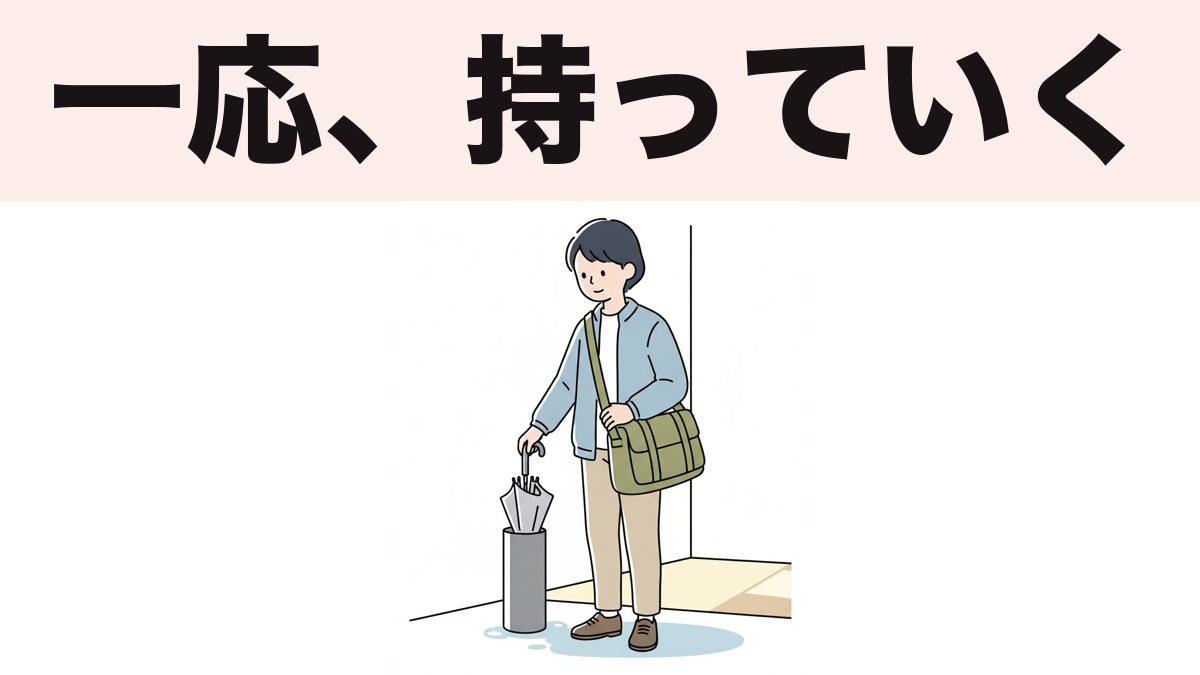
一応 attaches a small asterisk to whatever you just said — it can mean "just in case," "more or less," "for now," or "technically, yes," and Japanese speakers use it dozens of times a day.
「一応」は、今言ったことに小さな「※」をつけることばです。「念のため」「だいたい」「とりあえず」「一応は、はい」— 日本人は1日に何十回も使います。
It is one of the highest-frequency words that textbooks barely mention, because it does not translate. There is no single English word that covers it, so it gets skipped, and learners spend years wondering why every Japanese person answers a simple question with 一応 in front of it.
The basics
The four jobs of 一応
| Use | Rough English | Example |
|---|---|---|
| Just in case | To be safe | 一応傘を持っていく |
| More or less | Technically, sort of | 一応終わりました |
| For now | Tentatively | 一応これで行きましょう |
| Hedged yes | Yes, but don't expect much | 一応話せます |
All four share one idea: the thing is true, but do not lean on it too hard.
天気予報では降らないと言っていたけど、一応傘を持っていく。 — The forecast said no rain, but I'll take an umbrella just in case. (plain) 一応アラームを三つかけるつもりだ。 — I'm going to set three alarms, just to be safe. (plain)
一応 as "just in case"
This is the easiest use and the one to learn first. The action is precautionary: you do not expect to need it, and you are doing it anyway.
一応、予約しておきましょうか。 — Shall we book, just in case? (polite; note the 〜ておく, which does the same preparatory job) 一応、地図を見ておきます。 — I'll take a look at the map beforehand, just in case. (polite)
一応 pairs naturally with 〜ておく, because both are about covering a future possibility — see 〜ておく.
一応 as "more or less"
Here it reports that something is done, while signalling that it may not be perfect or complete.
一応終わりました。 — It's finished — more or less. (polite; honest, and slightly nervous) 一応読みましたが、よく分かりませんでした。 — I did read it, but I didn't really understand. (polite)
Be careful with this one at work. 一応終わりました tells your boss the job is done and that you have doubts about it. Sometimes that is exactly the right thing to say. If the work really is finished, 終わりました on its own is stronger and clearer.
Beyond the basics
一応 as modesty
This is the use that surprises learners most. Japanese speakers put 一応 in front of their own abilities to avoid sounding boastful.
日本語、話せますか。— 一応、話せます。 — Can you speak Japanese? — More or less, yes. (polite; often said by someone completely fluent) 一応、資格は持っています。 — I do hold the qualification, technically. (polite)
The speaker is not confessing weakness. They are declining to claim strength, which in Japanese is a form of politeness. Someone who answers はい、話せます flatly is not wrong, just noticeably direct — the same instinct behind the honne and tatemae split.
As a learner you can use this deliberately. 一応、日本語を勉強しています is a graceful answer that does not oversell you and does not sell you short either.
一応 vs とりあえず vs 念のため
These three overlap and are not interchangeable.
一応 — the thing is true, with reservations. (covers all four jobs above) とりあえず — for now, before anything else. (a first step, with more to come) 念のため — for caution's sake. (only the "just in case" job, and more formal)
とりあえずビールで。 — A beer to start with. (casual; the most famous sentence in this family, said the moment everyone sits down) 念のため、確認させていただきます。 — Allow me to confirm, just to be sure. (formal business)
とりあえず promises that something else follows. 念のため is the polite, business-safe version of "just in case," and it is the one to use in an email where 一応 might read as careless. 一応 is the everyday all-rounder.
Where it sits in the sentence
At the front of the clause, usually with a comma in writing, and it modifies everything after it.
一応、明日までに終わらせます。 — I'll get it done by tomorrow — that's the plan. (polite) 明日までに一応終わらせます。 — Same, with the hedge landing on 終わらせる itself. (polite)
In fast speech it is often clipped to いちお, which is why you may not recognise it at first.
Answering a question with just 一応
一応 can stand alone as a complete answer, and it usually means "yes, but."
もう食べた? — 一応。 — Have you eaten yet? — Sort of. (casual; you ate something, but not properly) 準備できた? — 一応ね。 — Ready? — More or less. (casual)
The listener hears that the answer is yes and that there is a caveat you are not bothering to spell out. If they need the detail, they will ask.
When 一応 undersells you
Because it hedges, 一応 can weaken a statement you wanted to sound confident. Three places to be careful:
- Reporting completed work to a superior. 一応終わりました invites a check. If it is genuinely done, say 終わりました.
- A job interview. 一応できます sounds tentative where you wanted competent. 対応できます or 経験があります is stronger.
- Reassuring someone. 一応大丈夫です is not reassuring. It means "probably fine."
The same care applies to the whole family of softeners, which is part of the wider question of when to switch registers.
Common mistakes
- Using 一応 for everything as a verbal tic. It is frequent in Japanese, but a learner who attaches it to every sentence sounds permanently unsure.
- Using it where とりあえず belongs. If you mean "first of all, before the rest," that is とりあえず.
- Using 一応 in a formal email for caution. 念のため is the business-appropriate word.
- Reading it as "one time." The kanji are 一 (one) and 応 (response), but the meaning is idiomatic, not literal.
- Saying 一応大丈夫です to reassure someone worried. It does the opposite.
- Missing it in speech. It contracts to いちお, and it is very often the first word in a reply.
Practice
Answers are hidden — say yours first, then open. Questions 2 and 3 are a pair: the same caution, once casual and once in a business email.
1. The forecast says no rain, but you take an umbrella anyway. Say it.
Show answer
一応、傘を持っていきます。 — The precautionary use. You do not expect rain and you are covering the possibility anyway.
2. You want to confirm a detail with a colleague, casually.
Show answer
一応、確認しておきます。 — 一応 pairs naturally with 〜ておく, because both point at a future possibility.
3. Now the same confirmation in a formal email to a client.
Show answer
念のため、確認させていただきます。 — 念のため is the business-safe version. 一応 here can read as casual or careless.
4. Someone asks 日本語、話せますか。 You are fluent but do not want to boast.
Show answer
一応、話せます。 — The modesty use. You are declining to claim strength rather than confessing weakness.
5. What does 一応終わりました tell your boss that 終わりました does not?
Show answer
That you have doubts about it. — It reports the work as done and invites a check. If it is genuinely finished, drop the 一応.
6. Everyone sits down at an izakaya and nobody has looked at the menu. What do you order?
Show answer
とりあえずビールで。 — とりあえず means "for now, before anything else." It promises that a real order follows.
7. Someone asks もう食べた? You had a snack but not a meal. Answer in one word.
Show answer
一応。 — A complete answer meaning "yes, but." The caveat is left unspoken, and the listener can ask if they need it.
8. Why is 一応大丈夫です a bad way to reassure a worried friend?
Show answer
It hedges the reassurance. — It means "probably fine." To reassure, say 大丈夫です with nothing in front of it.
9. What is the difference between 一応 and 念のため?
Show answer
Scope and register. — 念のため only covers "just in case" and is more formal. 一応 also covers "more or less," "for now" and the modest yes, and is everyday.
10. You have set three alarms for tomorrow's exam. Say it.
Show answer
一応、アラームを三つかけるつもりだ。 — Precautionary again: you expect one to be enough and you are covering the possibility.
FAQ
Is 一応 polite or casual? Neutral. It works in both, and it appears constantly in ordinary workplace conversation. The one place to avoid it is formal written communication, where 念のため is better.
Does 一応 make me sound unconfident? Once, no — it sounds normal and appropriately modest. On every sentence, yes. Watch the frequency rather than the word.
How do I say it naturally? いちおう, and in fast speech it collapses toward いちお. Both are normal; there is no separate casual word.
Is 一応 rude? No, but it can be dismissive when applied to someone else's work. 一応できてますね about a colleague's report reads as faint praise, which may not be what you meant.
What is the kanji doing? 一 is "one" and 応 is "response, to answer." The compound is idiomatic — it does not decompose into its parts in a way that helps, which is part of why it resists translation.
Can I use it about the future? Yes, and it is very common there: 一応、行く予定です ("I'm planning to go, tentatively"). It marks the plan as real but not fixed.
Vocabulary from this article
Tap the block to select all of it, then copy. In Anki: File → Import, note type Basic, separator Tab — the first column becomes the front, the second the back.
一応	いちおう — more or less; just in case; tentatively
とりあえず	とりあえず — for now, first of all
念のため	ねんのため — just to be sure, for caution's sake
傘	かさ — umbrella
天気予報	てんきよほう — weather forecast
予約	よやく — reservation, booking
確認	かくにん — confirmation, checking
資格	しかく — qualification, certification
準備	じゅんび — preparation
大丈夫	だいじょうぶ — fine, all right
対応	たいおう — handling, dealing with
経験	けいけん — experience
予定	よてい — plan, schedule
終わる	おわる — to finish, to end
I'm Yuuki, a Japanese teacher based in Tokyo. I've taught on italki as a Top 1% teacher and watched over 1,500 anime. 一応 is one of the words I actively hand to students, because it fills a gap English speakers keep reaching for and answering with a whole sentence.
Sources: the author's own lessons and standard reference grammars.
とてもよく使うのに、教科書にはほとんど出ません。英語に1語で訳せないからです。だから学習者はとばしてしまい、「どうしてみんな答えの前に『一応』と言うんだろう」と何年も思います。
基本
「一応」の4つの仕事
| 使い方 | だいたいの英語 | 例 |
|---|---|---|
| 念のため | to be safe | 一応傘を持っていく |
| だいたい | technically, sort of | 一応終わりました |
| とりあえず | tentatively | 一応これで行きましょう |
| ひかえめな「はい」 | yes, but | 一応話せます |
4つとも、言っていることは同じです。本当だけれど、強くたよらないでください。
天気予報では降らないと言っていたけど、一応傘を持っていく。 — The forecast said no rain, but I'll take an umbrella just in case. 一応アラームを三つかけるつもりだ。 — I'm going to set three alarms, just to be safe.
「念のため」の一応
いちばんかんたんで、最初に覚える使い方です。たぶん要らないけれど、やっておく、です。
一応、予約しておきましょうか。 — Shall we book, just in case? (ていねい) 一応、地図を見ておきます。 — I'll take a look at the map beforehand, just in case.
「一応」は「〜ておく」と相性がいいです。どちらも「先のことにそなえる」からです。〜ておく を見てください。
「だいたい」の一応
終わったことを伝えながら、「完ぺきではないかもしれない」と知らせます。
一応終わりました。 — It's finished — more or less. (正直だけれど、少し自信がない) 一応読みましたが、よく分かりませんでした。 — I did read it, but I didn't really understand.
仕事では気をつけてください。「一応終わりました」は、「終わった」と「自信がない」を同時に伝えます。本当に終わっているなら、「終わりました」だけの方が強くてはっきりします。
もう少し先へ
ひかえめに言う「一応」
学習者がいちばんおどろく使い方です。日本人は、自分の力を言う時に「一応」をつけて、いばらないようにします。
日本語、話せますか。— 一応、話せます。 — Can you speak Japanese? — More or less, yes. (ぺらぺらの人もこう言う) 一応、資格は持っています。 — I do hold the qualification, technically.
弱さを言っているのではありません。強さを言わないようにしているのです。日本語ではそれがていねいさです。「はい、話せます」も正しいですが、少しまっすぐに聞こえます。同じ感覚は 本音と建前 にもあります。
学習者も使えます。「一応、日本語を勉強しています」は、大きくも小さくも言わない、ちょうどいい答えです。
一応・とりあえず・念のため
3つは似ていますが、同じではありません。
一応 — 本当だけれど、ただし書きがある。(上の4つ全部) とりあえず — まず先に。(あとに続きがある) 念のため — 用心のために。(「念のため」だけ。少しかたい)
とりあえずビールで。 — A beer to start with. (すわってすぐ言う、有名な文) 念のため、確認させていただきます。 — Allow me to confirm, just to be sure. (ビジネス)
「とりあえず」は「あとに何かある」と約束します。「念のため」は仕事のメールで安全な形で、「一応」だとざつに聞こえる場面に向きます。「一応」はふだんの万能選手です。
文のどこに置く?
文の前です。書く時は読点をつけることが多く、後ろ全部にかかります。
一応、明日までに終わらせます。 — I'll get it done by tomorrow — that's the plan. 明日までに一応終わらせます。 — 同じ意味。「終わらせる」の方にただし書きが乗ります。
速い会話では「いちお」に近くなります。だから最初は聞き取りにくいです。
「一応」だけで答える
「一応」1語で答えになります。意味は「はい、でも」です。
もう食べた? — 一応。 — Have you eaten yet? — Sort of. (何か食べたが、ちゃんとではない) 準備できた? — 一応ね。 — Ready? — More or less.
相手は「はい」と「ただし書きがある」の両方を受け取ります。くわしく知りたければ、聞いてきます。
「一応」が自分を安くする時
ただし書きなので、自信を見せたい時には弱くなります。気をつける場面が3つあります。
- 上司に終わったと言う時。 「一応終わりました」はチェックを呼びます。本当に終わったなら「終わりました」。
- 面接。 「一応できます」は自信がなく聞こえます。「対応できます」「経験があります」の方が強いです。
- 心配している人を安心させる時。 「一応大丈夫です」は安心させません。「たぶん大丈夫」という意味です。
同じ注意は、やわらげることば全体に当てはまります。敬語とタメ口の切りかえ と同じ判断です。
よくあるまちがい
- 口ぐせのように全部につける。 日本語でもよく使いますが、毎文につけると「いつも自信がない人」に聞こえます。
- 「とりあえず」の場面で使う。 「まず先に」なら「とりあえず」です。
- かたいメールで「一応」を使う。 仕事のメールは「念のため」です。
- 「一回」の意味だと思う。 漢字は「一」と「応」ですが、意味は決まり文句で、分解しても分かりません。
- 心配している人に「一応大丈夫です」と言う。 逆の効果になります。
- 会話で聞きのがす。 「いちお」に縮みます。返事のいちばん最初に来ることが多いです。
練習
答えはかくしてあります。先に言ってから開けてください。2と3は同じ「確認」の、カジュアルとビジネスです。
1. 雨は降らないと言っていますが、傘を持っていきます。言ってください。
答えを見る
一応、傘を持っていきます。 — 「念のため」の使い方です。たぶん要らないけれど、そなえておきます。
2. 同僚に、カジュアルに確認しておきたいです。
答えを見る
一応、確認しておきます。 — 「一応」と「〜ておく」は相性がいいです。どちらも先のことにそなえます。
3. 同じ確認を、取引先へのかたいメールで。
答えを見る
念のため、確認させていただきます。 — 「念のため」が仕事で安全な形です。ここで「一応」はざつに読めます。
4. 「日本語、話せますか」と聞かれました。ぺらぺらですが、いばりたくありません。
答えを見る
一応、話せます。 — ひかえめな使い方です。弱さではなく、強さを言わないていねいさです。
5. 「一応終わりました」は「終わりました」と何がちがいますか。
答えを見る
自信がないことも伝わります。 — チェックを呼ぶ言い方です。本当に終わっているなら「一応」を外します。
6. 居酒屋ですわりました。まだメニューを見ていません。何を頼みますか。
答えを見る
とりあえずビールで。 — 「とりあえず」は「まず先に」。このあと本当の注文が来ます。
7. 「もう食べた?」と聞かれました。おかしは食べましたが、食事はまだです。1語で答えてください。
答えを見る
一応。 — 「はい、でも」という完全な答えです。ただし書きは言わず、必要なら相手が聞きます。
8. 心配している友だちに「一応大丈夫です」がよくないのはなぜですか。
答えを見る
安心をやわらげてしまうからです。 — 「たぶん大丈夫」に聞こえます。安心させたいなら「大丈夫です」だけ。
9. 「一応」と「念のため」のちがいは?
答えを見る
はばとかたさです。 — 「念のため」は「用心のため」だけで、少しかたいです。「一応」は「だいたい」「とりあえず」「ひかえめな はい」もカバーします。
10. 明日の試験のためにアラームを3つかけます。言ってください。
答えを見る
一応、アラームを三つかけるつもりだ。 — 1つで足りると思うけれど、そなえておく。「念のため」の使い方です。
よくある質問
「一応」はていねいですか、カジュアルですか。 中立です。どちらでも使えて、職場の会話にもよく出ます。さけるのはかたい書き言葉で、そこは「念のため」です。
「一応」を使うと自信がなく聞こえますか。 1回ならふつうで、ちょうどいいひかえめさです。毎文につけると「いつも不安な人」になります。回数の問題です。
発音は? 「いちおう」。速い会話では「いちお」に近くなります。どちらもふつうで、別のカジュアル語はありません。
失礼になりますか。 なりませんが、人の仕事に使うと冷たく聞こえることがあります。同僚の資料に「一応できてますね」と言うと、ほめていないように聞こえます。
漢字の意味は? 「一」+「応(こたえる)」ですが、意味は決まり文句です。分解しても分かりません。だから訳しにくいのです。
未来のことにも使えますか。 はい、とても多いです。「一応、行く予定です」」予定はあるが決定ではない、という意味になります。
この記事に出た単語
このブロックをタップして全部えらんでから、コピーしてください。Ankiでは File → Import、ノートタイプは Basic、区切りは Tab。左が表、右が裏になります。
一応	いちおう — more or less; just in case; tentatively
とりあえず	とりあえず — for now, first of all
念のため	ねんのため — just to be sure, for caution's sake
傘	かさ — umbrella
天気予報	てんきよほう — weather forecast
予約	よやく — reservation, booking
確認	かくにん — confirmation, checking
資格	しかく — qualification, certification
準備	じゅんび — preparation
大丈夫	だいじょうぶ — fine, all right
対応	たいおう — handling, dealing with
経験	けいけん — experience
予定	よてい — plan, schedule
終わる	おわる — to finish, to end
ユウキです。東京で日本語を教えています。 italki の Top 1% 講師で、アニメは1,500本以上見ました。「一応」は、こちらから生徒に渡すことばです。英語の人が何度も言いたくなって、そのたびに長い文で説明している、その場所にぴたりと入ります。
More drills like the ones above, plus a timed JLPT-style mock test: Practice上のような練習問題と、時間つきのJLPT形式のもぎ試験: 練習ページ
Want to try this in a real conversation?
本当の会話で、ためしてみませんか?
30-minute trial lesson, $13. Times shown in your own timezone.
30分の体験レッスン、$13。時間はあなたのタイムゾーンで表示されます。
Book a trial lesson · $13