Where Should You Eat in Akihabara? Eleven Shops, Compared with Photographed Prices
I ate at all eleven of these myself between August and November 2026 and photographed the menu, the ticket machine, the display case or the receipt at each. Every price on this page is copied from those photos, not from another blog.
For cheap and filling, Go!Go!Curry (from ¥750, two minutes from the station). For ramen under ¥1,000 at almost any hour, IFU (bowls from ¥790, open 05:00–04:00, large noodles free). For an actual steak lunch, Juke Steak (aged-beef sets from ¥1,100, lunch only, in a basement). For a set meal with a fully translated ticket machine, Shōwa Shokudō (open until 23:00). The first four are within four minutes of JR Akihabara, and I send tour guests to all four depending on the hour and the appetite. Seven more are covered below: Okinawan taco rice, dry tantanmen, katsudon, tsukemen, standing udon, gyudon and a tart café. Two of them are open from 05:00 or 07:00, and one takes no cash.
The short version
If you have one meal in Akihabara and no strong preference, eat a pork katsu curry at Go!Go!Curry for around ¥1,050. It is the fastest, the cheapest of the first four for a full plate, and the most distinctly regional — Kanazawa curry is not something you will find at home.
It is also the lunch break I build into my Akihabara anime tour most often, because it is fast enough to fit between shops without eating into the afternoon's shopping time.
What should I eat in Akihabara if I only have one meal?
Kanazawa curry. It is a real regional style — near-black thick roux on a stainless plate with a breaded cutlet and raw cabbage — and a medium pork katsu plate is ¥1,050. Read the full write-up in Is Go!Go!Curry in Akihabara worth eating at?
Akihabara is not a food destination the way Tsukiji or Shinjuku's alleyways are. What it has is a dense layer of cheap, fast, honest shops built for people who work here. That is what these are.
Ordering by screen
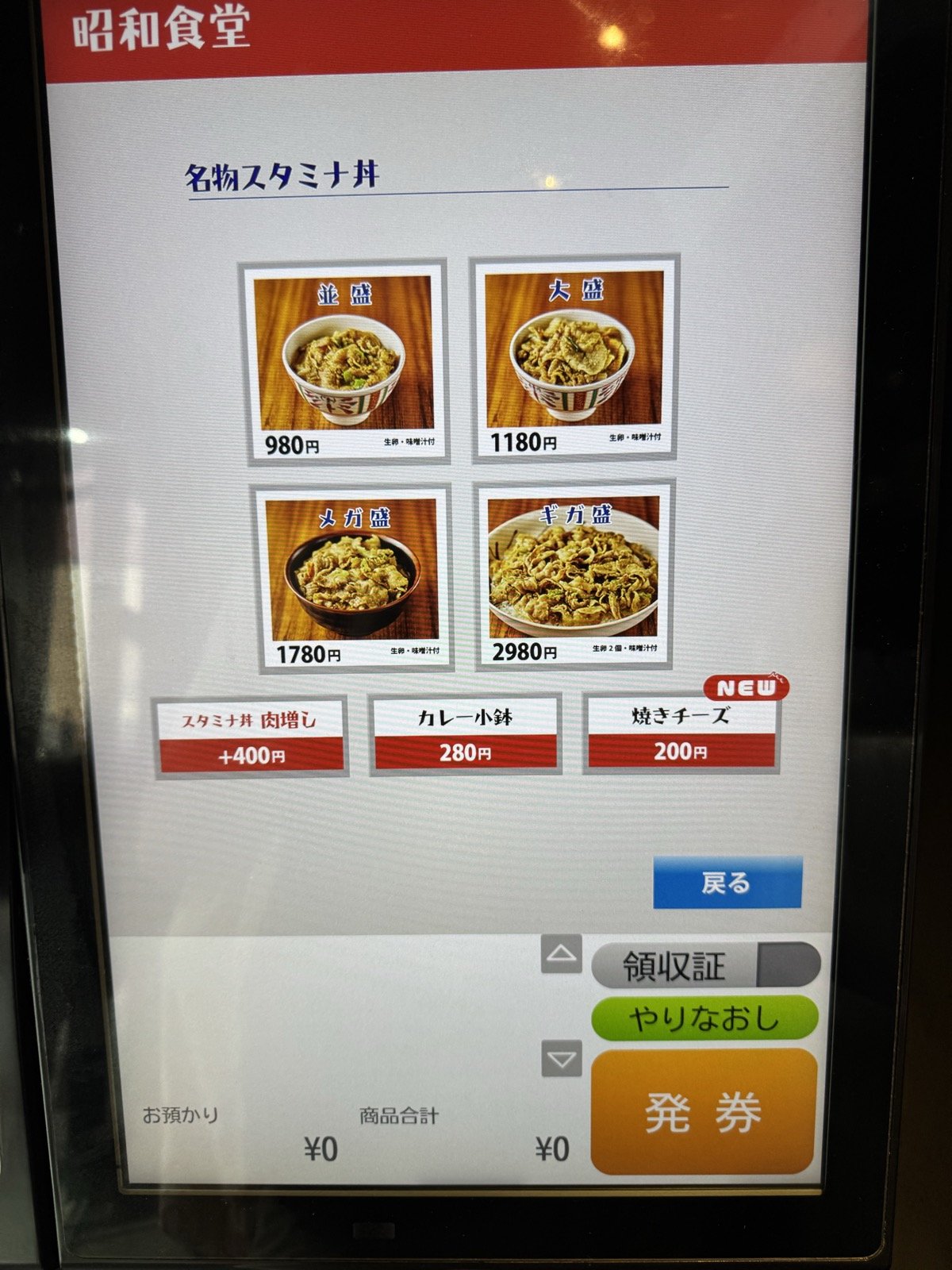
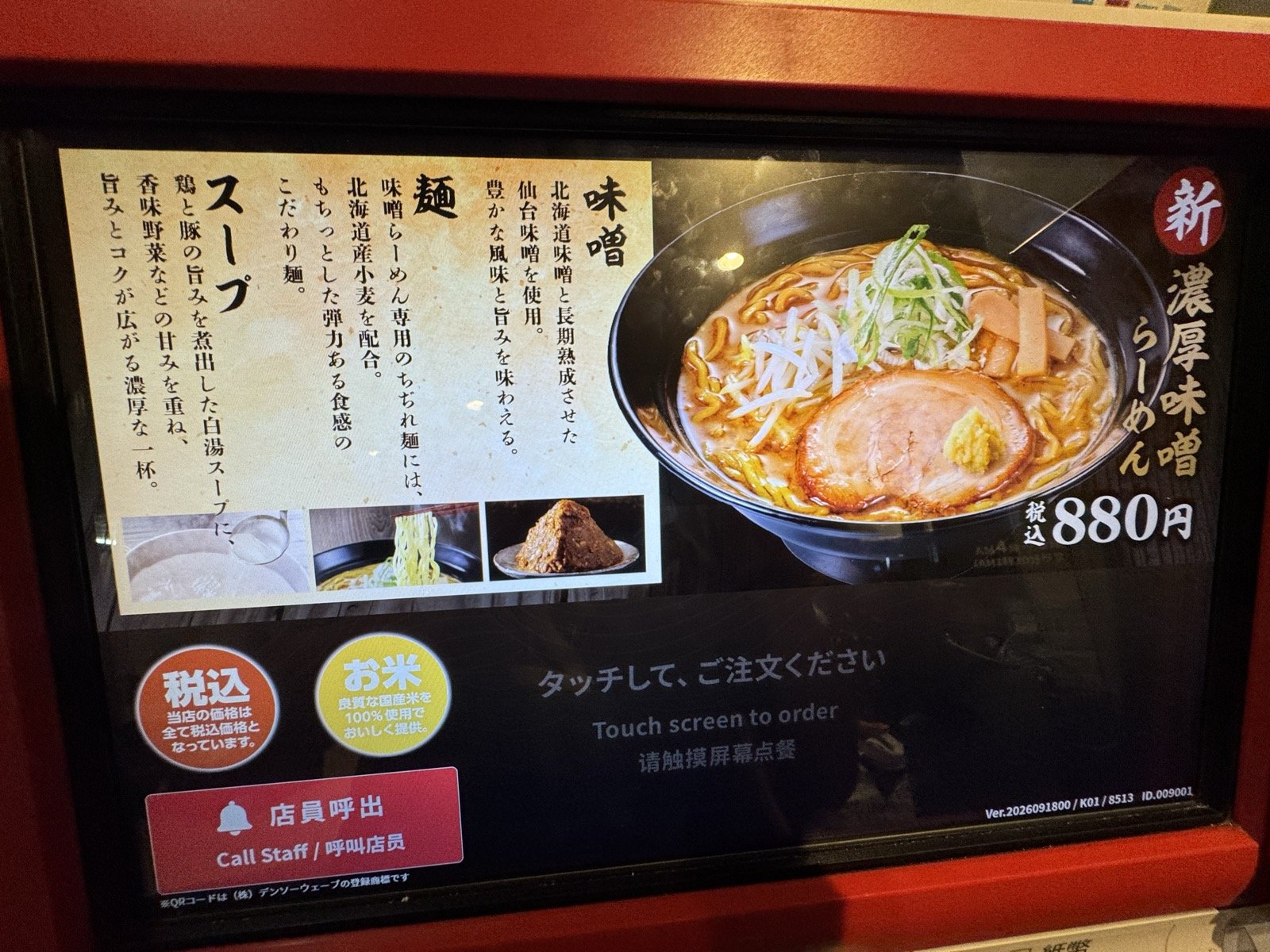
Shōwa Shokudō ticket machine, the Stamina don page with four sizes (Aug 2026)A touch-screen order panel with English and Chinese at a ramen shop near Akihabara (Sep 2026)
Photos: Yuuki (Anime Sensei)
Where can I eat in Akihabara without speaking Japanese?
Shōwa Shokudō. Its ticket machine has ENGLISH, 中文 and 한국어 buttons across the top, and pressing one redraws the whole menu with the same photographs. Most ticket machines in Tokyo are Japanese-only. Details in Is Shōwa Shokudō in Akihabara worth eating at?
IFU's machine also switches to English and Chinese, and it carries an allergen information button, which is rare at this price and the reason I am comfortable sending guests there. Go!Go!Curry is orderable with no Japanese too — the wall menu is numbered and the machine has labels — but the translation there is partial rather than complete.
Of the newer shops, Menya Musashi Iwatora's ticket machine works in English, Chinese (both scripts) and Korean, Yoshinoya's counter tablet switches to English, Chinese and Korean, and Oniyanma's ticket machine has an English mode. Yuzu Labo has bilingual counter cards but its machine is in Japanese.
Where can I get a proper steak lunch in Akihabara?
Juke Steak, a lunch-only basement counter about three minutes from the Central Gate (中央改札口). Aged-beef harami sets run ¥1,100–¥2,300 including rice, salad and soup, and a hamburg set starts at ¥990. Lunch is 11:30–14:30 only; after 14:00 the same room becomes an izakaya under a different name. Full menu and prices in Is Juke Steak in Akihabara worth eating at?
Where can I eat ramen near Akihabara station for under ¥1,000?
IFU, a miso ramen specialist about four minutes out on the Showa-dori side. Nineteen of its twenty-one bowls are under ¥1,100, the cheapest is ¥790, and a large portion of noodles costs nothing extra — you pick it on the screen before you pay. Full price list in Where can you eat ramen for under ¥1,000 by Akihabara station?
It is a chain-style shop rather than a destination ramen-ya, and the honest framing is that it is consistently cheap and consistently open rather than the best bowl in Tokyo. For a shopping district at nine at night, those are the qualities that matter.
Which one is open early or late?
IFU, 05:00–04:00 daily — the only hour it is shut is between four and five in the morning. Yoshinoya is open 05:00–02:00 daily (the official locator; I could not confirm 24 hours). For breakfast, Katsuya and Oniyanma both open at 07:00. Katsuya runs until 23:00 with last order at 22:30, and Oniyanma until 22:30 on weekdays. Shōwa Shokudō is open until 23:00 daily (one directory lists 07:00, others 11:00). Go!Go!Curry runs 09:55–21:55, and Juke Steak is lunch only, 11:30–14:30.
If you are jet-lagged and awake at five, or you have been out until the trains start again, that ordering matters more than the food does. The other newer shops open at 10:00 or 11:00 and close between 20:00 and 22:00; times are in the second table below.
What else is there near the station?
Seven more shops, each with its own write-up: Okinawan taco rice, dry tantanmen, katsudon, tsukemen, standing udon, gyudon and a tart café. They are all photographed the same way as the first four, and the table below puts budget, hours and payment side by side.
Taco rice:Jumbo Tacos serves Okinawan taco rice on the Kanda-Sudachō side, with about four seats plus take-away. Half is ¥800–850 and regular ¥1,200–1,300.
Dry tantanmen:Yuzu Labo is by Exit A1 of Iwamotocho Station. It serves brothless tantanmen with yuzu, you choose the spice and numbing level, and it is cash only.
Katsudon:Katsuya is a tonkatsu and katsudon chain about one minute from JR Akihabara, open from 07:00.
Tarts and coffee:a la campagne is a tart café on the fourth floor of atré Akihabara 1, where you can sit down for cake and a drink.
Tsukemen:Menya Musashi Iwatora serves dipping noodles from ¥1,190, and its ticket machine works in English.
Standing udon:Oniyanma is a standing udon counter at Ochanomizu, about a 15-minute walk away by my estimate. It is cashless only.
Gyudon:Yoshinoya is a beef bowl chain on Chuo-dori, with tablet ordering in English and hours of 05:00–02:00.
Posters list cards, IC, QR; one listing says no cards
In one table
This table covers the first four shops. The seven newer ones are in the table above.
Go!Go!Curry
IFU
Juke Steak
Shōwa Shokudō
Style
Kanazawa curry
Miso ramen specialist
Aged-beef harami steak (lunch only)
Teishoku diner
Budget
¥750–¥1,350
¥790–¥1,130
¥990–¥2,400
¥920–¥1,480
First-timer order
Rosu katsu curry, M, ¥1,050
Extra Rich Miso Ramen, ¥880
150g harami set, garlic soy, ¥1,100
Stamina Don, ¥980
Hours
09:55–21:55 daily
05:00–04:00 daily
11:30–14:30 daily, LO 14:00
07:00 or 11:00–23:00 daily
Nearest exit
Showa-dori exit, ~2 min
Showa-dori side, ~4 min
Central Gate, ~3 min
Electric Town exit, ~3 min
Payment
Cash
Cash, IC
Cash, IC, JCB/AMEX/Diners, QR
Cash
English
Labels on the machine, numbered wall menu
Full menu translation, plus an allergen button
Not seen
Full menu translation on the machine
Vegetarian
No
No
No
No
Seating
Counter only, ~10 seats
Narrow, counter-heavy
Basement, ~160 seats
Counter and tables
Prices photographed
1 Aug 2026
19 Sept 2026
27 Aug 2026
7 Aug 2026
How much should I budget for lunch in Akihabara?
¥1,000–¥1,500 covers a full plate with rice at any of the first four. Under ¥800 is possible four times over: a hot bowl at Oniyanma starts at ¥380, a katsudon at Katsuya at ¥682, a plain small curry at Go!Go!Curry is ¥750, and the cheapest bowl at IFU is ¥790. Over ¥2,000 only happens with a 1-pound steak, one of the giant curry challenges, or the top of the Menya Musashi tsukemen list (¥2,400).
Three of the first four are cash-first, and none of them is confirmed to take a Visa or Mastercard, so carry notes and coins. Yuzu Labo is also cash only. Oniyanma is the reverse: it takes no cash at all, only cards, IC cards and QR apps. Cash or card in Japan covers where that still matters.
Is there a "must eat" in Akihabara?
No — and that is the honest answer rather than a dodge. Akihabara is not a food destination the way Tsukiji or a ramen street is; it is a shopping district where you eat because you are hungry between floors. If you want one dish that belongs to the neighbourhood, it is curry, because the curry shops here have served the same hobbyist crowd for decades and price for it.
The "must eat" question usually comes from lists that copy each other. What I would actually tell a guest is to decide by constraint rather than by fame:
You have thirty minutes between floors. Curry or a standing counter. Fast, cheap, no waiting for a table.
You want to sit down and recover. A steak lunch or a set meal, which buys you an hour off your feet.
You are here at an odd hour. Opening times are the real constraint in Akihabara, not quality — see the tables above for which shops cover early and late.
The eleven shops on this page are the ones I have eaten at enough to photograph the prices. Anything I have not eaten at does not go on the list, which is why this page is short and why I am not going to name a "must" that I would not choose myself.
None of these work for me — what now?
None of the ten meal shops has a vegetarian main I could confirm. The first four are meat-only, and IFU is the clearest case: every bowl, including the vegetable ones, is built on a chicken-and-pork broth. Of the newer shops, no vegetarian dish was seen at Katsuya, Menya Musashi and Yoshinoya are unlikely or not recommended, Jumbo Tacos is probably not, and vegetarian is unconfirmed at Yuzu Labo and Oniyanma. The one option that is not built around meat is a la campagne, a tart café where you can sit down for cake and coffee; vegetarian is still unconfirmed there too, so ask before you order. If that rules them out, this page is not the right list for you, and I would rather say so than pad it with shops I have not eaten at.
If you are on a tour with me, tell me in advance and I will route around it.
Frequently asked questions
Q
Which of the Akihabara shops is the cheapest?
Oniyanma, from ¥380 for a hot bowl of standing udon, then Katsuya from ¥682 for a katsudon. Of the first four, Go!Go!Curry, just — a plain small curry is ¥750, against ¥790 for the cheapest bowl at IFU. For volume, IFU wins, because a large portion of noodles is free.
Q
Which Akihabara restaurant is best for a group?
Juke Steak. It has roughly 160 seats in the basement; the other three of the first four are counter-heavy and fill at lunchtime, and Jumbo Tacos has about four seats.
Q
Do restaurants in Akihabara take credit cards?
Juke Steak takes IC cards and JCB/AMEX/Diners plus major QR codes — I did not see a Visa or Mastercard logo on the sticker. IFU takes cash and transport IC cards. Treat Go!Go!Curry and Shōwa Shokudō as cash, and Yuzu Labo too. Oniyanma takes cards but no cash, and Yoshinoya's posters list cards, IC cards and QR wallets.
Q
How much should I budget for lunch in Akihabara?
¥1,000–¥1,500 covers a full plate with rice at any of the first four. Under ¥800 is possible at Oniyanma (from ¥380), Katsuya (from ¥682), Go!Go!Curry (¥750) and IFU (¥790).
Q
Can we eat at these on an Akihabara tour?
YESBefore or after the tour — the first four are a few minutes from the meeting point. If you want a meal break during the walk, ask when you book.
Q
Where do I eat late at night in Akihabara?
IFU, which runs until four in the morning. Yoshinoya is next, open until 02:00. After that, Shōwa Shokudō and Katsuya both run until 23:00; one directory lists it from 07:00 and others from 11:00, so check the door. Akihabara's shops close in the evening and the arcades run later; see Things to Do in Akihabara.
Sources and honesty note
Every number on this page is taken from the eleven articles linked above, and each of those transcribes a photo I took inside the shop on the date it states. The first four were photographed on 1 Aug, 7 Aug, 27 Aug and 19 Sept 2026. The seven newer ones were visited between September and November 2026: Jumbo Tacos on 2 Sept, Yuzu Labo on 2 Oct, Katsuya on 11 Oct, a la campagne on 21 Oct, Menya Musashi Iwatora on 29 Oct, Oniyanma on 31 Oct and Yoshinoya on 3 Nov. Some opening hours and addresses in those seven come from the shop's official page or a listing site rather than a photo, and the individual articles say which. Nothing here is a new claim: no shop appears on this page that I have not eaten at and photographed. I have deliberately not listed the other ramen shops beyond those linked above, maid cafés or chain restaurants around the station, because I have not documented their prices the same way and I would only be repeating other people's blogs.
Where the underlying articles flagged something as unconfirmed — whether Juke Steak accepts Visa or Mastercard, whether IFU accepts credit cards, whether Go!Go!Curry's branch has gone cashless since its listing was updated, and the unconfirmed payment, English-menu and vegetarian points at the seven newer shops — it stays flagged here rather than resolved.
No affiliate links. I eat at these because they are near where I work.
About the author. I am Yuuki, an anime tour guide based in Akihabara. I run private anime tours in English most weeks, and I have watched over 1,500 anime series, which is either a qualification or a warning depending on your point of view.
A private half-day in Akihabara with a local otaku guide. Three to four hours in English, never mixed with other travelers, rated 4.96 by 171 Airbnb guests. Booking here goes straight into my calendar.