Tax-Free Shopping in Japan After November 2026: Pay Full Price, Get It Back at the Airport
From purchases made on 1 November 2026, Japanese tax-free shops stop taking the consumption tax off at the till. You pay the full tax-inclusive price, show your purchases at a customs kiosk at the airport before you check in your bags, and the tax is refunded to you afterwards by the shop or its refund agent. The minimum spend stays the same: 5,000 yen before tax, in one shop, on one day.
That is the whole change in one paragraph. The details below are what decide whether you actually get the money back — and the one that catches people is the order of things at the airport.
What changes on 1 November 2026?
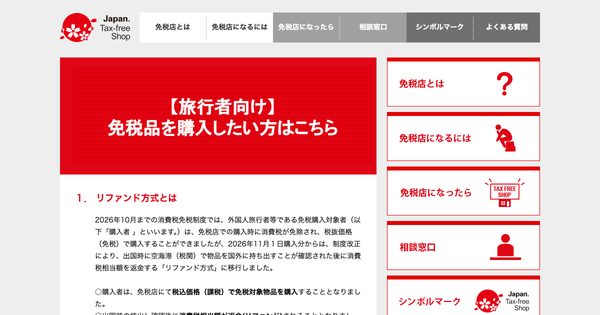
The point where the tax disappears moves from the shop to the airport. Until the end of October 2026, a tax-free shop sells you the item at the pre-tax price. From 1 November, the shop charges tax as normal, and you get it back only after customs has confirmed at departure that the goods are leaving Japan. The Japan Tourism Agency calls this the "refund method."
The reason is simple enough: under the old system, goods bought tax-free were sometimes resold inside Japan and never left. Charging the tax first and refunding it after the export check closes that gap. For an honest visitor, the practical result is an extra step at the airport and a wait for the money.
Until 31 October 2026
From 1 November 2026
Price you pay in the shop
Tax removed at the till
Full price, tax included
When you get the tax back
Immediately
After the customs check at departure
Minimum spend
5,000 yen (before tax), same shop, same day
Same — no change
Split between general goods and consumables
Yes
Abolished
500,000 yen cap on consumables and sealed bags
Yes
Abolished
Limit on quantity
—
What you can personally carry out of Japan
Deadline
—
Leave Japan within 90 days of purchase
On my Akihabara anime tour I now tell guests to keep every receipt in one envelope as they shop, since under this new order of operations a lost slip costs you the refund itself, not just a few minutes at the till.
What do you have to do at the airport?
Before you check in any luggage, go to a tax-free kiosk in the international departures area and scan your passport. The screen then shows green (done, no inspection) or red (take your purchases to the customs inspection point). You need every item from that receipt with you, so the purchases must still be in your hand or in the suitcase you have not yet checked in.
This order matters more than anything else in this article. The official guidance is explicit on three points:
You cannot do the check after checking your bag. Once a suitcase is handed to the airline, it cannot be pulled back for a customs inspection. If the kiosk shows red and your purchases are already in the hold, the refund is gone.
Arrive early. The kiosk itself takes seconds, but a red result means an inspection, and it all has to be finished before check-in. Missing a flight because of the tax check is, in the agency's words, not compensated by the airline or customs.
Do it at your last airport in Japan. If you fly domestically to connect to an international flight, the check happens at the airport you actually leave Japan from.
At the seven busiest airports — Narita, Haneda, Kansai, Chubu, Fukuoka, New Chitose and Naha — you can also complete the step online through Visit Japan Web, while connected to the dedicated Wi-Fi in the departures area before security.
When and how do you get the money back?
After customs confirms the export, the shop or the refund company it works with pays you. The method is chosen by the shop, not by the government: bank transfer, credit card, an app, or cash at the airport are all listed as possibilities. The shop explains how its refund works when you buy, so that is the moment to ask.
This is the part that varies most, and it is why no single "you get X back in Y days" figure exists. Two shops on the same street can use different refund agents with different methods. If you are making one large purchase — a figure, a camera, a set of knives — ask at the counter how and when the refund arrives before you pay. The staff at tax-free counters deal with this question all day.
Not if you want the refund on it. The sealed bags for food, drinks and cosmetics are abolished, but that does not mean you can open them: if you eat or use consumables in Japan, you cannot get the tax back on them. And the check works per receipt — if even one item from a receipt is missing, the refund for everything on that receipt is lost.
That second rule changes how you should shop. If you plan to eat some of the snacks you are buying and take the rest home, pay for them separately, so the ones you eat do not cost you the refund on the ones you keep. If you have already used something, the official instruction is not to use the kiosk for that receipt but to tell a customs officer at the counter.
Taking goods through the check and then not exporting them is treated as a tax offence: the tax is collected and penalties apply.
What counts as tax-free, and what does not?
Almost anything for personal use that you take out of Japan, as long as you spend at least 5,000 yen before tax in one shop on one day. The exceptions are gold and platinum bullion and coins, and items that are exempt from consumption tax anyway. Quantity is limited to what you can carry out yourself.
The "what you can carry" limit replaces the old separate caps. In practice it means that buying twenty of the same figure is the kind of purchase a shop may question, because it no longer looks like personal luggage. For single items priced at 1,000,000 yen or more before tax, the shop records the serial number, and customs may ask to see a certificate or warranty — keep them with the item.
Ask the shop. Whether a store will ship tax-free goods abroad is up to each store. What you can no longer do is buy tax-free and post the goods home yourself — that route was abolished on 31 March 2025.
This matters for bulky purchases. If a shop offers overseas shipping, the export happens through the shop and the tax-free procedure at the airport does not apply. If it does not, you are carrying the item out yourself. For moving a suitcase between hotels before the flight, luggage forwarding in Japan is the tool — but remember that anything you need to show at the tax-free kiosk has to be with you at the airport, not travelling separately.
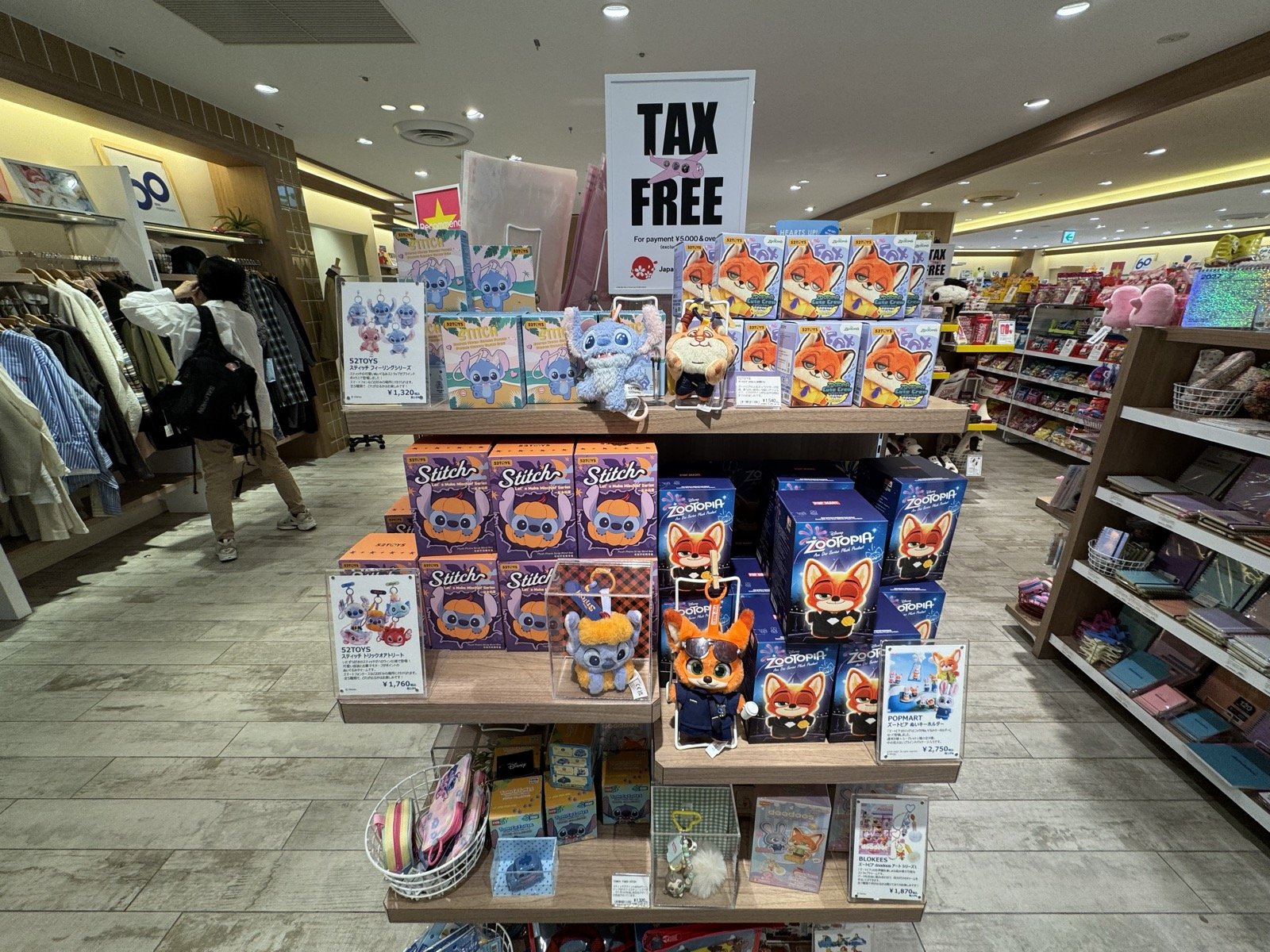
A TAX FREE sign for purchases of ¥5,000 and over, above a toy display in a Tokyo store (Oct 2026)
Common mistakes to avoid
Checking the suitcase first, opening a consumable that shares a receipt with things you want refunded, and arriving at the airport with no spare time. All three lose the refund, and none can be fixed afterwards.
Mistake
What happens
What to do instead
Checking in the suitcase before the kiosk
No inspection possible, no refund
Kiosk first, check-in second
Eating one snack from a shared receipt
Whole receipt loses the refund
Buy the things you will eat separately
Arriving late
No time for a red-result inspection
Allow extra time at the airport
Doing the check at a domestic transfer airport
Not your exit point
Check at the airport you leave Japan from
Waiting past 90 days
Outside the refund window
Leave within 90 days of purchase
Frequently asked questions
Q
Is tax-free shopping in Japan ending?
NOTax-free shopping is not ending; it is changing shape. From 1 November 2026 the shop charges you the full price, and the tax comes back after customs confirms at the airport that you are taking the goods out of Japan. The 5,000 yen minimum per shop per day stays, and the sealed consumables bag and the 500,000 yen cap go away.
Q
Is anything different if I shop before 1 November 2026?
YESPurchases made up to 31 October 2026 follow the old system: tax is removed at the till. The new process applies to purchases from 1 November.
Q
Do I still need my passport in the shop?
YESYou show your passport when you buy, as before. The shop records the purchase and sends it electronically; there is no paper slip stapled into the passport.
Q
Can I combine purchases from different shops to reach 5,000 yen?
NOThe minimum is per shop, per day.
Q
Does the kiosk take long?
The official figure is a few seconds from scanning the passport to the result. The time you need to allow is for a possible inspection, not the kiosk itself.
Q
I am a Japanese citizen living abroad. Can I shop tax-free?
If you have lived outside Japan for two years or more, yes, with proof. From November a My Number card showing that you moved abroad is accepted alongside the existing documents, and the permanent domicile no longer needs to be shown.
Q
I am spending a day in Akihabara before flying home. Should I shop that day?
It works well, as long as the purchases go in your hand luggage or the case you check in only after the kiosk. Things to do in Akihabara and what to pack for Japan cover the rest of the day.
Q
Do tax-free items still come in a sealed bag?
NOFrom 1 November 2026 the sealed bags for food, drinks and cosmetics are abolished, together with the 500,000 yen cap on consumables. That does not mean you can open them: if you eat or use consumables in Japan you cannot get the tax back on them, and the check at the airport kiosk works per receipt.
Q
Is there a spending limit?
There is a minimum, not a maximum: 5,000 yen before tax in one shop on one day. The old 500,000 yen cap on consumables is gone, and quantity is limited to what you can personally carry out of Japan. For a single item priced at 1,000,000 yen or more before tax, the shop records the serial number.
Q
Do you need a QR code?
Not for the kiosk itself. The kiosk reads your passport — the shop has already sent the purchase record electronically, so there is no paper slip to present. At the seven airports with Visit Japan Web (Narita, Haneda, Kansai, Chubu, Fukuoka, New Chitose and Naha) you can complete the step through that service instead, over the dedicated Wi-Fi in the departures area before security.
The one rule to remember
Kiosk first, check-in second. Everything else — the method, the timing of the refund — the shop tells you when you buy.
About the author. I am Yuuki, a Japanese teacher and Akihabara anime tour guide based in Tokyo. I run private anime tours in Akihabara, rated 4.96★ on Airbnb across 171 reviews, and the question of how tax-free works comes up at almost every figure shop we walk into. I also teach Japanese one-on-one online as an italki Top 1% teacher, 5.0★ across 358 reviews.
A private half-day with a local otaku guide, planned around your fandom. Three to four hours in English, never mixed with other travelers, rated 4.96 by 171 Airbnb guests. Booking here goes straight into my calendar.