Yare yare meaning: what does this anime phrase mean?やれやれ しかたがない うるさい アニメの8フレーズの使いどころ
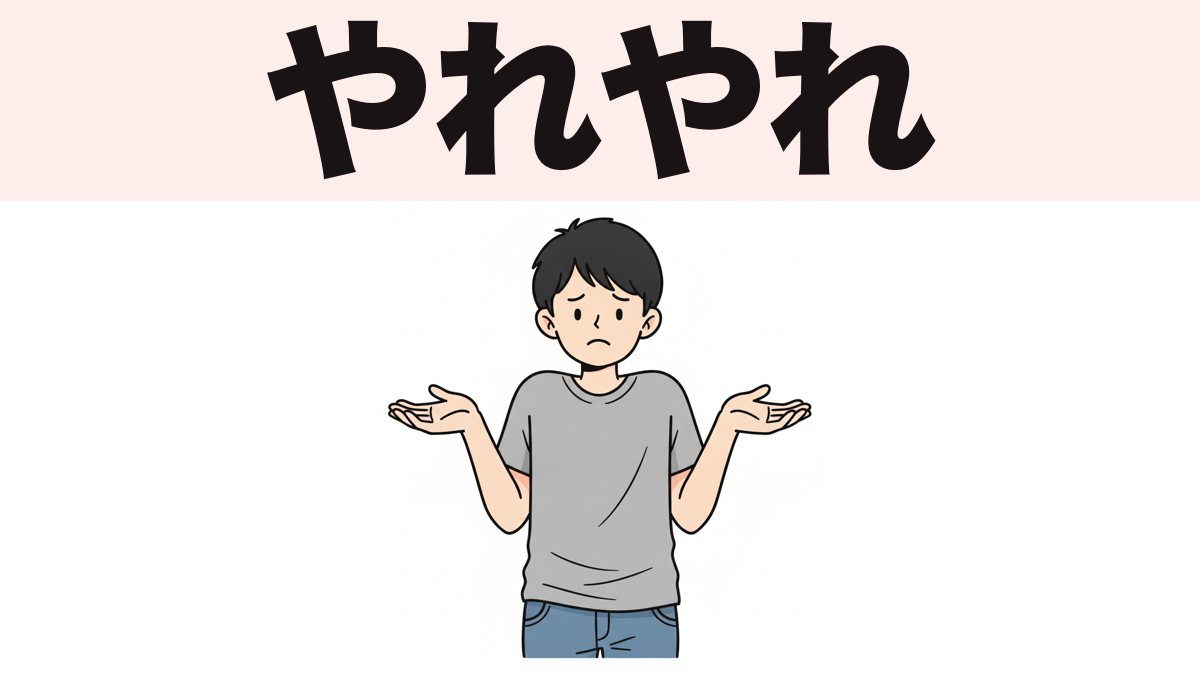
Yare yare (やれやれ) expresses a sigh of relief, tiredness, or exasperation: English translations include “phew” and “good grief.” It is real Japanese, but copying an anime delivery can make you sound theatrical or dismissive. Learn the situation and tone behind it, along with seven related anime phrases, before using them in conversation.
これらのことばは、もう知っているはずです。問題は、使えるかどうかです。
The basics
What does やれやれ actually mean?
やれやれ is an interjection: a short expression that conveys a reaction rather than naming an action or object. Its pronunciation is ya-re ya-re, with four short beats. The Japanese r is a brief tongue tap; you do not need to imitate a voice actor to make the word recognizable.
The important distinction is between releasing tension and expressing frustration. A dictionary translation such as “good grief” fits an annoying setback. It fits less well when you have finally completed a difficult task. Cambridge Dictionary lists relief, tiredness, and being troubled among the situations associated with the expression; see the reference in Sources.
Here are two original examples with different emotional directions:
やれやれ、やっと終わった。 — Phew, it is finally over.
Imagine closing your laptop after finishing a long assignment. The sigh comes from the effort you have just completed. You are not necessarily criticizing anyone.
やれやれ、また忘れたの? — Good grief, did you forget again?
Here the speaker reacts to another person's repeated mistake. Even without a swear word, the line can imply impatience or superiority. It may work as affectionate teasing between close friends, but a learner should not assume that the listener will hear it that way.
For a relieved reaction that does not carry the same weary flavor, consider:
よかった、間に合った。 — Thank goodness, I made it in time.
よかった communicates that the outcome is welcome. やれやれ draws more attention to the release of tension or the speaker's weary reaction. Choose according to what you want the other person to understand.
Eight phrases at a glance
These translations are starting points, not interchangeable scripts. The same words can perform different jobs depending on the preceding question, your relationship, and your delivery.
| Expression | Basic meaning | A useful context | What to watch |
|---|---|---|---|
| やれやれ (yare yare) | Phew; good grief | Reacting to a tiring task or setback | Directed at someone, it can sound dismissive |
| しかたがない / しょうがない | It cannot be helped | Accepting something you cannot change | It can dismiss a problem that still deserves attention |
| うるさい | Noisy; be quiet | Describing distracting sound | A direct exclamation can mean “shut up” |
| べつに | Not particularly | Giving a negative answer about a preference | A bare reply can seem cold |
| まさか | No way; surely not | Expressing disbelief | It may sound as if you doubt the speaker |
| だいじょうぶ / 大丈夫 | Okay; all right | Checking a condition or responding to an offer | A reply can be ambiguous |
| ちがう / 違う | Differ; be wrong | Correcting an interpretation | A bare correction can sound abrupt |
| がんばって / 頑張って | Good luck; do your best | Encouraging someone before an effort | More encouragement may feel like more pressure |
Hiragana and kanji spellings in this table represent the same expressions, not different levels of politeness. For example, writing 大丈夫 instead of だいじょうぶ does not make an utterance formal. Sentence endings and the situation do that work.
Beyond the basics
しかたがない and しょうがない: accepting a limit
しかたがない means that there is no workable way to change something, or that it cannot be helped. しょうがない is a colloquial form. Both can express practical acceptance, but neither automatically shows sympathy. If a friend is upset about a problem, acknowledge their feelings before concluding that nothing can be done.
雨だから、しょうがないね。 — It is raining, so it cannot be helped.
This could follow the cancellation of an outdoor picnic. The final ね invites shared understanding. It does not magically make the response considerate: saying it immediately after someone shares serious disappointment can still sound dismissive.
A more polite form is しかたがありません, though a polite ending does not remove that possible implication. For more examples of acceptance and resignation, read shikata ga nai and shouganai.
うるさい: a description can become a command
うるさい is an adjective meaning noisy or annoyingly loud. It can also describe bothersome behavior or someone being fussy about something. For a first useful distinction, compare a comment about sound with an exclamation aimed directly at a person.
外がうるさいですね。 — It is noisy outside, isn't it?
This describes the surroundings. It may be a shared observation about construction noise rather than a request for anyone present to change their behavior.
うるさい! — Shut up!
The second translation reflects its use as an angry direct response. Among friends it can sometimes be playful, but familiarity alone does not guarantee that a sharp delivery will be welcome. When you actually need quiet, ask for it explicitly:
すみません、もう少し静かにしてもらえますか。 — Excuse me, could you be a little quieter?
This gives the listener a clear action to take. It is more useful than assuming that adding です to an accusation will turn it into a tactful request.
べつに: listen for the omitted sentence
べつに, often written 別に, commonly appears with a negative expression to mean “not particularly.” As a short answer, the negative part may be left understood. Anime can exaggerate the resulting emotional distance, but the word itself is not inherently hostile.
別に嫌いじゃないよ。 — It is not that I dislike it.
The speaker denies disliking something without necessarily saying that they love it. The final よ presents the information to the listener; it is not a universal softener. Tone still matters.
A full sentence is not automatically neutral either. Replying “I do not particularly like it” to a handmade gift could hurt someone's feelings, however complete the grammar is. Ask what your answer does socially, not just whether it has a verb.
まさか: disbelief, not a general word for “no”
まさか expresses that something seems unexpected or hard to believe. Alone it can correspond to “No way!” Within a sentence it can frame a surprising possibility. It is not the usual response for declining a drink or refusing permission.
まさか、今日が試験なの? — Wait, is the exam today?
The surprise comes from the speaker's expectation being challenged. In a playful conversation, the expression may sound lively. If someone is reporting a painful experience, an immediate まさか could instead sound like disbelief in their account. A calmer request for clarification may fit better.
大丈夫: okay in which sense?
大丈夫 can describe being unhurt, feeling well, having no problem with a plan, or not needing help. The listener interprets the meaning from the situation. With rising intonation, the casual question 大丈夫? asks whether someone or something is okay.
大丈夫?けがはない? — Are you okay? Are you hurt?
はい、大丈夫です。けがはありません。 — Yes, I am okay. I am not hurt.
When someone offers an extra item, 大丈夫です can also mean “I am fine without it.” However, because the same phrase can express acceptance in other situations, add the relevant detail when misunderstanding would be inconvenient.
袋は大丈夫です。このバッグに入れます。 — I do not need a bag. I will put it in this bag.
Here the second sentence makes the refusal clear. Learn 大丈夫 as a flexible expression whose meaning depends on context, rather than memorizing “no thanks” as its one correct translation.
違う: correct the information clearly
違う means “to differ” or “to be different,” and it can reject an incorrect interpretation. A quick 違う! in an anime scene may be a defensive outburst. In ordinary conversation, explaining the difference often helps more than simply negating the previous statement.
少し違います。予約は明日です。 — That is a little different. The reservation is for tomorrow.
違います uses a polite verb ending, but it can still be direct. 少し is appropriate when the difference is genuinely limited; do not mechanically minimize a major error. With a straightforward factual mix-up, you can also give the correct information without an opening judgment about the other person's answer.
頑張って: encouragement with attention to the listener
頑張って is the te-form of 頑張る used as encouragement. Depending on the situation, “good luck,” “do your best,” or “keep going” may fit. 頑張ってください is a more polite request form, but politeness does not determine whether someone wants encouragement to make more effort.
明日の試験、頑張ってね。 — Good luck with your exam tomorrow.
This fits a friend preparing for a challenge. If that friend says they are exhausted after weeks of preparation, a different response may be more helpful:
今日は無理しないでね。 — Do not push yourself today.
Neither phrase is universally right or wrong. Listen to what the person has just told you. For a closer look at encouragement, see what ganbatte means in Japanese.
Common mistakes
Treating every subtitle as a reusable translation
“Whatever,” “no way,” and “it is fine” each cover several conversational functions in English. Japanese does not divide those functions in exactly the same way. Before saving an anime line, write down what happened immediately before it. Was the speaker refusing an offer, correcting a fact, expressing relief, or reacting with disbelief?
For やれやれ specifically, record whether a problem has ended or has just happened again. That distinction helps you choose between “phew” and “good grief.” Memorizing only the annoyed translation leaves you unable to explain the relieved use.
Assuming anime delivery is ordinary delivery
Long pauses, a low voice, and exaggerated emphasis can turn a short expression into a character performance. You can enjoy that performance while practicing a quieter version for everyday interaction. There is no need to imitate a character's age, gender presentation, or attitude to pronounce the word correctly.
For a wider explanation of how fictional dialogue differs from everyday interaction, read why anime Japanese can sound rude. The goal is to understand the social effect of a line, not to label all anime language unsuitable.
Adding です to everything
These expressions belong to different grammatical categories. 違う becomes 違います. 大丈夫 can be followed by です. やれやれ is an interjection and does not acquire a normal polite form by becoming やれやれです. If a weary sigh would be inappropriate, change what you say rather than attaching a polite ending.
Calling phrases universally safe or universally rude
A comment about the weather can dismiss someone's disappointment. A direct question about a person can express care. The important questions are what you are doing with the words, who is listening, and what response the situation needs. An explicit request, explanation, or acknowledgment is often easier to interpret than a short dramatic reaction.
Practice
Choose an expression or explain the tone. The suggested answers describe the stated situation; other answers may work if you change the context.
1. You finish a tiring assignment and say やれやれ、やっと終わった。 Does “phew” or “good grief” better capture the reaction?
Show answer
“Phew” better captures relief after completing the work. The phrase can still carry a sense of tiredness.
2. A new coworker forgets something. Why might やれやれ、また忘れたの? be an unhelpful response?
Show answer
It draws attention to a repeated mistake with a weary reaction and can sound condescending. Explain what is missing or ask how you can resolve the problem.
3. Rain cancels your picnic, and your friend has already agreed to stay indoors. Complete the casual response: 雨だから、__ね。
Show answer
しょうがない or しかたがない fits acceptance of the situation. This answer assumes you are sharing acceptance, rather than dismissing a friend's disappointment.
4. You need someone nearby to lower their voice. Which is the clearer polite request: うるさい! or すみません、もう少し静かにしてもらえますか。
Show answer
The second option asks for a specific change politely. The first can sound like “shut up” when directed at a person.
5. Does 別に嫌いじゃないよ necessarily mean that the speaker loves something?
Show answer
No. It denies disliking it. A stronger positive feeling would need more context or a clearer positive statement.
6. An exam is unexpectedly scheduled for today. Choose まさか or しょうがない to introduce your surprised question.
Show answer
まさか fits disbelief or surprise. しょうがない would express acceptance that something cannot be helped, which is a different reaction.
7. A shop assistant offers a bag. You say 大丈夫です, but they look unsure. Add a short sentence that makes your intended refusal clear.
Show answer
このバッグに入れます。 explains that you will put the purchase in your own bag. Naming what you will do helps clarify that you do not need another bag.
8. Change 違う to its polite form, then give the correct reservation day using 明日.
Show answer
違います。予約は明日です。 This is grammatically polite but direct. Depending on the relationship, simply explaining that the reservation is tomorrow may be enough.
9. A friend says they are exhausted from studying. Which better responds to that information: 頑張ってね or 無理しないでね?
Show answer
無理しないでね responds to their exhaustion by telling them not to push themselves. 頑張ってね can be encouraging before a challenge, but here it might feel like pressure to continue.
To rehearse these choices in conversation, bring a favorite anime line to Japanese speaking practice and explain the scene: Book a trial lesson · $13.
FAQ
Does it always mean “good grief”? No. “Good grief” suits exasperation, while “phew” suits relief after a difficult task or worry. Translate the speaker's reaction to the situation rather than assigning the expression one fixed English equivalent.
Is it automatically an insult? No, especially when it is a reaction to your own effort. Directed at another person's mistake, however, it can communicate impatience or a dismissive attitude. A new acquaintance has less shared context for interpreting it as friendly teasing.
Is it restricted to men? There is no grammatical restriction based on gender. A particular character's delivery may create a masculine, older, or theatrical impression, but that does not establish a rule about who may use the expression. Choose language that suits your own intention and the relationship.
Can it be ambiguous when answering an offer? Yes. It can mean that something is acceptable or that you are fine without something. If the listener hesitates, specify whether you want the offered item or explain that you already have what you need. The offer and surrounding conversation determine the interpretation.
Should I copy the entire performance? Start by identifying the expression's function and the relationship between the speakers. Then make your own example in a familiar situation and practice saying it without exaggerated acting. A teacher or conversation partner can help you check whether the intended emotion is coming across.
Vocabulary from this article
Every expression below appears earlier in the article. The table gives quick reading support; the plain text underneath contains the same entries separated by tabs for copying into a flashcard tool.
| Japanese | Reading | Meaning in this article |
|---|---|---|
| やれやれ | やれやれ | Phew; good grief |
| しかたがない | しかたがない | It cannot be helped |
| しょうがない | しょうがない | Colloquial form of しかたがない |
| うるさい | うるさい | Noisy; shut up when used as a sharp command |
| 別に | べつに | Not particularly, with a negative expression |
| まさか | まさか | No way; surely not |
| 大丈夫 | だいじょうぶ | Okay; all right |
| 違う | ちがう | To differ; to be wrong |
| 頑張って | がんばって | Good luck; do your best |
| 無理しないで | むりしないで | Do not push yourself |
| 試験 | しけん | Exam |
| 予約 | よやく | Reservation |
やれやれ	やれやれ	Phew; good grief
しかたがない	しかたがない	It cannot be helped
しょうがない	しょうがない	Colloquial form of しかたがない
うるさい	うるさい	Noisy; shut up as a sharp command
別に	べつに	Not particularly, with a negative expression
まさか	まさか	No way; surely not
大丈夫	だいじょうぶ	Okay; all right
違う	ちがう	To differ; to be wrong
頑張って	がんばって	Good luck; do your best
無理しないで	むりしないで	Do not push yourself
試験	しけん	Exam
予約	よやく	Reservation
Sources
- Cambridge Dictionary: やれやれ — Japanese–English entry describing its use for relief, tiredness, and troubled reactions.
- Digital Daijisen via Kotobank: やれやれ — Japanese dictionary reference for the interjection, including relief and disappointment.
- Digital Daijisen via Kotobank: 別に — Dictionary reference for the adverb and its use with a negative expression.
The example sentences and exercises are original teaching examples, not quotations from anime. Advice about delivery describes possible conversational effects, not a claim that every speaker will react identically.
ここにあることばは、どれも本物の日本語です。でも、字幕が見せてくれないものがあります。それは「温度」です。だれが、だれに向かって言うのか、そして、それを言うとどんな代償があるのか。ここでは、その部分を説明します。
1. やれやれ
Good grief. / Here we go again.
形になったため息です。相手のばかげたことに対する、うんざりした気持ちを表します。実際によく使われることばで、たいてい男性が、たいてい中年くらいの人が、たいてい自分に向かって言います。
使っても安全 ですが、1つだけ注意があります。相手に向かって言うと、上から目線に聞こえます。だからこそ、あるサングラスをかけたキャラクターは、これを相手に向かって声に出して言うのです。
2. しかたがない/しょうがない
It can't be helped.
このリストの中で、いちばん文化的な重みがあることばで、そしていちばん使えることばでもあります。だれにも直せない問題に、区切りをつけることばです。電車が止まった、天気が悪い、自分より上の人が決めたこと、そういう場面です。
とても安全で、とても自然です。 しょうがないは話しことばでよく使われるほうで、しかたがないより10倍くらい耳にします。
3. うるさい
Noisy. / Shut up.
もともとは「音が大きい」という意味の形容詞です。人に向かってさけべば「うるさい!!黙れ」になります。カフェについて言えば、ただの説明になります。
もの・場所に対しては安全です。人に対しては注意してください。 使うのは友だちだけにして、しかも、英語で「もう、うるさいなあ」と、あたたかい気持ちで言うのと同じ場面だけにしましょう。
4. べつに
Not particularly. / Whatever.
これだけで言われると、話に乗らない、という意味になります。どこかクールなキャラクターがよく使う、肩をすくめるようなことばです。
本物で、よく使われることばですが、どういう効果があるかは知っておいてください。まじめな質問に「べつに」とだけ答えると、少し冷たく聞こえます。文の一部として使うなら(べつに 好きじゃない ― I don't especially like it)、完全に中立です。
5. まさか
No way. / You can't be serious.
本当におどろいたときのことばです。1語だけの感嘆詞としても、「まさか」で文を始めて「まさかそんなはずは」という意味でも使えます。
まったく安全です。 日本語の中でも、ドラマチックなことばとして、いちばん使いやすいものの1つです。
6. だいじょうぶ
It's fine. / Are you okay? / No thanks.
アニメでは「大丈夫?」「あなた、平気?」という意味でよく出てきます。でも、日常生活では、ていねいな断り方 として使われることのほうがずっと多いです。お店で袋はいりますかと聞かれたとき、「大丈夫です」は「いりません」という意味になります。
安全で、ここに出てくることばの中でいちばん役に立ちます。 1つだけ覚えるなら、これにしてください。
7. ちがう
That's wrong. / No, not like that.
さっき言われたことを、はっきり否定します。友だちの間なら問題ありませんが、それ以外の人には、きつく聞こえます。
ほとんどの場面では、やわらげてください。 ちょっと ちがいます、または、ちがいます だけでも、きつさを出さずに同じ役目を果たします。知らない人に、そのまま ちがう と言うのは、ちょっとした平手打ちのようなものです。
8. がんばって
Do your best. / Good luck. / You've got this.
英語にきれいに当てはまることばがなく、だから翻訳者はいろいろな訳し方を試すことになります。試験、試合、大変な会話など、何かをがんばる前に言います。
安全で、あたたかいことばです。 1つだけ注意点があります。すでに疲れきってがんばっている人に言うと、「もっとがんばれ」と聞こえてしまうことがあります。そういうときは、無理しないで、のほうがやさしく聞こえます。その違いが分かる人は、本当に相手の話を聞いている人です。
まとめ
安全なことばと、そうでないことばを見比べてみてください。安全なことばは、状況について言うものが多いです。危ういことばは、人に向かって言うものが多いです。
これは、この8つ以外にも当てはまる、信頼できるルールです。日本語は、状況についてコメントする自由をたくさんくれますが、目の前の人に直接コメントする自由はあまりくれません。アニメのキャラクターは、このルールをしょっちゅう破ります。ドラマには、それを破る人が必要だからです。
レッスンでは
集めてきたセリフを持ってきてください。それぞれの「温度」を教えます。だれに言えることばか、そして、それを言うと場の空気がどう変わるか。
10分くらいで分かります。アニメで受け身のまま覚えたことばを、実際に使える日本語に変える、いちばん早い方法です。
More drills like the ones above, plus a timed JLPT-style mock test: Practice · N4上のような練習問題と、時間つきのJLPT形式のもぎ試験: 練習ページ · N4
Want to try this in a real conversation?
本当の会話で、ためしてみませんか?
30-minute trial lesson, $13. Times shown in your own timezone.
30分の体験レッスン、$13。時間はあなたのタイムゾーンで表示されます。
Book a trial lesson · $13