What language apps cannot teach you about Japanese語学アプリが教えてくれない日本語の部分
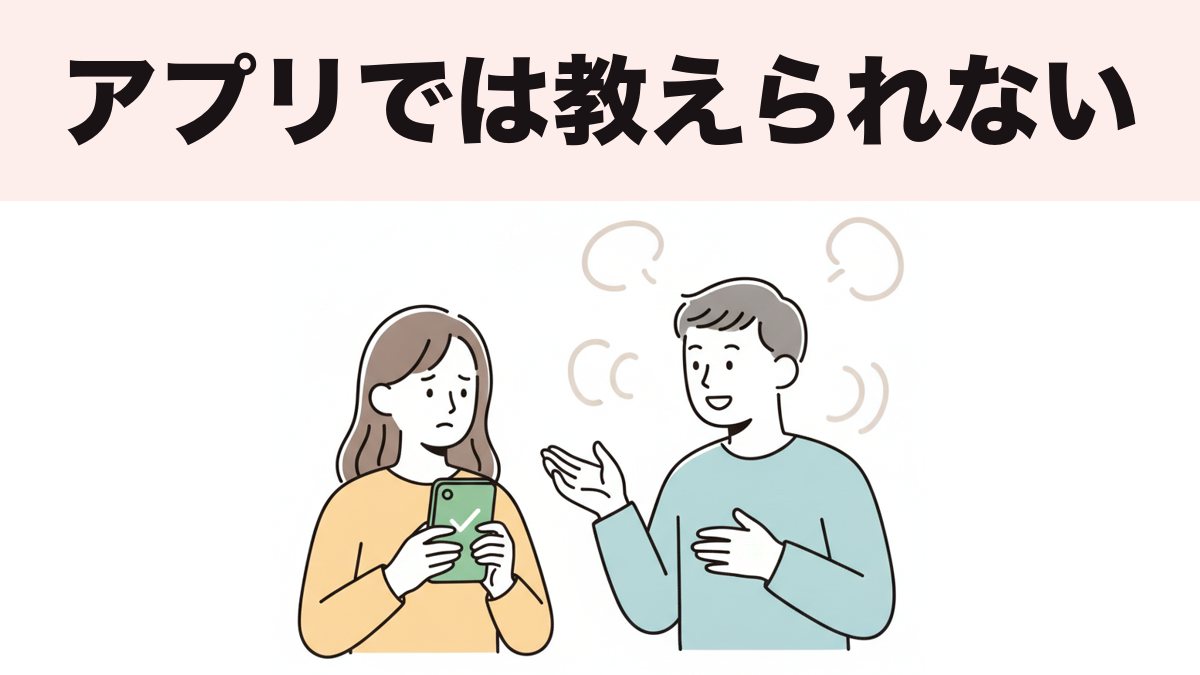
Japanese learning apps can support vocabulary, grammar, and a study routine, but completing exercises does not automatically prepare you for an unscripted conversation. To use what you know, practice finding your own words, choosing speech that fits the relationship, and checking what another person understood. Keep useful app practice and add opportunities to do those things with a listener.
アプリが本当に得意なことは1つだけです。毎日続けさせること。
The basics
What does an app score actually show?
A correct answer shows that you completed a particular task. Choosing the meaning of a word, arranging a sentence, and answering a personal question without hints are different tasks. You may do well at the first two and still need practice with the third. That does not erase the knowledge you have built.
The title of this article describes a limit of relying on apps alone, especially fixed exercises. It is not a claim that every app lacks speaking, explanations, or feedback. Evaluate the activity you actually do: does it give you the answer pieces, or does it ask you to decide what to say? Does the next turn depend on your meaning?
Consider the adjective 忙しい, meaning busy. Recognizing it on a screen is useful. In conversation, you also need to connect it to a time, a purpose, and a listener.
今日は忙しいです。 — I am busy today.
If someone has invited you out, that sentence could explain why you are unavailable. If someone has simply asked about work, it could be a factual update. The words alone do not tell you which conversational job they are doing.
Here is a practical way to review your routine. The right column contains suggested extensions, not promises about how quickly you will improve.
| Activity | What you are practicing | A conversational extension |
|---|---|---|
| Select a word from a list | Recognizing vocabulary | Use it in a true sentence with the list hidden |
| Arrange sentence tiles | Following a sentence pattern | Answer a new question without tiles |
| Repeat a recording | Reproducing sounds you hear | Say your own message and check what a listener heard |
| Read a model dialogue | Understanding a prepared exchange | Repeat the situation with different details |
| Complete a daily review | Returning to familiar material | Reuse one item in a short exchange |
Start with a small message
You do not need a long speech to practice producing Japanese. Begin with one thing you can truthfully say. A short sentence gives your partner something concrete to respond to and makes it easier to notice where you need help.
昨日、アニメを見ました。 — I watched anime yesterday.
After saying this, wait for a response. Your partner might ask for the title, ask whether you liked it, or mention another show. Preparing only your opening sentence leaves the next turn unpracticed. Ask a partner to choose one follow-up question without telling you in advance.
If the word you need is missing, use a simpler description or ask for it. The goal is to communicate a message and respond to the result. A conversation is not a test in which every hesitation cancels your answer.
Beyond the basics
Gap 1: Retrieving words without a prompt
A word bank narrows your choices. Speaking about your day requires you to choose the content as well as the language. You might remember several verbs but struggle to pick one while also deciding whether to mention work, lunch, or a television show.
Reduce that load at first. Choose one topic, close the exercise, and answer a specific question aloud. Then change a detail. If you practiced yesterday, try tomorrow; if you practiced your own preference, ask about someone else. Keep the sentences short enough that you can pay attention to the reply.
明日は何をしますか。 — What will you do tomorrow?
家で日本語を勉強します。 — I will study Japanese at home.
The answer does not repeat tomorrow because the question already establishes the time. You can include it, but Japanese conversation does not require every sentence to restate information that is clear. This is one reason a complete textbook sentence and a natural conversational response may look different.
Try speaking for about thirty seconds on a familiar topic, then listen to your recording. Identify one place where you lacked language. Look that up and try again. Treat the timer as a practice boundary, not a measure of your intelligence or a pass-fail fluency test.
Gap 2: Choosing register for a relationship
Register means the style of language you choose for a situation. Japanese has polite and plain forms, along with other ways to show respect or familiarity. Knowing a conjugation does not by itself tell you how a particular listener will experience it.
週末は何をしますか。 — What will you do this weekend?
週末は何する? — What are you doing this weekend?
The first is a reasonable starting point with someone you have just met. The second can fit a relaxed exchange with a close friend. These are examples, not rules based only on age. Work roles, the setting, the existing relationship, and personal preferences all matter.
Polite speech with a friend is not automatically wrong or cold. Plain speech is not automatically friendly when a stranger uses it. Avoid switching simply because a person sounds casual: the relationship may allow different styles in each direction. When unsure, polite forms are a useful starting point, and you can ask a teacher about the specific situation.
For more examples, see when to use polite and casual Japanese. In practice, describe who is speaking to whom before you choose a version. That gives feedback a purpose beyond marking a form correct or incorrect.
Gap 3: Repairing a conversation
Repair means dealing with something that was not heard, understood, or expressed as intended. It is part of conversation, including conversations between proficient speakers. You can practice it before you know enough Japanese to discuss complex topics.
もう一度お願いします。 — Once more, please.
もう少しゆっくり話してください。 — Please speak a little more slowly.
Use the first when repetition might help. Use the second when speed is the obstacle. Neither guarantees understanding: if the repeated sentence still contains an unknown word, identify that word and ask about its meaning.
「週末」はどういう意味ですか。 — What does “weekend” mean?
This is more informative than pretending you understood. It tells the other person where the problem is. Read how to ask someone to repeat in Japanese for additional phrasing, then select one request you can retrieve easily.
Repair also includes checking a detail that you think you heard. Imagine arranging a meeting when you are unsure of the time.
3時ですか。 — Is it at three?
That short check can be more useful than asking the speaker to repeat an entire explanation. A good practice partner can deliberately change a meeting time or location so that you have a reason to confirm it.
Gap 4: Discovering what a listener understood
Pronunciation practice is more useful when you know what happened to your message. A successful repetition exercise and a successful real-world request provide different kinds of evidence. Ask a listener to tell you what they heard before you show the sentence you intended to say.
Japanese vowel length is one possible source of confusion. For example, おばさん means aunt or middle-aged woman, while おばあさん means grandmother or elderly woman. These are vocabulary meanings, not a recommendation to address an unfamiliar person that way. A listener can help you check whether your intended distinction is audible.
If the listener misses your meaning, do not assume pronunciation is always responsible. An unfamiliar word, background noise, missing context, or an ambiguous sentence can also cause trouble. Try adding context or rephrasing, then ask which change helped.
すみません、もう一度言います。 — Sorry, I will say it again.
You can use this before trying a message again. Speaking louder is not always the solution; making the message shorter or more specific may work better.
Build a repeatable practice loop
Choose a situation that matters to you, such as discussing a show, introducing yourself, or making plans. Review a few relevant words, then close your notes. Have a brief exchange in which your partner can ask an unexpected question. Afterward, choose one difficulty to revisit rather than collecting corrections for every sentence.
A useful goal is observable: “I can arrange a meeting and confirm the time.” The Japan Foundation uses Can-do statements to frame practical communication goals in its Irodori learning materials. The practice loop here is an editorial suggestion, not a prescribed Irodori schedule or a guarantee of improvement within a certain number of lessons.
Common mistakes
Treating recognition as proof that you can speak
Understanding an answer after seeing it is different from producing it before seeing it. After an exercise, hide the answer and make a new sentence about your own life. If you struggle, note the missing step: a word, a verb form, or deciding what to say. Each calls for a different kind of practice.
Memorizing only your side of a dialogue
A perfect introduction can still end in silence if you have not practiced responding. Ask your partner to vary the next question. You can also prepare a question that invites the other person to contribute.
どんなアニメが好きですか。 — What kind of anime do you like?
Listen for an answer you can follow up on. You do not need to deliver a second prepared speech immediately. A relevant question or a brief reaction can keep the exchange moving.
Nodding when an important detail is unclear
Nodding can encourage a speaker to continue, but it does not resolve uncertainty. When a time, name, or instruction matters, check it. Practice saying your confirmation aloud so it is available when you need it. Using a repair phrase is a successful action, even if the original sentence was difficult.
Replacing all study with unstructured chatting
Conversation can expose gaps without necessarily fixing them. Keep a short record of useful language, review it, and use it again later. Conversely, more review alone may not address difficulty taking a turn. Combine activities according to the problem you observed rather than abandoning one method completely.
Expecting a fixed timeline
A streak does not tell you how much unscripted speaking you have done. Neither does a set number of lessons guarantee conversational comfort. Compare similar tasks over time: can you answer a follow-up, clarify a word, or confirm a detail more independently? Those observations are more actionable than judging yourself as simply good or bad at Japanese.
Practice
Answer aloud before opening each sample answer. Several tasks allow more than one natural response. For the situation questions, explain your choice as well as producing the Japanese.
1. You recognize 忙しい in an exercise. Say “I am busy today” without using a word bank.
Show answer
今日は忙しいです。 — I am busy today. This practices retrieving the word inside your own message.
2. Tell a new acquaintance that you watched anime yesterday. Use a polite form.
Show answer
昨日、アニメを見ました。 — I watched anime yesterday. 見ました is the polite past form used here.
3. Ask a person you have just met about their weekend plans. Choose a suitable starting register.
Show answer
週末は何をしますか。 — What will you do this weekend? Polite speech is a reasonable starting point with a new acquaintance.
4. Ask a close friend the same question in an established casual conversation.
Show answer
週末は何する? — What are you doing this weekend? This casual version fits the relationship described; it is not a universal replacement for polite speech.
5. You missed an entire short sentence. Ask for repetition.
Show answer
もう一度お願いします。 — Once more, please. If repetition does not help, identify whether speed or an unfamiliar word is the obstacle.
6. You hear the word 週末 clearly but do not know its meaning. Ask a focused question.
Show answer
「週末」はどういう意味ですか。 — What does “weekend” mean? Asking about the word targets the actual gap.
7. You think the meeting is at three, but you are unsure. Confirm the time.
Show answer
3時ですか。 — Is it at three? A short confirmation is enough when the meeting context is already clear.
8. A partner says they like anime. Ask what kind they like.
Show answer
どんなアニメが好きですか。 — What kind of anime do you like? This responds to their topic and invites new information.
9. You finish every sentence-tile exercise correctly but freeze at an unexpected question. What should you add to your next study session?
Show answer
Hide the prompts and answer a familiar question aloud, then ask a partner for an unprepared follow-up. Review one difficulty afterward. Completing more of the same tile exercise would not directly practice choosing your own response.
If you want feedback on these responses, Book a trial lesson · $13, or start with Japanese practice exercises and bring a question you found difficult.
FAQ
Is app practice still useful? Yes, if its activities serve a purpose in your routine. Keep exercises that help you review and understand language. Add a task that asks you to communicate your own meaning, especially if speaking is your goal. Judge the balance by what you can do outside the exercise.
Does talking to myself count as practice? Yes. Describing your day, answering recorded prompts, and retelling a short story can practice retrieval. They do not show how another person interprets your message. When possible, add an exchange with a teacher or language partner and compare the intended meaning with what they understood.
Must every friendship use plain forms? No. Relationships vary, and polite forms can remain comfortable between friends. Learn both styles, observe the situation, and ask for feedback when a choice feels uncertain. Avoid treating a grammar label as a complete guide to interpersonal distance.
Is there a minimum that guarantees fluency? No universal duration guarantees an outcome. Start with a manageable session and a concrete task, such as asking about plans and confirming one detail. Review what blocked you and repeat the task with changed information. Adjust your schedule according to your opportunities and what you notice.
Does hesitation mean I need to restart from zero? No. Try a shorter answer and give yourself a familiar topic. Difficulty can come from retrieving forms, processing a reply, deciding what to say, or feeling pressure. Notice which part is hardest. Ask your partner to allow pauses and help you practice that part without supplying every answer immediately.
Vocabulary from this article
These words and expressions appeared in the explanations or examples above. Review them as tools for a conversation, then use each in a situation of your own.
| Japanese | Reading | Meaning |
|---|---|---|
| 忙しい | いそがしい | busy |
| 今日 | きょう | today |
| 昨日 | きのう | yesterday |
| 明日 | あした | tomorrow |
| 週末 | しゅうまつ | weekend |
| 日本語 | にほんご | Japanese language |
| もう一度 | もういちど | once more |
| ゆっくり | ゆっくり | slowly; at an unhurried pace |
| 意味 | いみ | meaning |
| 好き | すき | liked; favorite |
For a plain-text flashcard copy, each line below contains the expression, reading, and meaning separated by tabs.
忙しい	いそがしい	busy
今日	きょう	today
昨日	きのう	yesterday
明日	あした	tomorrow
週末	しゅうまつ	weekend
日本語	にほんご	Japanese language
もう一度	もういちど	once more
ゆっくり	ゆっくり	slowly; at an unhurried pace
意味	いみ	meaning
好き	すき	liked; favorite
Sources
- The Japan Foundation, Irodori: Japanese for Life in Japan, and What is Irodori?. Resources and background for learning Japanese through practical communication goals and Can-do statements.
- Eri Banno, Yoko Ikeda, Yutaka Ohno, Chikako Shinagawa, and Kyoko Tokashiki, GENKI: An Integrated Course in Elementary Japanese I, third edition, The Japan Times Publishing. Reference for elementary sentence patterns, polite verb forms, and short forms.
The sample situations, exercises, and suggested practice routine are original teaching examples. These sources are not evidence that all apps have the same limitations or that a specific number of lessons guarantees progress.
これは小さなことではありません。2年間続けられた学習者は、多くの人がつまずく問題、つまり「やめてしまうこと」に勝っています。1,000日分の練習記録を持って来てくれた生徒もいて、その人たちはたくさんのことを知っています。
でも、そういう人でも、会話ができないまま来ることが多いです。その理由をはっきりさせる価値があります。その人のせいではありませんし、数週間で直せることだからです。
アプリが得意なこと
- 語彙を、正しい間隔で見せてくれること
- ひらがな・カタカナと、初級の漢字を覚えること
- 文法のパターンを、くり返し練習すること
- 毎日続けさせてくれること
これは偽物の進歩ではありません。本物の土台で、それをひとりで積み上げるのは、本当に大変なことです。
4つのすきま
1. 時間のプレッシャーの中で、自分で文を作ること。 アプリは、ほとんどいつも「材料」をくれます。単語のリスト、選択肢、続きを完成させる文。でも、実際の会話がくれるのは、白紙と2秒だけです。これはちがう力で、しかも、あなたが本当にほしかったのはこちらの力です。リストの中の「忙しい」を見て分かることと、目の前で待っている人に「今日は ちょっと 忙しいです」と自分で言うことは、同じ動作ではありません。
2. ていねいさの使い分け。 アプリは、たいてい です・ます という1つの段階だけを教えて、それが間違っていても、ほとんど教えてくれません。だから、友だちにもずっとていねいなままで、自分が距離を感じさせていることに気づけません。切りかえること自体はかんたんです。むずかしいのは、今どの場にいるかを知ることで、それには人からのフィードバックが必要です。
3. 会話を立て直すこと。 本物の会話は、しょっちゅう止まります。ネイティブの会話も止まります。ちがうのは、3秒で直して、そのまま続けることです。アプリは止まらないので、直し方を教えてくれません。だから、「知識は多い」学習者が固まってしまう一方で、直し方が上手な、知識の少ない学習者のほうが、20分間ずっと話し続けられたりします。
4. 聞いてもらうこと。 アプリは、あなたのことばを聞き間違えることができません。それは機能のように見えて、実は大きな問題です。もう一度言ってと、やさしく一度聞かれることほど、発音を良くするものはないからです。
直し方は小さい
アプリをやめる必要はありません。アプリは「インプット」の部分をちゃんとやってくれています。足りないのは「アウトプット」で、しかも必要な量は、思っているより少ないです。
週に2回、30分話すこと。 これだけで、たくさん持っている受け身の語彙を、使える語彙に変えられます。わたしの生徒の多くは、3、4回のレッスンで変化に気づきます。新しいことを覚えたからではなく、すでに知っていたことが、動くようになったからです。
この段階で先生ができることを、正直に言うとこれです。新しい語彙を教えることではありません。すでに手に入れている語彙に、たどりつけるようにすることです。
自分がそうかどうかの確かめ方
今、試してみてください。60秒タイマーをセットして、昨日したことについて声に出して話してください。日本語で。何も調べずに。
できたなら、アプリはよく機能しています。そのまま続けてください。
もし、言い方を知っているのに、2文目で固まってしまったなら、それがすきまです。知識の問題ではありませんし、直すのにもう1年かかるものでもありません。
レッスンでは
続けてきた記録があるなら、それを持ってきてください。ゼロから始める人より、1,000語知っていて使えない人のほうが、わたしはむしろいっしょにやりたいです。あなたは、思っているよりずっと会話に近いところにいます。
最初のレッスンは30分です。それだけで、あなたの日本語がすでにできることを見せるのに十分です。
More drills like the ones above, plus a timed JLPT-style mock test: Practice · N4上のような練習問題と、時間つきのJLPT形式のもぎ試験: 練習ページ · N4
Want to try this in a real conversation?
本当の会話で、ためしてみませんか?
30-minute trial lesson, $13. Times shown in your own timezone.
30分の体験レッスン、$13。時間はあなたのタイムゾーンで表示されます。
Book a trial lesson · $13