には: not one particle but two, and why learners sprinkle it everywhereには: ひとつではなく、ふたつ。使いすぎる理由
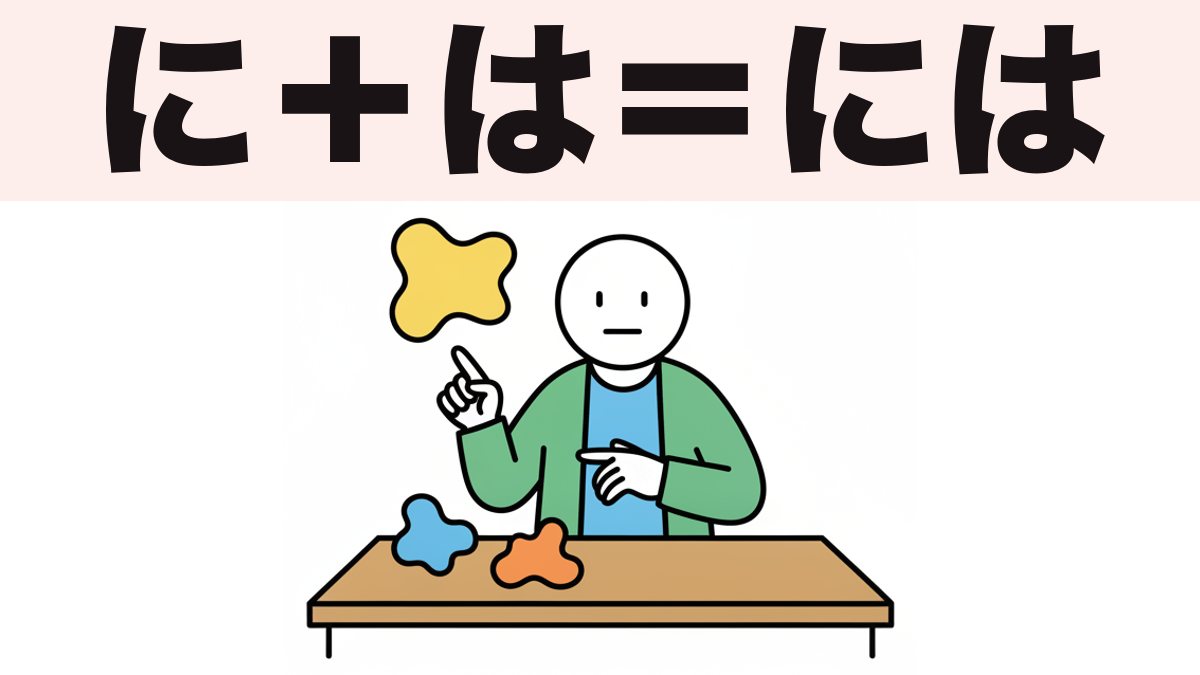
には is not a particle. It is に doing its usual job, with は stacked on top to make that に the topic — or the contrast — of the sentence.
「には」はひとつの助詞ではありません。「に」がいつもの仕事をして、その上に「は」がのっている形です。
Learners reach a stage where には starts appearing everywhere: 普通には, 仕事には, 昨日には. It sounds more advanced, so it feels safer. It is one of the clearest tells that someone has learned the shape of a pattern without the two jobs inside it. This page separates them, so you can tell when には is doing real work and when plain は was already enough.
The basics
What are the two pieces doing?
に marks a target: a place something exists, a time, a destination, a recipient. は marks the topic, and quietly sets up a contrast with everything it is not.
Stack them and you get "as for [that target]…"
東京には行きました。 — I did go to Tokyo. (neutral-polite; implies "somewhere else, I didn't") 机の上には本があります。 — On the desk, there are books. (polite; the desk is the topic)
Compare that second one with 机の上に本があります, which simply reports where the books are. Adding は makes the desk the thing under discussion — the sentence now sounds like an answer to "what's on the desk?"
When does に take は?
Whenever you want the に-phrase to be what the sentence is about, or to sit against an unstated alternative. Those are the same instinct viewed from two sides.
月曜日には会議があります。 — On Monday, there's a meeting. (polite; other days, maybe not) 私には分かりません。 — I don't understand it. (polite; "for me at least" — softer than 分かりません)
That last pattern is worth memorising whole. 私には難しいです ("it's difficult for me") is much gentler than 難しいです, because it frames the difficulty as yours rather than the thing's.
The particle は cannot follow が or を
This is the rule that decides half of all には questions. が and を do not survive under は — they are replaced by it. に, で, へ, と and から do survive, and stack.
- 本があります → 本はあります (the が vanishes)
- 本を読みます → 本は読みます (the を vanishes)
- 東京に行きます → 東京には行きます (に stays, は stacks)
So if your sentence has を on the noun, には is not an option — you were never marking a target in the first place. If the difference between が and は itself is still shaky underneath all this, は vs が is the layer below this page.
Beyond the basics
には for purpose: "in order to"
There is a second, entirely separate には: dictionary-form verb plus には, meaning "in order to do X" or "for the purpose of X-ing." It usually introduces what is needed.
日本語を上手に話すには、練習が必要です。 — To speak Japanese well, you need practice. (polite, the standard advice frame) 駅に行くには、どうすればいいですか。 — To get to the station, what should I do? (polite, asking directions)
This one is extremely common in advice and instructions, and it overlaps with ために — the difference is that には sets up a requirement or a method, while ために states a goal. ために and ように covers that pair in full.
にも, では, とは — the same stacking, different second particle
Once you see には as two particles, the whole family opens up. も works exactly where は does, adding "also" or, under a negative, "not even."
東京にも行きました。 — I went to Tokyo as well. (neutral-polite) どこにも行きませんでした。 — I didn't go anywhere. (polite; question word + にも + negative)
That second pattern — a question word plus も plus a negative — is how Japanese says "nothing," "nobody," "nowhere." It is a frequent sticking point and it has its own page: question word + も + negative.
では and とは stack the same way. では is に's cousin で ("at, by means of") plus は; とは is the quotation-and-companion と plus は, and it often introduces a definition: 「ネタバレ」とは何ですか — "what does ネタバレ mean?"
明日は and 明日には are not the same
With time words, adding に changes what kind of time you are talking about, and は then contrasts it.
明日は行きます。 — Tomorrow, I'll go. (polite; tomorrow as the topic — as opposed to today) 明日には終わります。 — It'll be finished by tomorrow. (polite; に points at a deadline)
明日 by itself does not normally take に at all — days like 明日, 今日, 昨日 are among the time words that refuse it. When には does appear on them, it is pushing the "by that point" reading. That is why 昨日には sounds wrong in most sentences: you cannot finish something "by yesterday" unless you are talking about a plan that already failed.
Why learners overuse it
There are three separate causes, and they need different fixes.
- Mapping it onto English "for." "For me it's difficult" is 私には難しい, so "for work" feels like it should be 仕事には. But 仕事 in "I use it for work" is 仕事で — a means, not a target.
- Using it where plain は was correct. 普通には is the single most common example. 普通は ("usually, as a rule") is the adverbial topic and needs no に, because nothing is being targeted.
- Thinking it sounds more polite. It does not. It adds contrast, and contrast where none is intended makes a sentence sound like it is arguing with something you did not say.
普通は六時に起きます。 — I usually get up at six. (polite, natural)
The fix is a single question: is there a target here — a place, a time point, a recipient? If not, delete the に and keep the は.
A last one: 〜には〜 for emphasis with the same verb
There is a set pattern where a verb is repeated around には, conceding a point before you contradict it.
食べるには食べましたが、おいしくなかったです。 — I did eat it, but it wasn't good. (polite; concede, then contradict)
You do not need to produce this. You need to recognise it, because it appears in conversation and looks bewildering until someone tells you it is a fixed shape.
Common mistakes
- Putting には on a direct object. 本には読みました is wrong. を is replaced by は, never stacked: 本は読みました.
- 普通には. It should be 普通は. Adverbs of this kind take は directly.
- Using には for "with" or "by means of." That is で, and under a topic it becomes では: 日本語では何と言いますか.
- Adding には to 明日 or 昨日 out of habit. These time words usually take no particle at all. には forces a "by then" reading that may not be what you mean.
- Assuming には is more polite. It is more contrastive. Politeness lives in the verb ending, not in the particle.
What stacks, and what does not
| Original particle | Under は | Example | Note |
|---|---|---|---|
| が | は | 本はあります | が disappears |
| を | は | 本は読みました | を disappears |
| に | には | 東京には行きました | に stays |
| で | では | 日本では普通です | で stays |
| へ | へは | 学校へは行きません | へ stays |
| と | とは | 彼とは話しません | often introduces a definition |
| から | からは | 明日からは頑張ります | に stays likewise |
| (none) | は | 普通は六時です | adverbs need no に |
FAQ
Is には a single particle I should learn as a unit? Learn the combination as a unit, but keep the two jobs visible. If you memorise には as one thing, you will reach for it whenever a sentence feels like it needs weight, which is exactly how the overuse starts.
What is the difference between 私は and 私には? 私は marks you as the subject-topic — the one doing something. 私には marks you as the point of reference — the one for whom something is true. 私は分かりません is "I don't understand"; 私には分かりません is "I, at least, don't understand it," softer and slightly more distancing.
Can I always turn に into には? No. It has to be a に that would be there anyway, and the phrase has to be worth topicalising. 六時に起きます is fine; 六時には起きます means "by six, I'm up" — a different claim.
Is the purpose には the same word as the topic には? Historically related, functionally separate. The purpose one attaches to a dictionary-form verb (話すには), the topic one attaches to a noun (東京には). Since the shapes before them differ, you will not confuse them in practice.
Why does どこにも mean "nowhere"? Because も with a negative flips from "also" to "not even" — question word plus も plus a negative verb is the standard construction for total negation. どこにも行かない: not to anywhere.
Does word order matter with には? Less than in English, but a には phrase near the front of the sentence is the normal position for a topic, and moving it later weakens the contrast. Japanese puts what the sentence is about at the start.
Practice
Build each answer before opening it. Questions 5 and 6 are a pair, and so are 7 and 8.
1. Something is wrong here: 本には読みました。
Show answer
本は読みました — 本 is the direct object, so it had を, and を is replaced by は rather than stacked under it.
2. Something is wrong here: 普通には六時に起きます。
Show answer
普通は六時に起きます — 普通 is adverbial here and takes は directly. There is no target for に to mark.
3. Say "For me, it's difficult."
Show answer
私には難しいです — には frames you as the point of reference, which softens the statement considerably.
4. Say "On the desk there are books" — making the desk the topic.
Show answer
机の上には本があります — に marks the location, は makes that location what the sentence is about.
5. Say "Tomorrow, I'll go" (as opposed to today).
Show answer
明日は行きます — 明日 normally takes no particle, so は goes on directly. This is the pair to question 6.
6. Say "It will be finished by tomorrow."
Show answer
明日には終わります — に adds the deadline reading, "by that point." This is the pair to question 5.
7. Say "To speak Japanese well, you need practice."
Show answer
日本語を上手に話すには、練習が必要です — dictionary form + には for purpose. This is the pair to question 8.
8. Say "I didn't go to Tokyo" — implying you went somewhere else.
Show answer
東京には行きませんでした — the topic には, not the purpose one. The contrast is doing the implying.
9. Say "I didn't go anywhere."
Show answer
どこにも行きませんでした — question word + にも + negative. Under a negative, も means "not even."
10. Turn 日本で普通です into a sentence that contrasts Japan with elsewhere.
Show answer
日本では普通です — で survives under は exactly as に does, and では is how "in Japan, at least" gets said.
Vocabulary from this article
Tap the block to select all of it, then copy. In Anki: File → Import, note type Basic, separator Tab — the first column becomes the front, the second the back.
机	つくえ — desk
上	うえ — top, above
本	ほん — book
会議	かいぎ — meeting
月曜日	げつようび — Monday
明日	あした — tomorrow
昨日	きのう — yesterday
普通	ふつう — usual, ordinary
練習	れんしゅう — practice
必要	ひつよう — necessary, need
上手	じょうず — skilled, good at
難しい	むずかしい — difficult
分かる	わかる — to understand
起きる	おきる — to get up
終わる	おわる — to finish, to end
行く	いく — to go
読む	よむ — to read
話す	はなす — to speak
仕事	しごと — work, job
駅	えき — station
I'm Yuuki, a Japanese teacher based in Tokyo. I've taught on italki as a Top 1% teacher and watched over 1,500 anime. には is the particle I most often have to take away from intermediate learners — the sentence is usually correct without it, and removing it is the fastest way to sound less like a textbook.
Sources: the author's own lessons and standard reference grammars.
日本語が中級になると、「には」をたくさん使う人がいます。「普通には」「仕事には」「昨日には」。上手に聞こえる気がするからです。でもこれは、形だけおぼえて、中の2つの仕事を見ていないしるしです。ここでは、その2つを分けます。
基本
2つの仕事
「に」は、場所・時間・相手など、目じるしをつけます。「は」は、話のテーマにして、言っていない何かとくらべます。
だから「には」は「その目じるしについて言うと……」です。
東京には行きました。 — I did go to Tokyo. (neutral-polite; implies "somewhere else, I didn't") 机の上には本があります。 — On the desk, there are books. (polite; the desk is the topic)
「机の上に本があります」は、ただ場所を言います。「は」を足すと、机がテーマになります。「机の上に何がありますか」への答えのように聞こえます。
いつ「に」に「は」をつけるか
その「に」の部分を、話のテーマにしたいときです。または、ほかのものとくらべたいときです。
月曜日には会議があります。 — On Monday, there's a meeting. (polite; other days, maybe not) 私には分かりません。 — I don't understand it. (polite; "for me at least" — softer than 分かりません)
「私には難しいです」は「難しいです」よりやわらかいです。むずかしさを「自分のもの」として言うからです。
「が」と「を」は、「は」といっしょに使えません
これが大事なルールです。「が」と「を」は「は」に変わります。「に」「で」「へ」「と」「から」はのこります。
- 本があります → 本はあります(「が」が消える)
- 本を読みます → 本は読みます(「を」が消える)
- 東京に行きます → 東京には行きます(「に」がのこる)
だから、「を」を使う文では「には」は使えません。
もう少し先へ
もうひとつの「には」=「するために」
動詞のふつうの形+「には」で、「〜するためには」の意味になります。必要なものを言うときに使います。
日本語を上手に話すには、練習が必要です。 — To speak Japanese well, you need practice. (polite, the standard advice frame) 駅に行くには、どうすればいいですか。 — To get to the station, what should I do? (polite, asking directions)
「ために」と似ていますが、「には」は方法や必要なものを出します。
「にも」「では」「とは」も同じ形
「は」のところに「も」が入ると、「も」の意味になります。
東京にも行きました。 — I went to Tokyo as well. (neutral-polite) どこにも行きませんでした。 — I didn't go anywhere. (polite; question word + にも + negative)
「どこにも」「何も」「だれも」+ 否定 は、「ぜんぶない」の言い方です。
「では」は「で」+「は」、「とは」は「と」+「は」です。「とは」は意味を聞くときにも使います。「『ネタバレ』とは何ですか」。
「明日は」と「明日には」
明日は行きます。 — Tomorrow, I'll go. (polite; tomorrow as the topic — as opposed to today) 明日には終わります。 — It'll be finished by tomorrow. (polite; に points at a deadline)
「明日」「今日」「昨日」は、ふつう「に」をつけません。「には」にすると「そのときまでに」の意味になります。だから「昨日には」はへんに聞こえます。
使いすぎる3つの理由
- 英語の for に合わせてしまう。 「私には難しい」はいいですが、「仕事で使います」は「仕事には」ではありません。
- 「は」だけでよかった。 いちばん多いのは「普通には」です。正しくは「普通は」です。
- ていねいに聞こえると思っている。 ていねいにはなりません。くらべる気もちが出るだけです。
普通は六時に起きます。 — I usually get up at six. (polite, natural)
直し方はかんたんです。「目じるし(場所・時間・相手)はありますか?」と聞いてください。なければ「に」を消します。
同じ動詞をくり返す「〜には〜」
食べるには食べましたが、おいしくなかったです。 — I did eat it, but it wasn't good. (polite; concede, then contradict)
自分で作らなくても大丈夫です。聞いて分かればいいです。
よくあるまちがい
- 「を」の名詞に「には」をつける。 「本には読みました」はまちがいです。「本は読みました」。
- 「普通には」。 「普通は」です。
- 「〜で」の意味で「には」を使う。 方法は「で」、テーマにすると「では」です。
- 「明日」「昨日」にくせで「には」をつける。 ふつうは助詞をつけません。
- 「には」がていねいだと思う。 ていねいさは文のおわりで決まります。
のこる助詞と、消える助詞
| もとの助詞 | 「は」をつけると | 例 | メモ |
|---|---|---|---|
| が | は | 本はあります | 「が」が消える |
| を | は | 本は読みました | 「を」が消える |
| に | には | 東京には行きました | 「に」はのこる |
| で | では | 日本では普通です | 「で」はのこる |
| へ | へは | 学校へは行きません | 「へ」はのこる |
| と | とは | 彼とは話しません | 意味の説明にも使う |
| から | からは | 明日からは頑張ります | のこる |
| なし | は | 普通は六時です | 副詞には「に」はいらない |
FAQ
「には」はひとつの言葉としておぼえてもいいですか。 形はひとつでおぼえていいですが、中の2つの仕事は見えるようにしてください。ひとつの言葉だと思うと、使いすぎが始まります。
「私は」と「私には」のちがいは? 「私は」は、することをする人。「私には」は、そう感じる人です。「私には分かりません」のほうがやわらかいです。
「に」はいつでも「には」にできますか。 できません。もともと「に」がいる文で、そこをテーマにしたいときだけです。「六時には起きます」は「六時までに起きている」になります。
「するには」と「東京には」は同じ言葉ですか。 形は同じですが、はたらきはべつです。前が動詞なら「ために」の意味、名詞ならテーマの意味です。
なぜ「どこにも」は nowhere になりますか。 「も」は否定といっしょに使うと「〜さえない」になるからです。
語順は大事ですか。 「には」の部分は、文の前のほうに置くのがふつうです。日本語は、話のテーマを先に言います。
練習
答えを見る前に、自分で作ってください。5と6、7と8は組です。
1. 「本には読みました」はどこがちがいますか。
答えを見る
本は読みました — 「本」は「を」の名詞です。「を」は「は」に変わります。上にのりません。
2. 「普通には六時に起きます」はどこがちがいますか。
答えを見る
普通は六時に起きます — 「普通」は副詞なので「は」だけです。目じるしがありません。
3. 「自分にはむずかしい」と言ってください。
答えを見る
私には難しいです — 「には」で「自分にとっては」になり、やわらかくなります。
4. 机をテーマにして「机の上に本があります」と言ってください。
答えを見る
机の上には本があります — 「に」が場所、「は」がテーマです。
5. 「(今日ではなく)明日行きます」と言ってください。
答えを見る
明日は行きます — 「明日」はふつう助詞をつけないので、「は」だけつきます。6と組です。
6. 「明日までに終わります」と言ってください。
答えを見る
明日には終わります — 「に」が「そのときまでに」を出します。5と組です。
7. 「日本語を上手に話すには、練習が必要です」と言ってください。
答えを見る
日本語を上手に話すには、練習が必要です — 動詞のふつうの形+「には」で「ために」の意味です。8と組です。
8. 「(ほかは行ったけど)東京には行きませんでした」と言ってください。
答えを見る
東京には行きませんでした — こちらはテーマの「には」です。くらべる気もちが出ます。7と組です。
9. 「どこにも行きませんでした」と言ってください。
答えを見る
どこにも行きませんでした — 疑問詞+「にも」+否定。「も」は否定といっしょだと「さえない」になります。
10. 「日本で普通です」を、ほかの国とくらべる形にしてください。
答えを見る
日本では普通です — 「で」も「に」と同じようにのこります。
この記事に出た単語
ブロックをタップして全部を選んでから、コピーしてください。Anki では ファイル → 読み込み、ノートタイプは 基本、区切りは タブ です。左が表、右が裏になります。
机	つくえ — desk
上	うえ — top, above
本	ほん — book
会議	かいぎ — meeting
月曜日	げつようび — Monday
明日	あした — tomorrow
昨日	きのう — yesterday
普通	ふつう — usual, ordinary
練習	れんしゅう — practice
必要	ひつよう — necessary, need
上手	じょうず — skilled, good at
難しい	むずかしい — difficult
分かる	わかる — to understand
起きる	おきる — to get up
終わる	おわる — to finish, to end
行く	いく — to go
読む	よむ — to read
話す	はなす — to speak
仕事	しごと — work, job
駅	えき — station
私はユウキです。東京で日本語を教えています。 italki の Top 1% の先生で、アニメは1,500本以上見ました。「には」は、中級の人から取ってあげることがいちばん多い助詞です。なくても正しい文が多く、消すと教科書っぽさが減ります。
More drills like the ones above, plus a timed JLPT-style mock test: Practice · N4上のような練習問題と、時間つきのJLPT形式のもぎ試験: 練習ページ · N4
Want to try this in a real conversation?
本当の会話で、ためしてみませんか?
30-minute trial lesson, $13. Times shown in your own timezone.
30分の体験レッスン、$13。時間はあなたのタイムゾーンで表示されます。
Book a trial lesson · $13