Kasu vs kariru: how do you say lend or borrow in Japanese?貸す と 借りる: 向きは助詞ではなく動詞にある
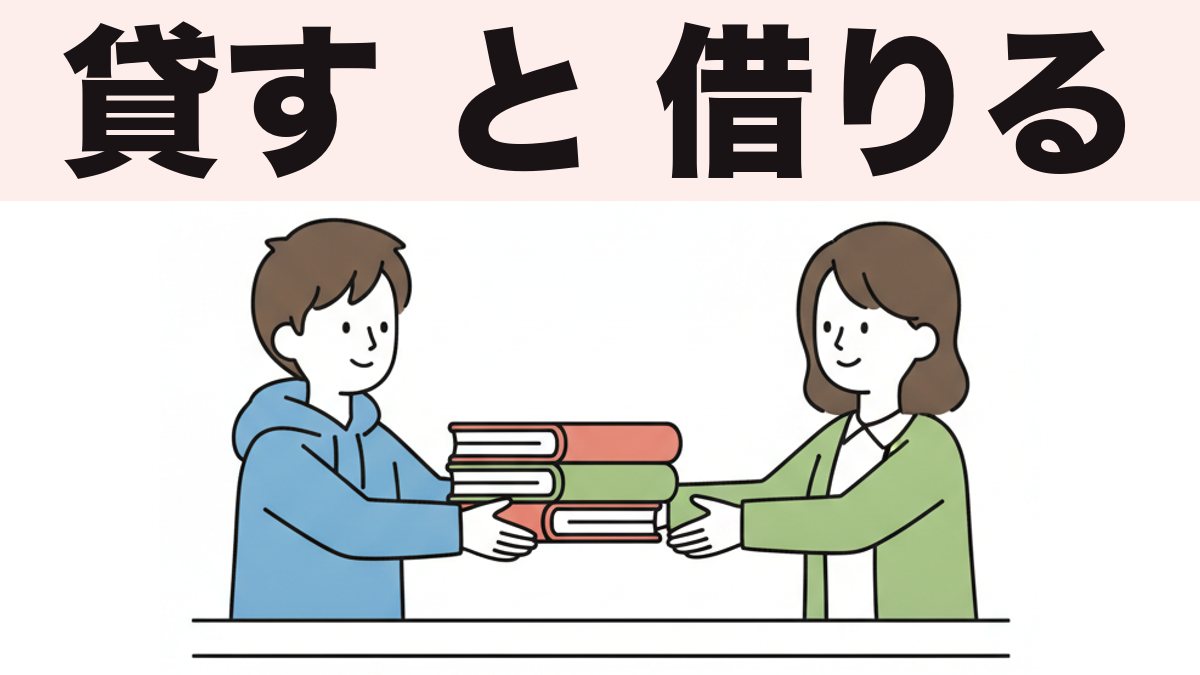
貸す means to lend (it leaves you) and 借りる means to borrow (it comes to you). The reason this pair is so hard is that both can take the particle に — so the particle does not tell you the direction. The verb does, and only the verb.
「貸す」は自分から出ていく、「借りる」は自分に来る、という意味です。むずかしいのは、どちらも「に」を使えるからです。だから助詞を見ても向きは分かりません。分かるのは動詞だけです。
In most languages you can lean on prepositions to sort this out: you lend to someone and borrow from someone. Japanese takes that crutch away. 友達に貸す and 友達に借りる are both correct sentences with the same particle, pointing in opposite directions.
The basics
The two verbs
友達に本を貸しました。 — I lent a book to a friend. (the book left me) 友達に本を借りました。 — I borrowed a book from a friend. (the book came to me)
Identical particles. Opposite directions. If you are trying to work out which is which from に, you are looking in the wrong place.
| Verb | Direction | Conjugation | Te-form |
|---|---|---|---|
| 貸す (かす) | It leaves you | Group 1 | 貸して |
| 借りる (かりる) | It comes to you | Group 2 | 借りて |
| 返す (かえす) | Giving it back | Group 1 | 返して |
返す is the third member and the one learners forget: 本を返しました ("I returned the book"). Note that 返す is the -su verb like 貸す, which is a useful hook — the two verbs where something leaves your hands both end in す.
The particle, and why から is safer
貸す always takes 人に. 借りる takes 人に or 人から, and から is the one that removes all ambiguity.
彼に千円貸した。 — I lent him 1,000 yen. 彼から千円借りた。 — I borrowed 1,000 yen from him. (から makes the source explicit) 図書館で本を借りました。 — I borrowed a book from the library. (で, because a place is where the action happened)
When you are unsure and speaking, use から with 借りる. It is natural, it is common, and it makes the sentence unmistakable.
That library example is worth a second look: institutions take で (the place of the action), not から. 図書館から借りる is not wrong, but 図書館で borrowing is what people say.
Asking to borrow something
Two natural ways, and they point at different people.
ペンを貸してください。 — Please lend me a pen. (you are asking them to act) ペンを借りてもいいですか。 — May I borrow a pen? (you are asking permission to act) ペン、貸してもらえますか。 — Could you lend me a pen? (polite, the softest of the three)
貸してもらえますか is the one to have ready, and it is built on the te-form like most polite requests. It is polite without being stiff, and it works with almost any verb — 見せてもらえますか, 手伝ってもらえますか. The 〜てもいいですか form is the permission grammar doing exactly what it always does.
Beyond the basics
This is a family, not a one-off
Once you see that Japanese puts direction inside the verb, the same shape appears everywhere — and each pair has caught every learner at least once.
| Coming toward you | Leaving you | English pair |
|---|---|---|
| 借りる | 貸す | borrow / lend |
| 習う | 教える | learn / teach |
| 買う | 売る | buy / sell |
| もらう | あげる | receive / give |
| 見る | 見せる | look at / show |
| 聞く | 聞かせる | hear / let hear |
習う and 教える are the pair that most often goes wrong after 貸す/借りる, for exactly the same reason: 先生に習う ("learn from the teacher") and 先生に教える ("teach the teacher") both take に. Japanese does not mark the direction on the noun, so it never will.
The practical takeaway is a study habit: whenever you learn a verb that involves something moving between two people, ask immediately whether it has a partner. Learning them as a pair costs nothing extra and prevents a very specific kind of embarrassing sentence.
貸してくれる — the version with a favour attached
くれる added to the te-form means "did it for me," and it is extremely common with 貸す.
友達が本を貸してくれた。 — A friend lent me a book. (and it was kind of them) お金を貸してくれませんか。 — Could you lend me some money? (polite request)
Note the particle changed: 友達が, because the friend is now the subject doing the favour. This is the most natural way to describe someone helping you out, and leaving out くれる makes a sentence sound oddly flat — 友達が本を貸した is grammatically fine but reads like a police report.
借り as a noun: owing someone
借り on its own means a debt or an obligation, and it is a fixed expression worth knowing.
借りができた。 — I owe you one. この借りは必ず返す。 — I'll definitely repay this debt.
That second sentence is anime dialogue almost verbatim — it shows up whenever a character has been rescued and is not emotionally equipped to say thank you. Note it uses 返す, the same verb as returning a borrowed book, which is why the metaphor works in the first place.
What about レンタル?
レンタル is used for commercial rental where money changes hands and the item is not personal: レンタカー (rental car), DVDのレンタル, レンタルオフィス.
レンタカーを借りました。 — I rented a car. (note: 借りる is still the verb)
The word for the service is レンタル; the verb is still 借りる. レンタルする exists but sounds like business vocabulary. For anything personal — a pen, a book, an umbrella — 借りる with no レンタル anywhere near it.
There is also 貸し出し, the formal noun for lending out, which you will see in libraries and rental counters: 貸出中 ("currently on loan"). You do not need to produce it, but it is on a lot of signs.
Common mistakes
- Reversing the two. 友達に本を借りました means you received the book. If you were the one handing it over, you needed 貸しました. There is no particle to save you here — check the verb.
- Using を for the person. 友達を本を貸した is doubly wrong: the person takes に, and a clause cannot have two を anyway.
- Saying 借りてください to mean "please lend me." That tells the other person to borrow something. You want 貸してください.
- Forgetting くれる when someone did you a favour. 貸してくれた is what native speakers say. 貸した on its own describes a transaction, not a kindness.
- Using レンタルする for personal lending. Asking a friend to レンタル you a pen is a strange sentence. 貸してもらえますか.
- Mixing up 返す and 帰る. Both are かえる-shaped, and they are different verbs: 返す is to give back an object, 帰る is to go home. 本を帰す is not a sentence.
Practice
Answers are hidden — build yours first, then open. Questions 1 and 2 are a pair: identical particles, opposite directions.
1. What does 友達に本を貸しました mean?
Show answer
I lent a book to a friend — the book left you. 貸す is the "it goes away from me" verb.
2. What does 友達に本を借りました mean?
Show answer
I borrowed a book from a friend — the book came to you. Same particle に as question 1, opposite direction. The verb is the only thing carrying that information.
3. Rewrite 彼に千円借りた to make the source unmistakable.
Show answer
彼から千円借りた — 借りる accepts either に or から, and から names the source explicitly. When speaking and unsure, use から.
4. Ask politely to borrow a pen.
Show answer
ペン、貸してもらえますか — polite without being stiff. ペンを貸してください and ペンを借りてもいいですか also work; the first asks them to act, the second asks permission for you to act.
5. Something is wrong here: ペンを借りてください。
Show answer
ペンを貸してください — 借りてください tells the other person to go and borrow something. You want them to lend, so the verb is 貸す.
6. Say "a friend lent me a book (and it was kind of them)."
Show answer
友達が本を貸してくれた — くれる marks it as a favour done for you, and the friend becomes the が subject. Without くれる the sentence sounds like a transaction record.
7. What is the partner verb of 習う, and what is the trap?
Show answer
教える — and both take に — 先生に習う is "learn from the teacher", 先生に教える is "teach the teacher". Exactly the same problem as 貸す/借りる, for exactly the same reason.
8. Say "I borrowed a book from the library."
Show answer
図書館で本を借りました — institutions take で, marking where the action happened. 図書館から is understood but not what people say.
9. What does 借りができた mean?
Show answer
I owe you one — 借り as a noun means a debt or obligation. Repaying it uses 返す, the same verb as returning a borrowed object.
10. Say "I rented a car."
Show answer
レンタカーを借りました — レンタル names the service, but the verb is still 借りる. レンタルする exists and sounds like business vocabulary.
FAQ
Is there a trick for remembering which is which? The two verbs where something leaves your hands both end in す: 貸す (lend it out) and 返す (give it back). 借りる, where something comes toward you, does not. It is not a rule of Japanese, but it is a reliable hook.
Can 借りる take から always? With people, yes, and it is clearer. With institutions and places, で is more natural (図書館で借りる, レンタル屋で借りる). から is never wrong, only sometimes less idiomatic.
How do I say "can I borrow your bathroom"? トイレをお借りできますか, or more simply トイレを借りてもいいですか. This is a genuinely standard phrase in Japan — asking to use a shop's or a home's toilet is phrased as borrowing it, which surprises most learners the first time.
What is the difference between 貸してください and 貸してもらえますか? Both are polite. 〜てください is a direct request, and to a stranger or someone senior it can feel a touch blunt. 〜てもらえますか asks whether they could, which leaves them room, and 〜ていただけますか is the formal step above that.
Is 借りる ever used for things that aren't objects? Yes — 力を借りる ("borrow someone's strength," i.e. get help) and 手を借りる ("lend a hand") are both common set phrases. 手を貸して ("give me a hand") is the version you will hear shouted.
Why does 返す conjugate like 貸す? Both are Group 1 verbs ending in す, so they follow the same pattern: 返します / 返して / 返した, 貸します / 貸して / 貸した. 借りる is Group 2 and behaves differently: 借ります / 借りて / 借りた.
Vocabulary from this article
Tap the block to select all of it, then copy. In Anki: File → Import, note type Basic, separator Tab — the first column becomes the front, the second the back.
貸す	かす — to lend
借りる	かりる — to borrow
返す	かえす — to give back, to return (an object)
帰る	かえる — to go home
友達	ともだち — friend
本	ほん — book
図書館	としょかん — library
千円	せんえん — 1,000 yen
お金	おかね — money
習う	ならう — to learn (from someone)
教える	おしえる — to teach
売る	うる — to sell
買う	かう — to buy
見せる	みせる — to show
手伝う	てつだう — to help
借り	かり — a debt, an obligation
貸出中	かしだしちゅう — currently on loan
力	ちから — strength, power
手	て — hand
I'm Yuuki, a Japanese teacher based in Tokyo. I've taught on italki as a Top 1% teacher and watched over 1,500 anime. Learners hunt for a particle rule here and there isn't one — the fix is to stop looking at に entirely and learn the pair as a pair, which also quietly fixes 習う and 教える before they can go wrong.
Sources: the author's own lessons and standard reference grammars.
ほかの言語では、前置詞で分かります。「lend to」「borrow from」です。日本語はそれをくれません。「友達に貸す」も「友達に借りる」も正しい文で、向きは反対です。
基本
2つの動詞
友達に本を貸しました。 — I lent a book to a friend. (本は自分から出ました) 友達に本を借りました。 — I borrowed a book from a friend. (本は自分に来ました)
助詞は同じです。向きは反対です。「に」から考えても、答えは出ません。
| 動詞 | 向き | グループ | て形 |
|---|---|---|---|
| 貸す(かす) | 自分から出る | グループ1 | 貸して |
| 借りる(かりる) | 自分に来る | グループ2 | 借りて |
| 返す(かえす) | もどす | グループ1 | 返して |
「返す」は3つめで、みんな忘れます。「本を返しました」。「貸す」と「返す」は、どちらも手から出ていく動詞で、どちらも「す」で終わります。おぼえる時のヒントになります。
助詞と、「から」が安全な理由
「貸す」はいつも「人に」です。「借りる」は「人に」でも「人から」でもいいです。「から」の方がはっきりします。
彼に千円貸した。 — I lent him 1,000 yen. 彼から千円借りた。 — I borrowed 1,000 yen from him. (「から」で出どころがはっきりします) 図書館で本を借りました。 — I borrowed a book from the library. (場所なので「で」)
まよった時は「借りる」に「から」を使ってください。自然で、まちがえようがありません。
図書館の例はだいじです。しせつは「で」(行動した場所)です。「図書館から借りる」も間ちがいではありませんが、「図書館で」がふつうです。
貸してほしい時の言い方
2つあって、それぞれちがう人に向いています。
ペンを貸してください。 — Please lend me a pen. (相手にしてもらう) ペンを借りてもいいですか。 — May I borrow a pen? (自分がしてもいいか聞く) ペン、貸してもらえますか。 — Could you lend me a pen? (いちばんやわらかい)
「貸してもらえますか」を持っておいてください。ていねいですが、かたくありません。ほかの動詞にも使えます。「見せてもらえますか」「手伝ってもらえますか」。
もう少し先へ
これは1つではなく、なかまです
日本語は向きを動詞の中に入れます。同じ形はほかにもあります。
| 自分に来る | 自分から出る | 英語 |
|---|---|---|
| 借りる | 貸す | borrow / lend |
| 習う | 教える | learn / teach |
| 買う | 売る | buy / sell |
| もらう | あげる | receive / give |
| 見る | 見せる | look at / show |
| 聞く | 聞かせる | hear / let hear |
「習う」と「教える」は、「貸す・借りる」の次によくまちがえます。理由も同じです。「先生に習う」も「先生に教える」も「に」だからです。
だから勉強のくせを1つ作ってください。2人の間でものが動く動詞を覚える時、あいてになる動詞があるかを必ず聞きます。2つでおぼえても時間はかわりません。でも、はずかしい文を1つ減らせます。
貸してくれる — 親切がついた形
「て形」+「くれる」は「私のためにしてくれた」という意味です。「貸す」といっしょによく使います。
友達が本を貸してくれた。 — A friend lent me a book. (親切でした) お金を貸してくれませんか。 — Could you lend me some money?
助詞が「友達が」にかわっています。友達が、してくれる人になったからです。「くれる」がないと、少し平らに聞こえます。「友達が本を貸した」はまちがいではありませんが、記録みたいです。
名詞の「借り」— かりがある
「借り」だけで「かりがあること」を表します。決まった言い方です。
借りができた。 — I owe you one. この借りは必ず返す。 — I'll definitely repay this debt.
2つめはアニメのせりふそのままです。助けてもらったキャラクターが、「ありがとう」と言えない時に使います。「返す」を使っているので、本を返すのと同じ形になっています。
「レンタル」は?
「レンタル」は、お金をはらう商売の時に使います。レンタカー、DVDのレンタル、レンタルオフィス。
レンタカーを借りました。 — I rented a car. (動詞はやっぱり「借りる」です)
サービスの名前が「レンタル」で、動詞は「借りる」のままです。「レンタルする」もありますが、仕事のことばに聞こえます。ペン・本・かさは「借りる」だけです。
「貸し出し」というかたい名詞もあります。図書館やお店の看板で見ます。「貸出中」」今かりられています。
よくある間違い
- 2つを反対にすること。 「友達に本を借りました」は、自分がもらった意味です。わたした側なら「貸しました」です。助詞は助けてくれません。
- 人に「を」を使うこと。 「友達を本を貸した」は2つまちがえています。人は「に」ですし、1つの文に「を」は2つ入りません。
- 「貸してください」のつもりで「借りてください」。 それは相手に「どこかで借りてきて」と言っています。
- 親切な時に「くれる」を忘れること。 「貸してくれた」が自然です。
- 人に「レンタルする」と言うこと。 友だちにペンを「レンタル」してもらうのは変です。「貸してもらえますか」です。
- 「返す」と「帰る」を混ぜること。 「返す」はものをもどす、「帰る」は家へ行く、です。「本を帰す」は文になりません。
練習
答えはかくれています。まず自分の答えを作ってから開いてください。1番と2番は対になっています。
1. 「友達に本を貸しました」はどんな意味ですか。
答えを見る
友達に本をあげた(かした) — 本は自分から出ました。「貸す」は「出ていく」動詞です。
2. 「友達に本を借りました」はどんな意味ですか。
答えを見る
友達から本をかりた — 本は自分に来ました。1番と助詞は同じ「に」で、向きだけが反対です。分かるのは動詞だけです。
3. 「彼に千円借りた」を、出どころがはっきりする形にしてください。
答えを見る
彼から千円借りた — 「借りる」は「に」も「から」も使えます。「から」は出どころをはっきりさせます。
4. ペンをかしてもらいたいです。ていねいに言ってください。
答えを見る
ペン、貸してもらえますか — ていねいですが、かたくありません。「貸してください」は相手にしてもらう形、「借りてもいいですか」は自分のきょかを聞く形です。
5. 直してください: ペンを借りてください。
答えを見る
ペンを貸してください — 「借りてください」は相手に「どこかで借りてきて」と言っています。かしてほしいなら「貸す」です。
6. 「友達が本をかしてくれて、うれしかった」という気もちで言ってください。
答えを見る
友達が本を貸してくれた — 「くれる」が「私のために」を表します。友達が「が」の主語になります。
7. 「習う」のあいての動詞は何ですか。落とし穴は何ですか。
答えを見る
教える。どちらも「に」を使います — 「先生に習う」は先生から学ぶ、「先生に教える」は先生に教える、です。「貸す・借りる」とまったく同じ問題です。
8. 「図書館で本をかりた」と言ってください。
答えを見る
図書館で本を借りました — しせつは「で」です。行動した場所を表します。「図書館から」も通じますが、ふつうは言いません。
9. 「借りができた」はどんな意味ですか。
答えを見る
かりがある(おんがある) — 名詞の「借り」は、かりや義理です。返す時は「返す」を使います。本を返すのと同じ動詞です。
10. 「車をレンタルした」と自然に言ってください。
答えを見る
レンタカーを借りました — 「レンタル」はサービスの名前で、動詞は「借りる」のままです。
よくある質問
おぼえるコツはありますか。 手から出ていく2つは「す」で終わります。「貸す」と「返す」です。自分に来る「借りる」はちがいます。文法のルールではありませんが、よく当たります。
「借りる」はいつも「から」が使えますか。 人にはそうです。はっきりします。しせつや場所には「で」の方が自然です(図書館で借りる)。
「トイレを借りたい」はどう言いますか。 「トイレをお借りできますか」「トイレを借りてもいいですか」です。日本では、お店や家のトイレを「借りる」と言います。はじめて聞くとおどろきます。
「貸してください」と「貸してもらえますか」はどうちがいますか。 どちらもていねいです。「〜てください」はまっすぐなおねがいで、知らない人や目上の人には少し強いです。「〜てもらえますか」は相手にえらぶ場所をのこします。「〜ていただけますか」はもっとていねいです。
ものじゃないものにも「借りる」を使いますか。 使います。「力を借りる」(助けてもらう)、「手を借りる」です。「手を貸して」は、よく聞く言い方です。
なぜ「返す」は「貸す」と同じ形ですか。 どちらも「す」で終わるグループ1だからです。返します/返して/返した、貸します/貸して/貸した。「借りる」はグループ2で、借ります/借りて/借りた になります。
この記事に出た単語
ブロックをタップすると全部選べます。そのままコピーしてください。Anki では ファイル → 読み込み、ノートタイプ 基本、区切り タブ。1列目が表、2列目が裏になります。
貸す	かす — to lend
借りる	かりる — to borrow
返す	かえす — to give back, to return (an object)
帰る	かえる — to go home
友達	ともだち — friend
本	ほん — book
図書館	としょかん — library
千円	せんえん — 1,000 yen
お金	おかね — money
習う	ならう — to learn (from someone)
教える	おしえる — to teach
売る	うる — to sell
買う	かう — to buy
見せる	みせる — to show
手伝う	てつだう — to help
借り	かり — a debt, an obligation
貸出中	かしだしちゅう — currently on loan
力	ちから — strength, power
手	て — hand
私はユウキです。東京で日本語を教えています。 italki の Top 1% の先生で、アニメは1,500本以上見ました。みんなここで助詞のルールをさがしますが、ありません。直し方は「に」を見るのをやめて、2つセットでおぼえることです。そうすると「習う・教える」も、まちがえる前になおります。
More drills like the ones above, plus a timed JLPT-style mock test: Practice · N5上のような練習問題と、時間つきのJLPT形式のもぎ試験: 練習ページ · N5
Want to try this in a real conversation?
本当の会話で、ためしてみませんか?
30-minute trial lesson, $13. Times shown in your own timezone.
30分の体験レッスン、$13。時間はあなたのタイムゾーンで表示されます。
Book a trial lesson · $13