Japanese words for happy: 嬉しい, 楽しい, 幸せ and which one you actually meanうれしい・たのしい・しあわせ: 「happy」の日本語の使い分け
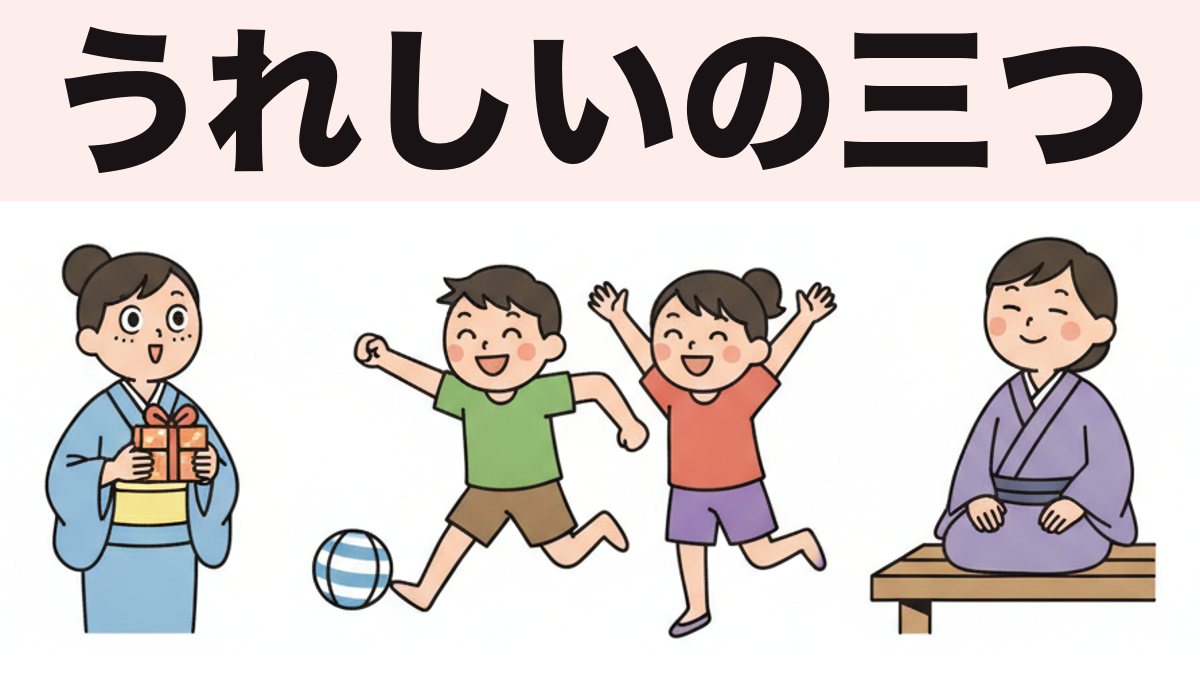
嬉しい is happy about a specific thing that happened to you, 楽しい is enjoying an activity while it is happening, and 幸せ is the settled happiness of a whole life. Choosing wrong is not a grammar error — it is saying something you did not mean.
「嬉しい」は、何かが起きてうれしいときです。「楽しい」は、していることが楽しいときです。「幸せ」は、人生ぜんたいが幸せなときです。英語はぜんぶ "happy" ですが、日本語はちがいます。
This is one of the first sets where English is genuinely less precise than Japanese, and it produces sentences that are technically correct and quietly strange. Telling someone 楽しいです when they give you a gift, or 幸せです about a good lunch, both land oddly for reasons that are hard to explain after the fact — so it is worth getting the three apart now.
The basics
嬉しい — happy about something
A reaction. Something happened, and you feel good about it. It points outward at a cause.
プレゼント、嬉しいです! — I'm so happy with the present! (polite, warm — the standard reaction) 会えて嬉しい。 — I'm happy to see you. (casual) 嬉しい気持ちでいっぱいです。 — My heart is full. (polite — literally "I am full of happy feelings")
嬉しい is the word for gratitude, good news, someone remembering your birthday. It is about an event, and it can be momentary — you can be 嬉しい for five seconds.
楽しい — enjoyable
Not about you feeling good; about the activity being fun. It describes the thing, not the person.
昨日のパーティーは楽しかった。 — Yesterday's party was fun. (casual) 日本語の勉強は楽しいです。 — Studying Japanese is enjoyable. (polite)
This is why 楽しい usually sits next to an activity: パーティー, 旅行, 勉強, 仕事. If you can put "fun" in front of it in English, 楽しい is the word.
幸せ — happy with life
The big one. A settled state covering your life or a long stretch of it, not a reaction to an event.
今、幸せです。 — I'm happy right now — with how things are. (polite, weighty) 幸せな家族。 — A happy family. (neutral)
幸せ is a な-adjective, unlike the other two. It is also a heavier word than English "happy": saying 幸せです in answer to "how are you?" would be a much bigger statement than the question invited.
Beyond the basics
The test that sorts all three
Ask what the happiness is attached to.
- Attached to an event → 嬉しい
- Attached to an activity → 楽しい
- Attached to your life → 幸せ
合格して嬉しい。 — I'm happy I passed. (an event) この仕事は楽しい。 — This job is enjoyable. (an activity) 家族がいて幸せだ。 — I'm fortunate to have my family. (a life)
The same situation can take different words depending on what you point at: 旅行は楽しかった (the trip was fun) and 行けて嬉しかった (I was glad I could go) are both true about one holiday.
You cannot say 嬉しい about other people
Like all Japanese emotion adjectives, 嬉しい and 楽しい describe feelings you have direct access to — your own. For someone else, you need a hedge or the がる form.
彼は嬉しそうです。 — He looks happy. (polite — そう marks appearance) 子どもが嬉しがっている。 — The child is showing delight. (neutral — がる for third-person feelings)
This is a general rule of Japanese rather than something about these particular words, and the full explanation is in ほしい vs たい.
The casual and emphatic versions
Real speech rarely stops at the dictionary form.
- 嬉しい! — on its own, as an exclamation. Extremely common.
- 超嬉しい / めっちゃ嬉しい — "super happy". 超 nationally, めっちゃ originally Kansai and now everywhere.
- 楽しみ — looking forward to something. A different word, formed from 楽しい, and one of the most useful nouns in the language: 楽しみにしています.
来週の旅行が楽しみです。 — I'm looking forward to next week's trip. (polite)
Note the difference: 楽しい is enjoying now; 楽しみ is anticipating later. Mixing them up is very common.
嬉しい vs ありがたい
ありがたい means grateful — literally "hard to exist", i.e. rare and therefore precious. When someone does you a favour, both work, but they say different things.
手伝ってくれて嬉しい。 — I'm happy you helped me. (focus on your feeling) 手伝ってくれてありがたい。 — I'm grateful you helped me. (focus on their kindness)
ありがたい is the more adult of the two in a work context, and ありがとう is its close relative — the full picture is in how to say thank you in Japanese.
幸せ vs 幸運 vs ラッキー
幸せ is happiness. 幸運 (こううん) and ラッキー are luck, and they are not the same claim.
ラッキー! — Lucky! (casual — a good break) 幸運を祈ります。 — I wish you good luck. (formal, written)
Saying 幸せ about winning a raffle overstates it considerably.
Common mistakes
- Saying 楽しいです when given a gift. The gift is not an activity. 嬉しいです is the reaction word.
- Saying 幸せです about a good meal. 幸せ covers your life. For a meal, 美味しかった or 嬉しい.
- Using 楽しみ and 楽しい interchangeably. 楽しみ is anticipation; 楽しい is enjoyment happening now.
- Saying 彼は嬉しいです. For another person you need 嬉しそう or 嬉しがっている.
- Treating 幸せ as an い-adjective. It is a な-adjective: 幸せな人, not 幸せい.
The three-way table
| Word | Attached to | Type | Example |
|---|---|---|---|
| 嬉しい | An event | い-adjective | プレゼント、嬉しい |
| 楽しい | An activity | い-adjective | パーティーが楽しい |
| 幸せ | Your life | な-adjective | 今、幸せです |
| 楽しみ | Something coming | Noun | 旅行が楽しみ |
| ありがたい | Someone's kindness | い-adjective | 手伝ってくれてありがたい |
FAQ
Which one do I use when someone gives me a present? 嬉しいです. It is a reaction to an event, and it is warmer than ありがとう alone — many people say both.
Can I say 幸せ to my partner? Yes, and it carries real weight. 一緒にいられて幸せ is a serious, sincere thing to say, not a casual one.
What is the noun form of 嬉しい? 嬉しさ, "the degree of happiness", used mostly in writing. In speech people restructure the sentence instead.
How do I say "I had fun today"? 今日は楽しかったです. Past tense of 楽しい, and a very common closing line for a day out or a lesson.
Is めっちゃ rude? No, just casual and slightly regional in flavour. Avoid it in business Japanese; it is fine with friends.
What is 幸せ者? "A fortunate person" — 幸せ者です is a modest, slightly old-fashioned way of saying you are lucky in life.
Practice
Build each answer before opening it. Questions 1 and 2 are a pair — the same day, two different words.
1. Someone gives you a present. React.
Show answer
嬉しいです — a reaction to an event. This is the pair to question 2.
2. Say yesterday's party was fun.
Show answer
昨日のパーティーは楽しかった — an activity, so 楽しい. This is the pair to question 1.
3. Something is wrong here: いいランチで幸せです。
Show answer
美味しかったです or 嬉しいです — 幸せ covers your whole life, which is a lot to claim about a lunch.
4. Say you're looking forward to next week's trip.
Show answer
来週の旅行が楽しみです — 楽しみ is anticipation, not enjoyment happening now.
5. Something is wrong here: 彼は嬉しいです。
Show answer
彼は嬉しそうです — you cannot state another person's feelings as fact. そう marks appearance.
6. Say "I'm happy I passed."
Show answer
合格して嬉しい — passing is an event.
7. Say "this job is enjoyable."
Show answer
この仕事は楽しい — a job is an activity.
8. Thank a colleague for helping, focusing on their kindness.
Show answer
手伝ってくれてありがたい — 嬉しい would put the focus on your own feeling instead.
9. Say "I had fun today" at the end of a lesson.
Show answer
今日は楽しかったです — a very common closing line.
10. Which is the な-adjective: 嬉しい, 楽しい or 幸せ?
Show answer
幸せ — 幸せな人. The other two are い-adjectives.
Vocabulary from this article
Tap the block to select all of it, then copy. In Anki: File → Import, note type Basic, separator Tab — the first column becomes the front, the second the back.
嬉しい	うれしい — happy (about something)
楽しい	たのしい — enjoyable, fun
楽しみ	たのしみ — something to look forward to
幸せ	しあわせ — happy, fortunate (in life)
幸運	こううん — good luck
ありがたい	ありがたい — grateful, much appreciated
合格	ごうかく — passing an exam
旅行	りょこう — trip, travel
家族	かぞく — family
仕事	しごと — work, job
手伝う	てつだう — to help
勉強	べんきょう — study
会う	あう — to meet
来週	らいしゅう — next week
昨日	きのう — yesterday
気持ち	きもち — feeling
I'm Yuuki, a Japanese teacher based in Tokyo. I've taught on italki as a Top 1% teacher and watched over 1,500 anime. 楽しみにしています is the phrase I most often add to a student's vocabulary in the first month — it ends a message warmly, and it is the one of these four they never arrive with.
Sources: the author's own lessons and standard reference grammars.
ここは、英語の方があいまいなところです。まちがえても文法はただしいので、気づきにくいです。プレゼントをもらって「楽しいです」、おひるごはんに「幸せです」は、どちらもへんに聞こえます。
基本
嬉しい
何かが起きて、いい気もちになったときです。りゆうが外にあります。
プレゼント、嬉しいです! — I'm so happy with the present! (polite, warm — the standard reaction) 会えて嬉しい。 — I'm happy to see you. (casual)
お礼、いい知らせ、たんじょう日をおぼえていてくれたとき。みじかい時間でも使えます。
楽しい
自分の気もちではなく、「していることが楽しい」という意味です。ものやことをせつめいします。
昨日のパーティーは楽しかった。 — Yesterday's party was fun. (casual) 日本語の勉強は楽しいです。 — Studying Japanese is enjoyable. (polite)
だから、「パーティー」「旅行」「勉強」「仕事」といっしょに使います。
幸せ
大きな言葉です。人生や、長い時間のことを言います。
今、幸せです。 — I'm happy right now — with how things are. (polite, weighty) 幸せな家族。 — A happy family. (neutral)
「な」の形容詞です。英語の "happy" より重い言葉です。「元気ですか」の答えに「幸せです」と言うと、大きすぎます。
もう少しくわしく
三つを分けるテスト
「何について幸せなのか」を見てください。
- できごと → 嬉しい
- していること → 楽しい
- 人生 → 幸せ
合格して嬉しい。 — I'm happy I passed. (an event) この仕事は楽しい。 — This job is enjoyable. (an activity) 家族がいて幸せだ。 — I'm fortunate to have my family. (a life)
同じ旅行でも、「旅行は楽しかった」と「行けて嬉しかった」はどちらも正しいです。
人の気もちには使えない
日本語の気もちの形容詞は、自分のことしか言えません。ほかの人には、形をかえます。
彼は嬉しそうです。 — He looks happy. (polite — そう marks appearance) 子どもが嬉しがっている。 — The child is showing delight. (neutral — がる for third-person feelings)
→ ほしい と たい
会話の形
- 嬉しい! — それだけで使います。とても多いです。
- 超嬉しい/めっちゃ嬉しい — とてもうれしい。「めっちゃ」は関西からです。
- 楽しみ — これからのことを待つ気もちです。「楽しい」から作られた、べつの言葉です。
来週の旅行が楽しみです。 — I'm looking forward to next week's trip. (polite)
「楽しい」は今、「楽しみ」はこれからです。まちがえやすいところです。
「嬉しい」と「ありがたい」
「ありがたい」は「あることがむずかしい」」めずらしくて大切、という意味です。
手伝ってくれて嬉しい。 — I'm happy you helped me. (focus on your feeling) 手伝ってくれてありがたい。 — I'm grateful you helped me. (focus on their kindness)
しごとでは「ありがたい」の方が大人の言い方です。→ 「ありがとう」の言い方
「幸せ」と「幸運」
「幸せ」は happiness、「幸運」「ラッキー」は luck です。同じではありません。
ラッキー! — Lucky! (casual — a good break) 幸運を祈ります。 — I wish you good luck. (formal, written)
くじが当たって「幸せです」は、言いすぎです。
よくあるまちがい
- プレゼントに「楽しいです」と言う。 プレゼントは「していること」ではありません。「嬉しいです」です。
- おいしいごはんに「幸せです」と言う。 「幸せ」は人生の言葉です。
- 「楽しみ」と「楽しい」をまぜる。「楽しみ」はこれから、「楽しい」は今です。
- 「彼は嬉しいです」と言う。「嬉しそうです」です。
- 「幸せ」を「い」の形容詞だと思う。「幸せな人」です。
三つの表
| 言葉 | 何について | 形 | 例 |
|---|---|---|---|
| 嬉しい | できごと | い形容詞 | プレゼント、嬉しい |
| 楽しい | していること | い形容詞 | パーティーが楽しい |
| 幸せ | 人生 | な形容詞 | 今、幸せです |
| 楽しみ | これからのこと | 名詞 | 旅行が楽しみ |
| ありがたい | 相手のしんせつ | い形容詞 | 手伝ってくれてありがたい |
よくある質問
プレゼントをもらったら? 「嬉しいです」です。「ありがとう」と両方言う人も多いです。
こいびとに「幸せ」と言える? 言えます。重い言葉です。「一緒にいられて幸せ」は、まじめな言い方です。
「嬉しい」の名詞は? 「嬉しさ」です。書き言葉が多いです。
「今日は楽しかった」はどう言う? 「今日は楽しかったです」です。一日のおわりやレッスンのおわりによく使います。
「めっちゃ」は失礼? いいえ、カジュアルなだけです。しごとではさけてください。
「幸せ者」とは? 「運のいい人」という意味です。少し古い言い方です。
練習
答えを見る前に、自分で作ってください。1番と2番はペアです。
1. プレゼントをもらいました。何と言う?
答えを見る
嬉しいです — できごとへの返事です。2番とペアです。
2. きのうのパーティーは楽しかったと言う。
答えを見る
昨日のパーティーは楽しかった — していることは「楽しい」です。1番とペアです。
3. まちがいをなおす: いいランチで幸せです。
答えを見る
美味しかったです/嬉しいです — 「幸せ」は人生の言葉です。
4. 来週の旅行が待ちどおしいと言う。
答えを見る
来週の旅行が楽しみです — 「楽しみ」はこれからのことです。
5. まちがいをなおす: 彼は嬉しいです。
答えを見る
彼は嬉しそうです — ほかの人の気もちは、そのまま言えません。
6. 「合格してうれしい」と言う。
答えを見る
合格して嬉しい — 合格はできごとです。
7. 「この仕事は楽しい」と言う。
答えを見る
この仕事は楽しい — 仕事はしていることです。
8. 同りょうのしんせつにお礼を言う(相手のしんせつに目を向けて)。
答えを見る
手伝ってくれてありがたい — 「嬉しい」だと自分の気もちの話になります。
9. レッスンのおわりに「今日は楽しかった」と言う。
答えを見る
今日は楽しかったです — とてもよく使う言い方です。
10. 「な」の形容詞はどれ? 嬉しい・楽しい・幸せ
答えを見る
幸せ — 「幸せな人」。ほかの二つは「い」の形容詞です。
この記事に出た単語
上のブロックをタップしてぜんぶ選んで、コピーしてください。Ankiでは ファイル → インポート、ノートタイプは 基本、区切りは タブ です。左が表、右がうらになります。
嬉しい	うれしい — happy (about something)
楽しい	たのしい — enjoyable, fun
楽しみ	たのしみ — something to look forward to
幸せ	しあわせ — happy, fortunate (in life)
幸運	こううん — good luck
ありがたい	ありがたい — grateful, much appreciated
合格	ごうかく — passing an exam
旅行	りょこう — trip, travel
家族	かぞく — family
仕事	しごと — work, job
手伝う	てつだう — to help
勉強	べんきょう — study
会う	あう — to meet
来週	らいしゅう — next week
昨日	きのう — yesterday
気持ち	きもち — feeling
More drills like the ones above, plus a timed JLPT-style mock test: Practice · N5上のような練習問題と、時間つきのJLPT形式のもぎ試験: 練習ページ · N5
Want to try this in a real conversation?
本当の会話で、ためしてみませんか?
30-minute trial lesson, $13. Times shown in your own timezone.
30分の体験レッスン、$13。時間はあなたのタイムゾーンで表示されます。
Book a trial lesson · $13