Japanese verb groups: the three-way split every conjugation depends on動詞のグループ: すべての活用がここで決まります
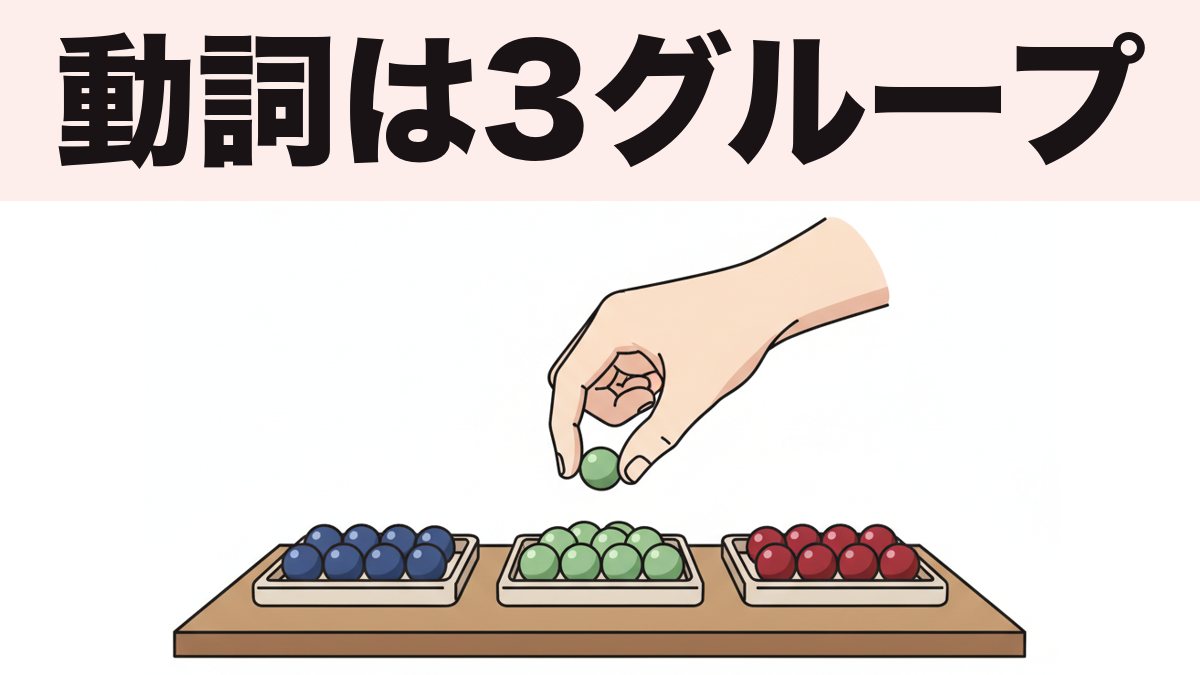
Japanese verbs come in three groups, and which group a verb is in decides every single form it takes — ます, て, ない, potential, passive, causative, imperative. Group 2 verbs all end in る, but so do some Group 1 verbs (帰る, 走る, 知る), which is the one thing that makes this hard.
日本語の動詞は3つのグループに分かれます。どのグループかで、その動詞のぜんぶの形(ます・て・ない・可能・受身・使役)が決まります。グループ2はぜんぶ「る」で終わりますが、グループ1にも「る」で終わる動詞があります(帰る・走る・知る)。むずかしいのは、そこだけです。
Learners often skip this and try to memorise conjugations verb by verb. That works for about thirty verbs and then collapses. Sorting a verb into its group takes two seconds and gives you every form for free.
The basics
The three groups
| Group | Also called | Dictionary form ends in | Examples |
|---|---|---|---|
| Group 1 | う-verbs, godan, 五段 | Any う-row sound: う, く, ぐ, す, つ, ぬ, ぶ, む, る | 書く, 話す, 飲む, 買う, 帰る |
| Group 2 | る-verbs, ichidan, 一段 | る, with an e or i sound before it | 食べる, 見る, 起きる, 教える |
| Group 3 | Irregular | — | する, 来る |
Group 3 has exactly two members. する appears in hundreds of compound verbs (勉強する, 確認する, 電話する) but conjugates the same way every time, so it is two verbs' worth of memorising, not two hundred.
The core conjugations, by group
| Group 1 (書く) | Group 2 (食べる) | する | 来る | |
|---|---|---|---|---|
| ます-form | 書きます | 食べます | します | きます |
| Negative | 書かない | 食べない | しない | こない |
| te-form | 書いて | 食べて | して | きて |
| Past | 書いた | 食べた | した | きた |
| Potential | 書ける | 食べられる | できる | こられる |
| Volitional | 書こう | 食べよう | しよう | こよう |
Group 1 changes the vowel of the last syllable and Group 2 just drops る. That is the whole difference. Note 来る: the kanji stays the same while the reading changes — き, こ, き, こ — which is worth drilling out loud.
Why it matters
Every grammar point you meet later is built on one of these forms. The te-form alone unlocks requests, permission, progressive, prohibition and half a dozen others — and the te-form rules are entirely different for the two groups.
毎日日本語を書きます。 — I write Japanese every day. (polite — Group 1) 毎日野菜を食べます。 — I eat vegetables every day. (polite — Group 2)
Beyond the basics
The Group 1 verbs that end in る
This is the actual difficulty. Group 2 verbs always have an e or i sound before る — but so do these Group 1 verbs:
| Verb | Reading | Meaning |
|---|---|---|
| 帰る | かえる | to go home |
| 入る | はいる | to enter |
| 走る | はしる | to run |
| 切る | きる | to cut |
| 知る | しる | to know |
| 要る | いる | to need |
| 減る | へる | to decrease |
| 喋る | しゃべる | to chat |
| 蹴る | ける | to kick |
| 滑る | すべる | to slip |
7時に帰ります。 — I'll go home at seven. (polite — Group 1: 帰ります, not 帰ます)
Ten verbs, and they are all common. Learn them as a list; there is no rule that separates them from 食べる and 教える by sight.
The test that never lies
Put the verb into its plain negative. If the syllable before ない has an a sound, it is Group 1.
| Verb | Negative | Group |
|---|---|---|
| 帰る | 帰らない | 1 — the ら gives it away |
| 食べる | 食べない | 2 — る just dropped |
| 走る | 走らない | 1 |
| 起きる | 起きない | 2 |
If you know a verb's negative, you know its group, and therefore every other form. This is the single most useful thing to learn from this article.
切る vs 着る: same sound, different groups
紙を切ります。 — I'll cut the paper. (polite — 切る, Group 1) シャツを着ます。 — I'll put on a shirt. (polite — 着る, Group 2)
Both are きる in dictionary form. 切ります and 着ます are different because the groups are different, and the kanji is the only thing telling you which is which. The same pair appears in the negative: 切らない vs 着ない.
Group 2 gets the ambiguous potential
Group 2's potential form and its passive form are identical: 食べられる means both "can eat" and "is eaten." Group 1 keeps them apart (書ける vs 書かれる).
納豆が食べられます。 — I can eat natto. (polite — potential reading, from context)
In casual speech, Group 2 potentials often drop the ら — 食べれる, 見れる — which is called ら抜き言葉. Extremely common in speech, still flagged as incorrect in writing. Recognise it; write the full form. For the ambiguity itself, see the potential form and the passive.
する compounds
Any noun of action plus する becomes a verb: 勉強する, 電話する, 確認する, 準備する. They all conjugate as する, so learning one gives you hundreds.
今、確認しています。 — I'm checking now. (polite, teiru)
Common mistakes
- 帰ます. 帰る is Group 1: 帰ります.
- 走れる treated as Group 2's potential. 走る is Group 1, so its potential is 走れる and its passive is 走られる — they are different, unlike 食べられる.
- 知らない vs 知りません confusion. Both are correct; 知らない is plain, 知りません is polite. The verb is Group 1 either way.
- Assuming e/i before る means Group 2. It usually does, and the ten verbs above are the exceptions that matter.
- Writing 食べれる in an exam. Say it, don't write it.
- Treating する compounds as new verbs. They are all one verb wearing different nouns.
Practice
Answers are hidden — build yours first, then open. Questions 5 and 6 are a pair: the same sound, two different groups.
1. Which group is 書く, and what is its ます-form?
Show answer
Group 1, 書きます — Group 1 changes the vowel of the last syllable: く → き.
2. Which group is 食べる, and what is its negative?
Show answer
Group 2, 食べない — Group 2 just drops る.
3. Something is wrong here: 7時に帰ます。
Show answer
帰ります — 帰る ends in る but is Group 1. It is one of the ten common exceptions.
4. What is the test for a verb's group?
Show answer
The plain negative — if the syllable before ない has an "a" sound (帰らない, 走らない), it is Group 1. If る just dropped (食べない), it is Group 2.
5. Put 切る (to cut) into the polite present.
Show answer
切ります — Group 1, so the last syllable changes: る → り.
6. Put 着る (to wear) into the polite present.
Show answer
着ます — Group 2, so る just drops. This is the pair to question 5: same dictionary sound, different groups, and only the kanji tells you.
7. What are the only two irregular verbs?
Show answer
する and 来る — and する appears in hundreds of compounds that all conjugate identically, so it is two verbs to learn, not two hundred.
8. Why is 食べられます ambiguous?
Show answer
Group 2 potential and passive are the same form — it can mean "can eat" or "is eaten," and only context separates them. Group 1 keeps them apart: 書ける vs 書かれる.
9. What is ら抜き言葉, and should you use it?
Show answer
Dropping the ら from Group 2 potentials — 食べれる, 見れる — extremely common in speech, still marked wrong in writing. Recognise it; write the full form.
10. How many verbs do you learn when you learn 勉強する?
Show answer
All of them — every noun + する compound conjugates as する: 電話する, 確認する, 準備する.
FAQ
Are the group numbers standard? There are two naming systems. "Group 1 / 2 / 3" is common in textbooks for learners; "godan / ichidan / irregular" is the Japanese grammatical terminology. They map onto each other exactly.
Is there a rule for the Group 1 verbs ending in る? No reliable one. The list of common ones is short enough to memorise, and the negative test catches anything not on it.
What about ある? Group 1, but with an irregular negative: ない, not あらない.
Does 行く follow the pattern? Almost — it is Group 1, but its te-form is 行って rather than the 行いて you would predict. One exception, worth memorising.
Are there really only two irregular verbs? Two fully irregular ones. A handful of others have one odd form each (行く's te-form, ある's negative, honorific verbs like いらっしゃる).
Which group do I meet most? Group 1 is the largest by far. Group 2 is smaller but includes many of the most common everyday verbs.
Vocabulary from this article
Tap the block to select all of it, then copy. In Anki: File → Import, note type Basic, separator Tab — the first column becomes the front, the second the back.
書く	かく — to write
話す	はなす — to speak
飲む	のむ — to drink
買う	かう — to buy
帰る	かえる — to go home (Group 1)
入る	はいる — to enter (Group 1)
走る	はしる — to run (Group 1)
切る	きる — to cut (Group 1)
知る	しる — to know (Group 1)
要る	いる — to need (Group 1)
減る	へる — to decrease (Group 1)
喋る	しゃべる — to chat (Group 1)
蹴る	ける — to kick (Group 1)
滑る	すべる — to slip (Group 1)
食べる	たべる — to eat (Group 2)
見る	みる — to see (Group 2)
起きる	おきる — to get up (Group 2)
教える	おしえる — to teach (Group 2)
着る	きる — to wear (Group 2)
来る	くる — to come (irregular)
勉強	べんきょう — study
電話	でんわ — telephone
確認	かくにん — confirmation
準備	じゅんび — preparation
野菜	やさい — vegetables
紙	かみ — paper
納豆	なっとう — natto
毎日	まいにち — every day
I'm Yuuki, a Japanese teacher based in Tokyo. I've taught on italki as a Top 1% teacher and watched over 1,500 anime. The learners who stall around N4 are usually the ones who never sorted the groups and have been memorising conjugations one verb at a time. Ten minutes on the negative test saves months.
Sources: the author's own lessons and standard reference grammars.
ここをとばして、動詞ごとに形をおぼえる人が多いです。30語くらいまでは持ちますが、そのあとくずれます。グループを分けるのは2秒で、その動詞のぜんぶの形が手に入ります。
基本
3つのグループ
| グループ | 別の呼び方 | じしょ形の終わり | れい |
|---|---|---|---|
| グループ1 | う動詞・五段 | う・く・ぐ・す・つ・ぬ・ぶ・む・る | 書く・話す・飲む・買う・帰る |
| グループ2 | る動詞・一段 | る(前が e か i の音) | 食べる・見る・起きる・教える |
| グループ3 | ふきそく | — | する・来る |
グループ3は2つだけです。「する」は「勉強する」「確認する」「電話する」のようにたくさんの形で出ますが、活用はいつも同じです。
グループ別の形
| グループ1(書く) | グループ2(食べる) | する | 来る | |
|---|---|---|---|---|
| ます形 | 書きます | 食べます | します | きます |
| うちけし | 書かない | 食べない | しない | こない |
| て形 | 書いて | 食べて | して | きて |
| かこ | 書いた | 食べた | した | きた |
| 可能 | 書ける | 食べられる | できる | こられる |
| いこう形 | 書こう | 食べよう | しよう | こよう |
グループ1はさいごの音のぼいんが変わり、グループ2は「る」が落ちるだけです。「来る」は漢字が同じで読みだけ変わります(き・こ・き・こ)。声に出して練習してください。
どうして大事か
あとで習う文法は、ぜんぶこの形の上に立っています。
毎日日本語を書きます。 — I write Japanese every day. 毎日野菜を食べます。 — I eat vegetables every day.
もう少しくわしく
「る」で終わるグループ1
ここが本当のむずかしさです。グループ2は前が e か i の音ですが、下の動詞も同じ形でグループ1です。
| 動詞 | 読み | 意味 |
|---|---|---|
| 帰る | かえる | to go home |
| 入る | はいる | to enter |
| 走る | はしる | to run |
| 切る | きる | to cut |
| 知る | しる | to know |
| 要る | いる | to need |
| 減る | へる | to decrease |
| 喋る | しゃべる | to chat |
| 蹴る | ける | to kick |
| 滑る | すべる | to slip |
7時に帰ります。 — I'll go home at seven.
10語で、ぜんぶよく使います。見ただけで分けるルールはないので、リストでおぼえてください。
うそをつかないテスト
ふつうのうちけしにします。「ない」の前が a の音なら、グループ1です。
| 動詞 | うちけし | グループ |
|---|---|---|
| 帰る | 帰らない | 1 |
| 食べる | 食べない | 2 |
| 走る | 走らない | 1 |
| 起きる | 起きない | 2 |
うちけしが分かれば、グループが分かり、ぜんぶの形が分かります。
「切る」と「着る」
紙を切ります。 — I'll cut the paper. シャツを着ます。 — I'll put on a shirt.
じしょ形はどちらも「きる」です。グループがちがうので「切ります」「着ます」になります。分けてくれるのは漢字だけです。
グループ2の可能形はあいまい
グループ2は可能形と受身が同じ形です。「食べられる」は「食べることができる」と「食べられてしまう」の両方です。グループ1は分かれます(書ける/書かれる)。
納豆が食べられます。 — I can eat natto.
会話では「ら」を落とします(食べれる・見れる)。「ら抜き言葉」といいます。とてもよく使いますが、書きことばでは間違いとされます。読めればよくて、書く時は「ら」を入れてください。
「する」の仲間
動作の名詞+する で動詞になります。「勉強する」「電話する」「確認する」「準備する」。ぜんぶ「する」と同じ活用です。
今、確認しています。 — I'm checking now.
よくある間違い
- 帰ます。 「帰る」はグループ1なので「帰ります」です。
- 「走られる」を可能だと思う。 「走る」はグループ1なので可能は「走れる」です。
- e/i の前なら必ずグループ2だと思う。 上の10語が例外です。
- 試験で「食べれる」と書く。 話すのはOK、書くのはNGです。
- 「する」の仲間を新しい動詞だと思う。 ぜんぶ同じ1つの動詞です。
練習
答えはかくれています。まず自分で作ってから開いてください。5番と6番が対です。同じ音で、グループがちがいます。
1. 「書く」はどのグループで、ます形は?
答えを見る
グループ1、書きます — さいごの音のぼいんが変わります(く→き)。
2. 「食べる」はどのグループで、うちけしは?
答えを見る
グループ2、食べない — 「る」が落ちるだけです。
3. 直してください: 7時に帰ます。
答えを見る
帰ります — 「帰る」は「る」で終わりますがグループ1です。10語の例外の1つです。
4. グループを見分けるテストは?
答えを見る
ふつうのうちけし — 「ない」の前が「a」の音(帰らない・走らない)ならグループ1です。
5. 「切る」をていねいな今の形にしてください。
答えを見る
切ります — グループ1なので「る→り」です。
6. 「着る」をていねいな今の形にしてください。
答えを見る
着ます — グループ2なので「る」が落ちます。5番と対で、分けてくれるのは漢字だけです。
7. ふきそくな動詞は何と何ですか。
答えを見る
する と 来る — 「する」の仲間はぜんぶ同じ活用なので、おぼえるのは2つです。
8. 「食べられます」はどうしてあいまいですか。
答えを見る
グループ2は可能と受身が同じ形だから — グループ1は「書ける/書かれる」で分かれます。
9. 「ら抜き言葉」とは何で、使っていいですか。
答えを見る
「食べれる」「見れる」のように「ら」を落とすこと。話すのはOK、書くのはNGです
10. 「勉強する」をおぼえると、いくつの動詞が使えますか。
答えを見る
「する」の仲間ぜんぶ — 電話する・確認する・準備する、ぜんぶ同じ活用です。
この記事に出た単語
ブロックをタップすると全部選べます。そのままコピーしてください。Anki では ファイル → 読み込み、ノートタイプ 基本、区切り タブ。1列目が表、2列目が裏になります。
書く	かく — to write
話す	はなす — to speak
飲む	のむ — to drink
買う	かう — to buy
帰る	かえる — to go home
入る	はいる — to enter
走る	はしる — to run
切る	きる — to cut
知る	しる — to know
要る	いる — to need
減る	へる — to decrease
喋る	しゃべる — to chat
蹴る	ける — to kick
滑る	すべる — to slip
食べる	たべる — to eat
見る	みる — to see
起きる	おきる — to get up
教える	おしえる — to teach
着る	きる — to wear
来る	くる — to come
勉強	べんきょう — study
電話	でんわ — telephone
確認	かくにん — confirmation
準備	じゅんび — preparation
野菜	やさい — vegetables
紙	かみ — paper
納豆	なっとう — natto
毎日	まいにち — every day
動詞	どうし — verb
可能	かのう — potential
受身	うけみ — passive
私はユウキです。東京で日本語を教えています。 italki の Top 1% の先生で、アニメは1,500本以上見ました。N4のあたりで止まる人は、たいていグループを分けないまま、動詞ごとに形をおぼえてきた人です。うちけしのテストに10分使うと、何か月分かが浮きます。
More drills like the ones above, plus a timed JLPT-style mock test: Practice · N5上のような練習問題と、時間つきのJLPT形式のもぎ試験: 練習ページ · N5
Want to try this in a real conversation?
本当の会話で、ためしてみませんか?
30-minute trial lesson, $13. Times shown in your own timezone.
30分の体験レッスン、$13。時間はあなたのタイムゾーンで表示されます。
Book a trial lesson · $13