行く vs 来る: why "I''m coming!" is 今行きます in Japanese行く と 来る: 「今行きます!」がただしい理由
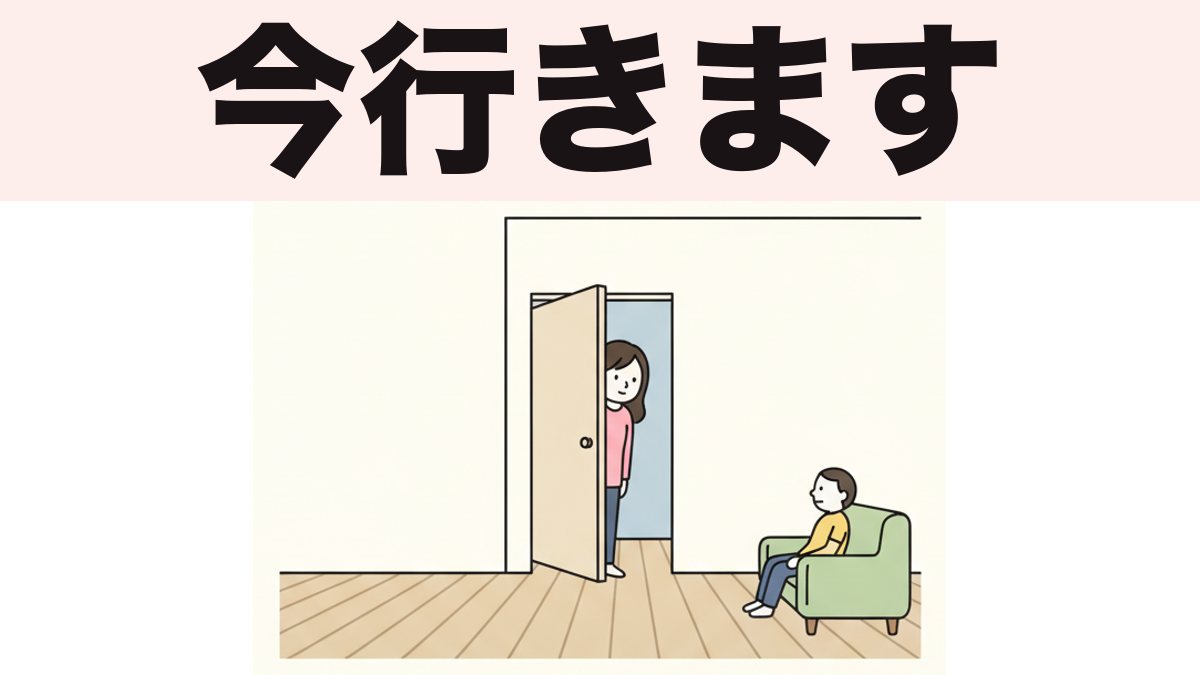
来る means moving toward where *the speaker* is. English "come" can mean moving toward the listener, which is why 今行きます — literally "I'm going now" — is the correct answer when someone calls you. Saying 今来ます means someone else is on their way to you.
「来る」は、**話している人**のところへ動くことです。英語の "come" は、聞いている人の方へ動くことも言えます。だから、よばれた時の返事は「今行きます」です。「今来ます」だと、だれかがこちらへ向かっている、という意味になります。
This is a small vocabulary pair that behaves like grammar, because it forces you to keep track of whose position the sentence is anchored to. Once you notice it, you start hearing it everywhere.
The basics
The anchor is the speaker
| Verb | Direction | Anchor |
|---|---|---|
| 行く | Away from where I am | The speaker |
| 来る | Toward where I am | The speaker |
| 帰る | Back to where I belong | Home base |
明日、そちらに行きます。 — I'll come over to your place tomorrow. (polite — Japanese says "go," because you are moving away from where you are now) 友達がうちに来ます。 — A friend is coming to my place. (polite — toward me)
English lets you borrow the listener's viewpoint: "I'll come to you." Japanese does not. The verb is chosen from where the speaker physically is at the moment of speaking.
Answering when someone calls you
今行きます! — Coming! (polite — you are moving away from your current spot)
This is the single most useful application, and the most commonly botched. If you shout 今来ます, you have announced that someone is arriving.
帰る is not 行く
帰る means returning to your own base — home, your country, your hometown. It is not interchangeable with 行く.
家に帰ります。 — I'm going home. (polite — 帰る, because home is your base)
Saying 家に行きます sounds like you are visiting a house that is not yours. Similarly, 国に帰る is "return to my country"; 国に行く would be visiting someone else's.
Beyond the basics
〜ていく and 〜てくる: direction attached to any verb
Attach いく or くる to the te-form and the whole action gains a direction:
傘を持っていきます。 — I'll take an umbrella (with me). (polite — away from here) 傘を持ってきます。 — I'll bring an umbrella (back here). (polite — toward here)
Same verb, opposite logistics. 持っていく / 持ってくる is the pair learners need first, followed by 連れていく / 連れてくる ("take someone" / "bring someone").
子どもを連れてきてもいいですか。 — May I bring my child? (polite — toward the listener's location, because that is where you will both be)
The other 〜てくる: change over time
てくる also marks a change that has moved toward the present:
だんだん寒くなってきました。 — It's been getting colder. (polite — the change arrived at now) 日本語が分かるようになってきました。 — I've been starting to understand Japanese. (polite — progress up to now)
And ていく points the change into the future:
これからも増えていくでしょう。 — It will probably keep increasing. (polite — the change heads away from now)
This is the same directional logic applied to time instead of space, and it is one of the most elegant things in the language once you see it.
Where does the speaker "stand" in writing?
In letters and messages you can project yourself to the reader's location, and then 行く flips:
来週そちらに行きます。 — I'll come to you next week. (polite — still 行く, because you are writing from here)
If you have mentally placed yourself at the destination — for instance, describing a scene in a story set there — 来る becomes possible. In ordinary messages, stick with 行く.
〜てきて and 〜ていって as requests
ちょっと買ってきて。 — Go buy it and come back. (casual — the whole errand in three words)
買ってきて packs "go, buy, return" into one verb chain. This compactness is why てくる is so common in daily speech, and why translating it word by word never quite works.
The giving verbs work the same way
行く/来る is one of several Japanese pairs anchored on the speaker. あげる, くれる and もらう are the other big one: くれる means giving toward me, exactly as 来る means moving toward me. If one of these pairs has clicked for you, the other should feel familiar.
Common mistakes
- 今来ます when someone calls you. It has to be 今行きます.
- 家に行きます for going home. Use 家に帰ります.
- 持ってくる vs 持っていく mixed up. Ask yourself where the object ends up: here, or there?
- 来週来ます in a message to someone abroad. From your desk, you are going: 行きます.
- Reading every てくる as physical movement. 寒くなってきた is about time, not travel.
Practice
Answers are hidden — build yours first, then open. Questions 3 and 4 are a pair: the same umbrella, opposite directions.
1. Someone calls your name from another room. Answer.
Show answer
今行きます — you are moving away from where you are, so 行く. 来ます would mean someone else is arriving.
2. Something is wrong here: 疲れたので、家に行きます。
Show answer
家に帰ります — 帰る is returning to your own base. 家に行く sounds like visiting someone else's house.
3. Say "I'll take an umbrella with me."
Show answer
傘を持っていきます — the umbrella leaves with you, away from here.
4. Say "I'll bring an umbrella back here."
Show answer
傘を持ってきます — the umbrella ends up here. This is the pair to question 3: same verb, opposite logistics.
5. Ask politely whether you may bring your child to someone's event.
Show answer
子どもを連れてきてもいいですか — 連れてくる, because you are asking from the perspective of the place you will both be.
6. Say "it's been getting colder."
Show answer
だんだん寒くなってきました — てくる for a change that arrived at the present. No physical movement involved.
7. Say "it will probably keep increasing."
Show answer
これからも増えていくでしょう — ていく points the change away from now, into the future.
8. You are writing to a friend overseas about next week's visit. 行きます or 来ます?
Show answer
来週そちらに行きます — you are writing from where you are, so you are going.
9. Send someone on a quick errand, casually.
Show answer
ちょっと買ってきて — "go, buy, come back," all in one verb chain. This compactness is why てくる is everywhere in speech.
10. How is くれる like 来る?
Show answer
Both point toward the speaker — くれる is giving toward me, 来る is moving toward me. Japanese anchors several verb pairs on the speaker's position.
FAQ
What about 行ってきます and いってらっしゃい? 行ってきます ("I'll go and come back") is what you say leaving the house; いってらっしゃい is the reply. The てくる is doing real work — it promises a return.
Is 来る irregular? Yes, one of only two irregular verbs: 来る → 来ます → 来た → 来ない, read き, き, き, こ. The kanji stays the same while the reading changes, which is worth drilling.
Can I use 来る about the future arriving? Yes: 春が来る ("spring is coming"), 時間が来た ("the time has come"). Time moves toward you.
What is 行ってくる? "I'll go and come back" — the casual version of 行ってきます, and also used for short trips: ちょっと行ってくる.
Does 帰る work for going back to a hotel? Yes, if you are staying there — it is your base for the trip. ホテルに帰ります is natural.
Why is 来る sometimes written in kana? Mostly in casual writing, and in compounds like やってくる. The kanji is standard otherwise.
Vocabulary from this article
Tap the block to select all of it, then copy. In Anki: File → Import, note type Basic, separator Tab — the first column becomes the front, the second the back.
行く	いく — to go
来る	くる — to come
帰る	かえる — to return, to go home
明日	あした — tomorrow
友達	ともだち — friend
家	いえ — house, home
国	くに — country
傘	かさ — umbrella
持つ	もつ — to hold, to carry
連れる	つれる — to take (a person) along
子ども	こども — child
寒い	さむい — cold
増える	ふえる — to increase
来週	らいしゅう — next week
買う	かう — to buy
疲れる	つかれる — to get tired
分かる	わかる — to understand
春	はる — spring
時間	じかん — time
I'm Yuuki, a Japanese teacher based in Tokyo. I've taught on italki as a Top 1% teacher and watched over 1,500 anime. 行った and 来た get sorted out late, usually because both keep producing sentences that are understood. The moment it clicks is normally when someone calls the learner's name and they shout 今来ます by reflex.
Sources: the author's own lessons and standard reference grammars.
小さなことばのペアですが、文法のようにはたらきます。文が「だれの場しょ」から見ているかを、ずっと持っていないといけないからです。
基本
中心は話している人
| 動詞 | 向き | 中心 |
|---|---|---|
| 行く | 今いる場しょからはなれる | 話す人 |
| 来る | 今いる場しょへ近づく | 話す人 |
| 帰る | 自分のばしょへもどる | ホーム |
明日、そちらに行きます。 — I'll come over to your place tomorrow. 友達がうちに来ます。 — A friend is coming to my place.
英語は、聞いている人の目で言えます。日本語はできません。話す人が今いる場しょで、動詞が決まります。
よばれた時
今行きます! — Coming!
いちばん使う形で、いちばん間違える形です。「今来ます」と言うと、だれかが着く、という意味になります。
「帰る」は「行く」ではない
「帰る」は自分のばしょへもどることです。家・国・じっ家。
家に帰ります。 — I'm going home.
「家に行きます」だと、よその家をたずねる感じです。「国に帰る」は自分の国へ、「国に行く」はよその国へ、です。
もう少しくわしく
「〜ていく」「〜てくる」
「て形」に「いく」「くる」をつけると、その動作に向きがつきます。
傘を持っていきます。 — I'll take an umbrella (with me). 傘を持ってきます。 — I'll bring an umbrella (back here).
同じ動詞で、行き先が反対です。「持っていく/持ってくる」を先に、そのあと「連れていく/連れてくる」(人をつれる)をおぼえてください。
子どもを連れてきてもいいですか。 — May I bring my child?
もう1つの「〜てくる」」時間の変化
「てくる」は、今までの変化にも使います。
だんだん寒くなってきました。 — It's been getting colder. 日本語が分かるようになってきました。 — I've been starting to understand Japanese.
「ていく」は、これからの変化です。
これからも増えていくでしょう。 — It will probably keep increasing.
場しょの向きを、時間にそのまま使っています。分かるととてもきれいです。
手紙やメッセージでは
書く時は、自分のいる場しょから言います。だから「行く」のままです。
来週そちらに行きます。 — I'll come to you next week.
「〜てきて」はおねがい
ちょっと買ってきて。 — Go buy it and come back.
「行って、買って、もどる」が3語に入っています。だから会話でとてもよく使います。
「くれる」も同じしくみ
「行く/来る」は、話す人を中心にしたペアの1つです。「あげる・くれる・もらう」も同じです。「くれる」は「自分の方へくれる」。「来る」が「自分の方へ来る」のと同じです。
よくある間違い
- よばれて「今来ます」。 「今行きます」です。
- 家に行きます。 「家に帰ります」です。
- 「持ってくる」と「持っていく」をまぜる。 そのものが、どこに着くかで決めます。
- 外国の友だちへのメッセージで「来ます」。 自分のつくえから見て、行くのです。
- 「てくる」をぜんぶ動きだと読む。 「寒くなってきた」は時間の話です。
練習
答えはかくれています。まず自分で作ってから開いてください。3番と4番が対です。同じかさで、向きが反対です。
1. べつの部屋からよばれました。返事をしてください。
答えを見る
今行きます — 今いる場しょからはなれるので「行く」です。「来ます」だとだれかが着く意味になります。
2. 直してください: 疲れたので、家に行きます。
答えを見る
家に帰ります — 「帰る」は自分のばしょへもどることです。
3. 「かさを持って出かけます」を「ていく」で言ってください。
答えを見る
傘を持っていきます — かさは自分といっしょに、ここからはなれます。
4. 「かさをここへ持ってきます」を言ってください。
答えを見る
傘を持ってきます — かさはここに着きます。3番と対です。
5. 子どもをつれて行っていいか、ていねいに聞いてください。
答えを見る
子どもを連れてきてもいいですか — 2人がいる場しょから見るので「連れてくる」です。
6. 「だんだん寒くなりました」を「てくる」で言ってください。
答えを見る
だんだん寒くなってきました — 今までの変化です。動きの話ではありません。
7. 「これからも増えるでしょう」を「ていく」で言ってください。
答えを見る
これからも増えていくでしょう — 「ていく」は、これからの変化です。
8. 外国の友だちに、来週たずねると書きます。「行きます」と「来ます」のどちらですか。
答えを見る
来週そちらに行きます — 自分のいる場しょから書いているので「行く」です。
9. 「買って、もどってきて」を3語で言ってください。
答えを見る
ちょっと買ってきて — 「行って、買って、もどる」が入っています。
10. 「くれる」は「来る」とどこがにていますか。
答えを見る
どちらも自分の方へ向かっています — 日本語には、話す人を中心にしたペアがいくつもあります。
この記事に出た単語
ブロックをタップすると全部選べます。そのままコピーしてください。Anki では ファイル → 読み込み、ノートタイプ 基本、区切り タブ。1列目が表、2列目が裏になります。
行く	いく — to go
来る	くる — to come
帰る	かえる — to return, to go home
明日	あした — tomorrow
友達	ともだち — friend
家	いえ — house, home
国	くに — country
傘	かさ — umbrella
持つ	もつ — to hold, to carry
連れる	つれる — to take (a person) along
子ども	こども — child
寒い	さむい — cold
増える	ふえる — to increase
来週	らいしゅう — next week
買う	かう — to buy
疲れる	つかれる — to get tired
分かる	わかる — to understand
部屋	へや — room
私はユウキです。東京で日本語を教えています。 italki の Top 1% の先生で、アニメは1,500本以上見ました。「行った」と「来た」の整理は、いつもおそくなります。どちらでも通じる文ができてしまうからです。分かる時はたいてい、名前をよばれて、思わず「今来ます」と言ってしまった時です。
More drills like the ones above, plus a timed JLPT-style mock test: Practice · N5上のような練習問題と、時間つきのJLPT形式のもぎ試験: 練習ページ · N5
Want to try this in a real conversation?
本当の会話で、ためしてみませんか?
30-minute trial lesson, $13. Times shown in your own timezone.
30分の体験レッスン、$13。時間はあなたのタイムゾーンで表示されます。
Book a trial lesson · $13