How do you say "enough" in Japanese? 十分, 足りる and もういい日本語の「enough」: 十分・足りる・もういい
Japanese splits "enough" into three different jobs: 十分 (じゅうぶん) says something is sufficient, 足りる (たりる) says the amount covers what you need, and もういい says "that's enough, stop." お金は十分ある, お金が足りる and もういい! all translate as "enough," and none of them can stand in for the others.
日本語は「enough」を3つの仕事に分けます。十分(じゅうぶん)は「それで足りている」。足りる(たりる)は「量が間に合う」。もういいは「もうやめて」。「お金は十分ある」「お金が足りる」「もういい!」は全部 enough と訳せますが、入れかえることはできません。
The mix-ups are predictable once you see the split. Learners use 十分 to stop someone talking, or 足りる to praise something as "good enough," and both come out slightly strange.
The basics
What does 十分 mean?
十分 (じゅうぶん) is "sufficient, plenty." It describes a quantity or a quality as meeting the need, and it works as a na-adjective (十分な時間, plenty of time) and an adverb (十分わかる, I understand it well enough).
時間は十分あります。 — We have plenty of time. (sufficient) これで十分です。 — This is plenty. / This will do. (polite, accepting what you're given) 一人で十分できる。 — I can easily do it on my own. (adverb: well enough)
The kanji are "ten parts" — ten out of ten. You will also see 充分, with the same reading and meaning. Both are correct; 十分 is the one newspapers and textbooks use.
How is 十分 read — じゅうぶん or じっぷん?
It depends on meaning. As "enough" it is always じゅうぶん. As "ten minutes" it is じっぷん or じゅっぷん. The characters are identical, so context does all the work.
駅まで十分(じっぷん)かかる。 — It takes ten minutes to the station. (time) 十分(じゅうぶん)間に合う。 — We'll easily make it. (enough)
A sentence like 十分で着く is genuinely ambiguous in writing — "arrive in ten minutes" — and a listener only knows it is minutes because of じっぷん. When you speak, the reading removes the doubt.
What about 足りる?
足りる is a verb: "to be enough," "to suffice." It is about amount — is there enough of the thing to cover the need? Its negative, 足りない, is used even more often, for anything that falls short.
千円で足りる? — Is a thousand yen enough? (asking about amount) 椅子が一つ足りない。 — We're one chair short. (shortfall) 寝不足で、集中力が足りない。 — I didn't sleep enough, so I can't concentrate. (lacking)
Note the particle: the thing that is (or is not) enough takes が. お金が足りない, not お金を足りない.
Side by side
| Word | Type | Question it answers | Example |
|---|---|---|---|
| 十分 | na-adjective / adverb | Is it sufficient? | 時間は十分ある |
| 足りる / 足りない | verb | Does the amount cover it? | お金が足りない |
| もういい | phrase | Should we stop? | もういい、やめよう |
| いい加減にして | phrase | Will you stop already? | いい加減にして! |
| 結構です | phrase | No more, thank you | もう結構です |
Beyond the basics
How do you say "that's enough!"?
This is where anime comes in, and where 十分 is the wrong choice. To stop something, Japanese uses いい ("good, fine") in the sense of "we're done."
もういい! — Enough! / Forget it! (frustrated, sharp) もういいよ。 — It's fine, you can stop now. (soft, often kind) いい加減にして! — Cut it out! / That's enough! (exasperated)
The same もういい can be warm or cold depending on the tone and the よ. Said gently to someone apologising over and over, もういいよ means "it's okay, you don't need to keep saying sorry." Shouted and followed by a door slamming, it means the conversation is over. いい加減にしろ is the rough, mostly male version you hear in shouting matches on screen.
How do you politely say "that's enough, thank you"?
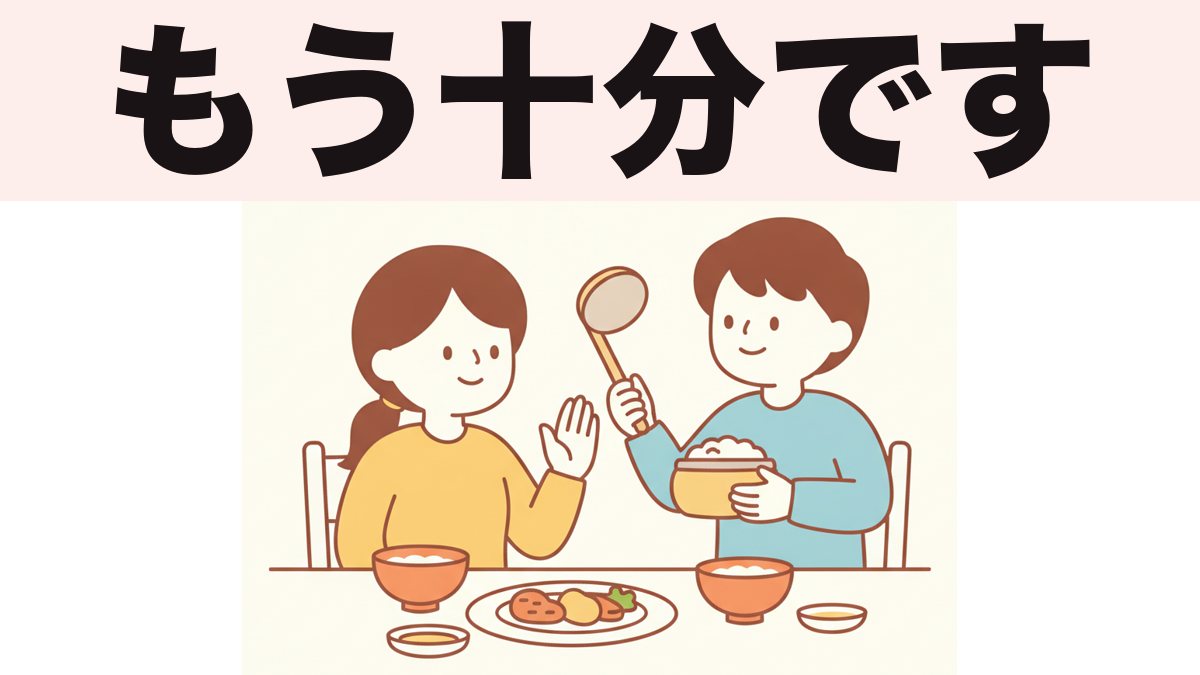
At a table, when someone offers more food or another drink, the polite refusal is 結構です or もう十分です.
もう十分いただきました。 — I've had plenty, thank you. (very polite) いえ、もう結構です。 — No, I'm fine, thank you. (polite refusal)
結構です is tricky because it can also mean "that's fine" as a yes. The もう and the tone decide it: もう結構です is almost always "no more." When turning down offers in general, a small ありがとうございます in front keeps it warm. Other soft refusals are in how to say no in Japanese, and the words around the meal itself are in いただきます and ごちそうさま.
Why does 十分 sometimes sound cold?
Because "sufficient" can imply "not more than sufficient." If a friend shows you a drawing they worked hard on and you say 十分だよ, it can land as "it's adequate." For praise, use a real compliment instead: すごい, いいね, 上手.
The same thing happens in English with "it'll do." 十分 is a verdict about need, not a compliment.
What does 〜で十分 mean?
〜で十分 is "just 〜 is enough" — a humble way to say you don't need more.
水で十分です。 — Water is fine for me. (don't go to any trouble) コンビニのおにぎりで十分。 — A convenience-store rice ball is all I need. (casual)
It pairs naturally with offers: someone asks what you would like, and 〜で十分です says you are happy with the simple option. For the rhythm of too much and too little, 〜すぎる is the natural next step — 食べすぎ is what happens when 十分 is ignored.
Common mistakes
- Using 十分 to stop someone. 十分! as "enough, stop!" sounds odd. Use もういい or やめて.
- Using を with 足りる. お金を足りない is wrong. The amount takes が: お金が足りない.
- Reading 十分 as じっぷん when you mean "enough." じっぷん is ten minutes. "Enough" is always じゅうぶん.
- Praising with 十分. 十分上手 can sound like "skilled enough, barely." For a compliment, just say 上手.
- Saying 足りません for "no thanks." At a table, 足りません means "there isn't enough" — the opposite of what you want. Say もう十分です or 結構です.
- Forgetting that もういい depends on tone. The same words can comfort or end a conversation. Add よ and soften your voice when you mean kindness.
Practice
Answers are hidden — build yours first, then open. Questions 1 and 2 are a pair: the same idea from two sides.
1. Say "We have plenty of time," politely.
Show answer
時間は十分あります — sufficiency, so 十分. は contrasts time with other things you may be short of.
2. Say "We don't have enough time."
Show answer
時間が足りない — a shortfall, so 足りない. 十分じゃない is possible but less common in speech.
3. Ask a friend: "Is two thousand yen enough?"
Show answer
二千円で足りる? — a question about amount, so 足りる. で marks the amount you are testing.
4. Someone keeps apologising. Tell them kindly it's fine and they can stop.
Show answer
もういいよ — soft もういい with よ. Said gently, it releases the other person.
5. At dinner, the host offers more food. Refuse politely.
Show answer
もう十分いただきました (or いえ、もう結構です) — polite refusal. 足りません would say the opposite.
6. Read this aloud correctly: 十分で駅に着きます (it means ten minutes).
Show answer
じっぷん(じゅっぷん)で駅に着きます — time reading. じゅうぶん would change it to "enough."
7. Tell someone who offered you a drink that water is fine.
Show answer
水で十分です — 〜で十分 is "just this is enough," a humble way to decline anything fancier.
8. Fix: 財布にお金を足りない。
Show answer
財布にお金が足りない — 足りる takes が for the thing that falls short.
9. Your roommate has played the same song twenty times. Snap at them: "Cut it out!"
Show answer
いい加減にして! — exasperated "that's enough." 十分 would never work here.
FAQ
Is 十分 the same as 充分? Same reading, same meaning. 十分 is the standard spelling; 充分 is common in novels and ads and suggests "full" rather than "ten out of ten."
Is 十分 an adjective or an adverb? Both. 十分な時間 (adjective, with な) and 十分わかる (adverb, no particle) are both normal.
What is 不十分? "Insufficient." It is formal — reports, reviews, feedback. In conversation 足りない is more natural.
How do you say "I've had enough of this"? もううんざり or もう嫌だ. These express being fed up, which is emotional rather than a statement about amount.
Can I say じゅうぶん in casual speech? Yes. 十分だよ and それで十分 are everyday casual phrases.
Why does anime use もういい so much? Because it compresses a whole argument into two words. It can mean "forget it," "I give up on you," or "it's okay now," and the voice acting tells you which.
Vocabulary from this article
Tap the block to select all of it, then copy. In Anki: File → Import, note type Basic, separator Tab — the first column becomes the front, the second the back.
十分	じゅうぶん — enough, sufficient, plenty
足りる	たりる — to be enough, to suffice
足りない	たりない — not enough, short of
結構	けっこう — fine; (もう結構です) no more, thank you
いい加減	いいかげん — (いい加減にして) cut it out
時間	じかん — time
間に合う	まにあう — to make it in time
椅子	いす — chair
寝不足	ねぶそく — lack of sleep
集中力	しゅうちゅうりょく — concentration
上手	じょうず — skilful, good at
財布	さいふ — wallet
不十分	ふじゅうぶん — insufficient
充分	じゅうぶん — enough (alternative spelling)
駅	えき — station
水	みず — water
嫌	いや — unpleasant, not wanting
I'm Yuuki, a Japanese teacher based in Tokyo. I've taught on italki as a Top 1% teacher and watched over 1,500 anime. 十分 comes up in lessons when a student hears じゅうぶん and thinks I said 自分 — which is a good moment to sort out the whole "enough" family at once.
Sources: the author's own lessons and standard reference grammars.
まちがい方はだいたい決まっています。「十分」で相手を止めようとしたり、「足りる」でほめようとしたりすると、少し変に聞こえます。
基本
十分の意味
十分(じゅうぶん)は「足りている、たっぷり」です。な形容詞(十分な時間)にも、副詞(十分わかる)にもなります。
時間は十分あります。 — We have plenty of time. (sufficient) これで十分です。 — This is plenty. / This will do. (polite, accepting what you're given) 一人で十分できる。 — I can easily do it on my own. (adverb: well enough)
漢字は「10のうち10」です。「充分」と書くこともあります。読み方も意味も同じです。新聞や教科書は「十分」を使います。
読み方は「じゅうぶん」?「じっぷん」?
意味で変わります。enough の時はいつも「じゅうぶん」。10 minutes の時は「じっぷん」か「じゅっぷん」。漢字は同じなので、文で分かります。
駅まで十分(じっぷん)かかる。 — It takes ten minutes to the station. (time) 十分(じゅうぶん)間に合う。 — We'll easily make it. (enough)
「十分で着く」は、書くと2つの意味に読めます。話す時は、読み方で分かります。
足りるは?
足りるは動詞です。「量が足りているか」を言います。否定の「足りない」は、もっとよく使います。
千円で足りる? — Is a thousand yen enough? (asking about amount) 椅子が一つ足りない。 — We're one chair short. (shortfall) 寝不足で、集中力が足りない。 — I didn't sleep enough, so I can't concentrate. (lacking)
助詞は「が」です。「お金が足りない」。「お金を足りない」ではありません。
ならべてみる
| ことば | 種類 | 答える質問 | 例 |
|---|---|---|---|
| 十分 | な形容詞/副詞 | 足りている? | 時間は十分ある |
| 足りる/足りない | 動詞 | 量は間に合う? | お金が足りない |
| もういい | 決まった言い方 | もうやめる? | もういい、やめよう |
| いい加減にして | 決まった言い方 | いつまでやるの? | いい加減にして! |
| 結構です | 決まった言い方 | もういりません | もう結構です |
もう少し先へ
「もうやめて!」はどう言う?
アニメでよく聞くところです。ここで「十分」は使いません。止める時は「いい」を「もう終わり」の意味で使います。
もういい! — Enough! / Forget it! (frustrated, sharp) もういいよ。 — It's fine, you can stop now. (soft, often kind) いい加減にして! — Cut it out! / That's enough! (exasperated)
同じ「もういい」でも、声と「よ」でやさしくも冷たくもなります。何度もあやまる人にやさしく「もういいよ」と言えば「大丈夫、もうあやまらなくていい」。大きな声で言ってドアをしめたら、話はおしまいです。「いい加減にしろ」は、けんかの場面で聞く乱暴な言い方です。
ていねいに「もう十分です」と言うには
食事の時、もっと食べ物や飲み物をすすめられたら、「結構です」か「もう十分です」でことわります。
もう十分いただきました。 — I've had plenty, thank you. (very polite) いえ、もう結構です。 — No, I'm fine, thank you. (polite refusal)
「結構です」は「いいですよ(はい)」の意味にもなるので注意してください。「もう」が付くと、たいてい「もういりません」です。ほかのことわり方は「いいえ」の言い方、食事のことばはいただきます・ごちそうさまの記事にあります。
十分が冷たく聞こえる時
「足りている」は「それ以上ではない」にも聞こえます。友だちががんばってかいた絵に「十分だよ」と言うと、「まあまあ」に聞こえることがあります。ほめる時は「すごい」「いいね」「上手」を使ってください。
〜で十分
「〜で十分」は「〜だけでいい」です。えんりょする言い方です。
水で十分です。 — Water is fine for me. (don't go to any trouble) コンビニのおにぎりで十分。 — A convenience-store rice ball is all I need. (casual)
多すぎる・少なすぎるは〜すぎるの記事にあります。
よくあるまちがい
- 「十分!」で相手を止める。 「もういい」か「やめて」です。
- 足りるに「を」を使う。 「お金が足りない」です。
- enough の意味なのに「じっぷん」と読む。 enough はいつも「じゅうぶん」です。
- 「十分」でほめる。 「十分上手」は「ぎりぎり上手」に聞こえることがあります。
- 食事で「足りません」と言う。 「足りない」の意味になり、反対です。「もう十分です」か「結構です」。
- 「もういい」の声を気にしない。 やさしく言いたい時は「よ」を付けて、声をやわらかく。
練習
答えはかくしてあります。先に自分で考えてから開けてください。1と2はペアです。
1. ていねいに「時間はたっぷりある」と言う。
答えを見る
時間は十分あります — 足りているので「十分」です。
2. 「時間が足りない」と言う。
答えを見る
時間が足りない — 足りないので「足りない」。「十分じゃない」も言えますが、話し言葉では少なめです。
3. 友だちに「二千円で足りる?」と聞く。
答えを見る
二千円で足りる? — 量の質問なので「足りる」。「で」はためす金額です。
4. 何度もあやまる人に、やさしく「もう大丈夫」と言う。
答えを見る
もういいよ — やさしい「もういい」+「よ」です。
5. 食事で、もっとすすめられた。ていねいにことわる。
答えを見る
もう十分いただきました(または いえ、もう結構です) — 「足りません」だと反対の意味です。
6. 正しく読んでください: 十分で駅に着きます(10 minutes の意味)。
答えを見る
じっぷん(じゅっぷん)で駅に着きます — 時間の読み方です。
7. 飲み物をすすめられた。「水でいいです」と言う。
答えを見る
水で十分です — 「〜で十分」は、えんりょの言い方です。
8. 直してください: 財布にお金を足りない。
答えを見る
財布にお金が足りない — 足りるは「が」です。
9. ルームメイトが同じ曲を20回かけた。「いいかげんにして!」と言う。
答えを見る
いい加減にして! — 「もうやめて」です。「十分」は使えません。
よくある質問
十分と充分は同じ? 読み方も意味も同じです。「十分」がふつうの書き方です。
十分は形容詞?副詞? 両方です。「十分な時間」「十分わかる」。
不十分は? 「足りない」のかたい言い方です。報告書などで使います。会話では「足りない」が自然です。
「もううんざり」は? 「もういやだ」という気持ちです。量の話ではありません。「もう嫌だ」とも言います。
くだけた会話で「じゅうぶん」を使える? 使えます。「十分だよ」「それで十分」はふつうの会話です。
アニメで「もういい」が多いのはなぜ? 2つのことばで、けんか全体を言えるからです。「もういい」は「わすれて」「あきらめた」「もう大丈夫」のどれにもなります。
この記事に出た単語
ブロックをタップして全部を選び、コピーしてください。Anki では File → Import、ノートタイプは Basic、区切りは Tab です。左が表、右が裏になります。
十分	じゅうぶん — enough, sufficient, plenty
足りる	たりる — to be enough, to suffice
足りない	たりない — not enough, short of
結構	けっこう — fine; (もう結構です) no more, thank you
いい加減	いいかげん — (いい加減にして) cut it out
時間	じかん — time
間に合う	まにあう — to make it in time
椅子	いす — chair
寝不足	ねぶそく — lack of sleep
集中力	しゅうちゅうりょく — concentration
上手	じょうず — skilful, good at
財布	さいふ — wallet
不十分	ふじゅうぶん — insufficient
充分	じゅうぶん — enough (alternative spelling)
駅	えき — station
水	みず — water
嫌	いや — unpleasant, not wanting
私はユウキです。東京で日本語を教えています。 italki の Top 1% の先生で、アニメは1,500本以上見ました。レッスンでは、生徒が「じゅうぶん」を「自分」と聞きまちがえた時によく出ます。「enough」の仲間をまとめて整理するいいタイミングです。
出典: 著者自身のレッスンと、一般的な文法書。
More drills like the ones above, plus a timed JLPT-style mock test: Practice · N4上のような練習問題と、時間つきのJLPT形式のもぎ試験: 練習ページ · N4
Want to try this in a real conversation?
本当の会話で、ためしてみませんか?
30-minute trial lesson, $13. Times shown in your own timezone.
30分の体験レッスン、$13。時間はあなたのタイムゾーンで表示されます。
Book a trial lesson · $13