だ or です: the one decision that changes how you sound「だ」か「です」か: 話し方が変わる、たった1つの決めごと
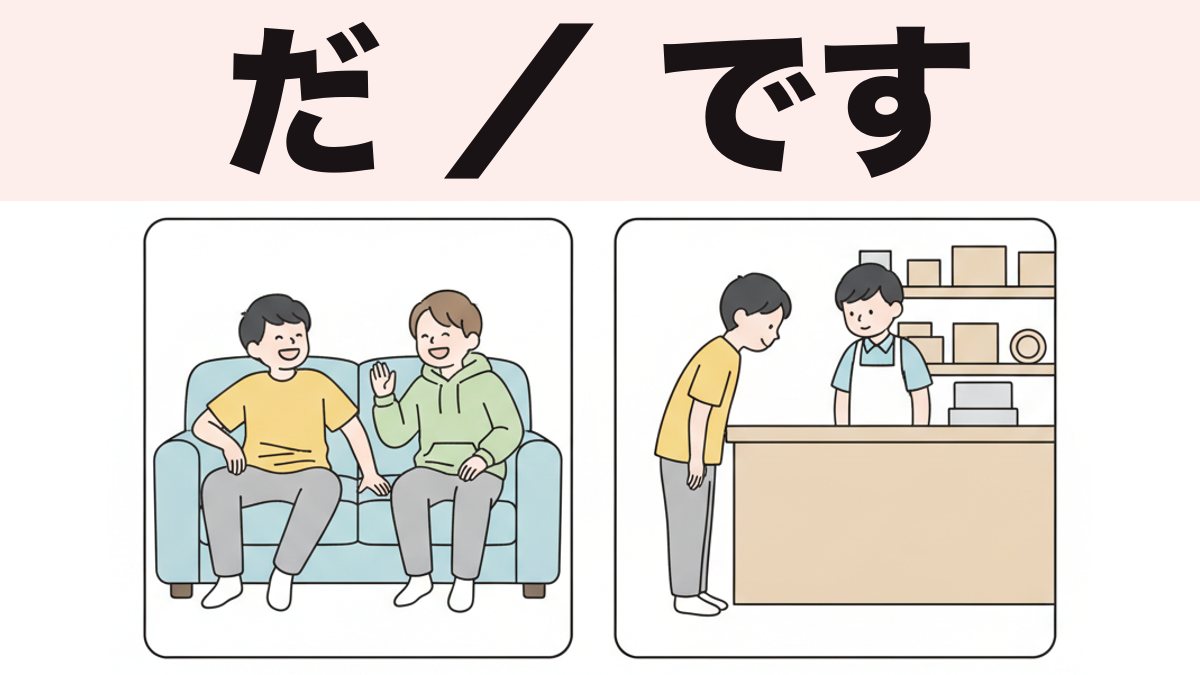
だ and です can give the same information while presenting a different relationship: 学生だ is plain, and 学生です is polite. I start with that pair, then separate nouns, adjectives, and verbs so that the switch works beyond a self-introduction.
英語は「ことばの選び方」でていねいさを出します。日本語は「文の最後の2文字」で出します。
Sentence endings carry a great deal of information about politeness in Japanese. They are not the whole system: word choice, tone, and context matter too. Still, changing the ending is a practical way to start adjusting how a sentence sounds without replacing every word in it. I teach both styles because learners need to recognise ordinary conversation as well as speak politely with someone they have just met.
The basics
The switch: same information, different relationship
学生だ。 — I'm a student. (plain) 学生です。 — I'm a student. (polite)
Neither sentence contains an explicit “I.” In a self-introduction, the context supplies that meaning. In a different conversation, the same Japanese could describe someone else. The ending tells me about the style of the statement, not who its subject must be.
I use “plain” for the grammatical form and “casual” for a conversational style. The distinction matters because plain forms also appear in writing and inside polite sentences. A plain form is not automatically rude, and a polite ending does not automatically make an unkind statement considerate.
The ending depends on the word before it
I do not teach です as something that can be added after any finished sentence. Nouns, な-adjectives, い-adjectives, and verbs follow different patterns. This table keeps the meaning stable while changing the style.
| Type | Plain statement | Polite statement | Meaning |
|---|---|---|---|
| Noun | 学生だ | 学生です | I am a student |
| な-adjective | 静かだ | 静かです | It is quiet |
| い-adjective | 面白い | 面白いです | It is interesting |
| Verb | 行く | 行きます | I will go |
ここは静かだ。 — It is quiet here. (plain) ここは静かです。 — It is quiet here. (polite) この映画は面白い。 — This film is interesting. (plain) この映画は面白いです。 — This film is interesting. (polite) 行く。 — I'll go. (plain) 行きます。 — I'll go. (polite)
The い-adjective already forms a plain predicate, so 面白い does not need だ. The ordinary polite version adds です, but the plain version is not 面白いだ. Likewise, 行く already forms a plain verb predicate. Its ordinary polite partner is 行きます, not 行くです or 行くだ.
I identify the word type before changing an ending. If that step is still difficult, my guide to い-adjectives and な-adjectives gives the distinction more room. The useful habit here is to change the grammatical pattern rather than mechanically replace every です with だ.
Past and negative meanings need their own forms
Politeness and tense are separate decisions. I can describe the past politely or plainly, and I can make a negative statement in either style. For a noun, these are useful starting pairs.
| Meaning | Plain | Polite |
|---|---|---|
| Am a student | 学生だ | 学生です |
| Was a student | 学生だった | 学生でした |
| Am not a student | 学生じゃない | 学生じゃないです |
| Was not a student | 学生じゃなかった | 学生じゃなかったです |
I use じゃないです here as a common conversational polite negative. ではありません is another polite choice, with a more formal feel. These are alternatives within the polite range, rather than evidence that one ending fits every situation.
学生でした。 — I was a student. (polite past) 学生じゃないです。 — I'm not a student. (polite negative)
With an い-adjective, the adjective itself carries the past ending: 面白かった becomes 面白かったです in ordinary polite speech. I avoid 面白いでした. With a verb, 見た and 見ました form a plain and polite past pair. Keeping these families separate makes conversion much more reliable.
Beyond the basics
Which style I choose
I start with です/ます when speaking to someone I have just met, asking for help in a shop, or addressing a teacher in an ordinary lesson setting. It gives me a workable default when I do not yet know the relationship. It is a starting point, not a promise that these endings alone cover every formal situation.
Among friends or family, plain speech can express familiarity. I do not decide that someone should receive plain speech just because they are younger or junior. The relationship, the setting, and the way we already speak to each other matter more than a simple age rule. A close colleague may use casual speech privately and polite speech during a meeting.
Both styles are necessary. Staying polite with friends can create distance in some situations, but it can also be a comfortable personal habit. I listen for how the conversation develops rather than treating closeness as a demand to switch immediately. My guide to when to switch between polite and casual Japanese develops this choice further.
Consistency is a useful practice rule
I ask beginners to choose a main style for a short conversation or description. That makes accidental changes easier to hear. Consider this sequence:
昨日、映画を見た。とても面白かったです。 — I watched a film yesterday. It was very interesting. (plain, then polite)
Both sentences are grammatical. What needs attention is the reason for changing style. Without context, I cannot call the sequence wrong. A speaker might first recall an event to themselves and then address the listener politely. In an exercise intended as a steady polite account, however, I would make the endings consistent.
昨日、映画を見ました。とても面白かったです。 — I watched a film yesterday. It was very interesting. (polite throughout) 昨日、映画を見た。とても面白かった。 — I watched a film yesterday. It was very interesting. (plain throughout)
A new topic or a new person joining can provide a clear moment to reconsider the style. Real conversation also includes smaller shifts for quotations, reactions, and thinking aloud. I use consistency as a learning aid, not as a rule that native speakers must keep one ending throughout an entire conversation.
Thinking aloud can stay plain
えーと、何だっけ… — Er, what was it again… (thinking aloud)
This can appear during an otherwise polite conversation because the speaker is searching their own memory. It is not necessarily an invitation for the other person to become more casual. I distinguish a sentence directed at the listener from a brief phrase directed at myself.
The distinction also helps with listening. Hearing a plain form once does not establish the style of the whole relationship. I listen to the surrounding exchanges before deciding whether the speakers have changed how they address each other.
Plain forms inside polite sentences
昨日見た映画は面白かったです。 — The film I saw yesterday was interesting. (plain modifier, polite ending)
Here, 見た describes 映画. It is part of a noun-modifying clause, so ordinary Japanese uses the plain form even though the sentence ends politely. 見ました映画 is not the corresponding polite version. I keep 見た and express the politeness in 面白かったです.
For this basic pattern, I look for the noun being described and then find the ending of the larger sentence. That prevents me from making every verb polite simply because the listener is someone I address politely. It also explains why recognising plain forms is useful before I start using casual conversation myself.
“Everything inside a sentence is plain” would be too broad a rule. Quotations and connected clauses can contain polite forms. Also, a noun or な-adjective before another noun does not simply keep sentence-final だ: 静かだ becomes 静かな部屋, “a quiet room.” I learn noun modification as its own pattern instead of treating every internal position identically.
Softening without changing the main style
The original contrast between plain and polite is only part of how a sentence feels. Sentence-final particles can show how I present information or involve the listener.
行くよ。 — I'll go, just so you know. (presenting information) 行くね。 — I'll go, okay? (seeking acknowledgement) 行くけど… — I'll go, but… (leaving something open)
I do not describe よ as automatically warm or ね as automatically gentle. Depending on tone and context, よ can sound insistent, and ね can request agreement rather than merely soften a statement. Ending with けど leaves room for something unstated; the listener needs context to understand what is being left open.
These devices do not require a switch to plain speech. 行きますよ and 行きますね keep the polite verb form while adding a conversational function. Similarly, a bare plain sentence is not always cold. 行く can be a neutral answer among people who already speak casually. Anime dialogue can exaggerate a character's manner, so I listen for tone and situation as well as the written ending.
Reading and listening for the relationship
Plain forms appear frequently in books, articles, and subtitles, but writing does not have a single compulsory style. An article can use polite endings, and subtitles generally follow the speech they represent. I treat reading as practice in recognising forms, rather than assuming that written Japanese must be casual.
A useful listening exercise is to follow the endings while temporarily paying less attention to unfamiliar vocabulary. I notice who uses です/ます with whom, whether someone is speaking to themselves, and whether a quoted line belongs to a different speaker. Those observations reveal clues about the relationship, though endings alone cannot explain the whole social situation.
How I practise the switch
I take five familiar sentences and convert them from polite to plain, then reverse the direction. I include a noun, a な-adjective, an い-adjective, and a verb so that the exercise cannot become a simple replacement task. I check the tense and negative meaning before deciding that a conversion is complete.
A short practice session can focus entirely on those endings. Afterwards, I say the sentences as part of a connected description, keeping the main style stable. Finally, I imagine a different listener and choose the style again. This connects the grammar to a communicative choice without requiring a new vocabulary list each time.
Common mistakes
- Replacing every です with だ. I first check the word type. 面白いです becomes 面白い, while 学生です becomes 学生だ.
- Adding です after an ordinary dictionary-form verb. I use 行きます for a straightforward polite statement, not 行くです.
- Making noun-modifying verbs polite. I keep 見た in 昨日見た映画, even when the larger sentence ends with です.
- Treating every style change as a grammatical error. I check whether the speaker is thinking aloud, quoting, or changing who they address.
- Assuming younger people automatically receive casual speech. I choose a default based on the relationship and setting.
- Assuming particles guarantee friendliness. I consider what よ, ね, or けど contributes and how the line is said.
Practice
I use these questions to check both form and context. Each answer explains the choice so that a correct guess can become a reusable pattern.
1. Make 学生だ polite without changing its meaning.
Show answer
学生です。 — 学生 is a noun, so its plain affirmative ending だ changes to polite です.
2. Make ここは静かです plain.
Show answer
ここは静かだ。 — 静か is a な-adjective, which takes だ in this plain affirmative statement.
3. Correct the plain statement この映画は面白いだ。
Show answer
この映画は面白い。 — An い-adjective forms a plain predicate without adding だ.
4. Change 行く to an ordinary polite statement.
Show answer
行きます。 — A verb uses its polite ます form here; adding です to 行く does not make this statement polite.
5. Say “I was a student” politely.
Show answer
学生でした。 — でした is the polite past form used after this noun, keeping both the past meaning and polite style.
6. Make 学生じゃない polite using the conversational negative taught above.
Show answer
学生じゃないです。 — Adding です to this negative form produces a conversational polite negative; the affirmative ending だ is not used here.
7. Correct 昨日見ました映画は面白かったです。
Show answer
昨日見た映画は面白かったです。 — 見た modifies 映画 and stays plain, while the larger sentence expresses politeness at its final predicate.
8. Keep this account consistently polite: 昨日、映画を見た。とても面白かったです。
Show answer
昨日、映画を見ました。とても面白かったです。 — 見ました makes the first sentence polite and past, matching the requested style of the second sentence.
9. Someone says えーと、何だっけ… while otherwise speaking politely. Must this mean they have switched to casual speech with their listener?
Show answer
No. — This phrase can be thinking aloud, directed at the speaker's own memory rather than changing the way they address the listener.
10. Add ね to 行きます while keeping the polite style.
Show answer
行きますね。 — ね follows the polite verb form and can seek acknowledgement; the particle does not require changing 行きます to 行く.
FAQ
Is だ rude? I treat it as a plain form, not an automatic insult. With a new acquaintance it may sound too familiar or direct, while among friends it can fit the relationship.
Can I always use です to be safe? I start with polite speech when the relationship is unclear, but I still choose the correct grammar. Verbs normally need their ます form, and context may call for additional respectful language.
Do friends have to stop using です? No. I listen to the style the people involved are comfortable using. Polite speech can remain part of an established friendship.
Why does a polite sentence contain 見た? In 昨日見た映画, 見た modifies the noun 映画. I keep that modifier plain and put the polite ending on the larger sentence's final predicate.
Is mixing plain and polite speech always wrong? No. I practise a consistent main style to avoid accidental shifts, but thinking aloud, quoting, and changing the person addressed can explain a deliberate change.
Vocabulary from this article
Tap the block to select all of it, then copy. In Anki: File → Import, note type Basic, separator Tab.
学生	がくせい — student
静か	しずか — quiet
ここ	ここ — here
映画	えいが — film, movie
面白い	おもしろい — interesting
行く	いく — to go
昨日	きのう — yesterday
見た	みた — saw, watched
とても	とても — very
部屋	へや — room
I'm Yuuki, a Japanese teacher based in Tokyo. I use plain and polite versions of the same sentence to make the difference audible. I focus on the word type, the listener, and the purpose of the sentence so that the choice becomes part of speaking, rather than an ending added afterwards.
Sources
- い-adjectives vs な-adjectives, this site's companion grammar guide.
- When to switch between polite and casual Japanese, this site's companion guide to register.
これは、いいニュースです。ていねいに話すために、新しいことばをたくさん覚える必要はありません。スイッチを1つ、正しいタイミングで切りかえるだけです。
スイッチ
学生だ。 — I'm a student. (ふつう) 学生です。 — I'm a student. (ていねい) 行く。 — I'll go. (ふつう) 行きます。 — I'll go. (ていねい)
情報は同じ。ことばも同じ。ちがうのは「相手との関係」だけです。
どちらを使う?
です/ます — 安全なほう。 学校で一緒ではなかった人、お店の人、仕事の人、先生、知らない人、年上の人。まよったら、いつもこちらです。
ふつうの形 — 近い人に。 友だち、家族、自分よりはっきり下の人、そして自分の心の中。本、記事、字幕は、ぜんぶふつうの形で書かれています。
初心者は「ですを使いなさい」と言われて、そこで止まります。すると、友だちにも手紙のように話す人になります。両方が必要です。「です」は、まよったときの基本、というだけです。
本当に大事なまちがい
「ふつうすぎる」ことではありません。まぜることです。
❌ 昨日 映画を 見た。とても 面白かったです。
半分ふつう、半分ていねい。日本人の耳には、ずっとふつうで話すよりも変に聞こえます。話している途中で、相手への気持ちが変わったように聞こえるからです。
1つの会話では、1つの形を選んで、最後まで続けてください。変えるなら、はっきりした区切りで。新しい話題、新しい人が来たとき、などです。
早く知っておきたい2つの例外
1. 自分への質問は、ふつうの形。 どんなにていねいな会話でも、考えごとを声に出すときはふつうの形です。
えーと、何だっけ… — er, what was it again…
2. 文の中の文は、いつもふつうの形。 ていねいな形は、文の最後にだけあります。文の中では、どんなにていねいに話していても、ふつうの形です。
昨日 見た 映画は 面白かったです。 — The film I saw yesterday was interesting.
「見た」は「映画」を説明しているだけで、文を終わらせていません。だから、ふつうの形です。「見ました映画」と言う人がいますが、これはまちがいです。
スイッチを切りかえずに、やわらかくする
「です」は遠い、でもふつうの形は強すぎる。そう感じるときは、日本語には真ん中があります。小さなことばを足すだけです。
行くよ。 — I'll go, just so you know. (気軽で、あたたかい) 行くね。 — I'll go, right? (相手に確かめる) 行くけど… — I'll go, but… (ふくみをもたせる)
友だちは、こうやって話します。何も足さないふつうの形は、いちばん平らで、冷たい形です。だから、アニメの冷たいキャラクターによく合うのです。
練習のしかた
「です」の形で知っている文を5つ選んで、ふつうの形で言ってみてください。次に、その反対。2分で、文ではなく「最後」を切りかえる感覚がつきます。それが全部です。
そして、聞いてください。次にアニメを見るとき、ことばではなく「最後」を追いかけてみてください。だれが、だれに「です」を使っているか。10分で、その作品の人間関係が全部見えます。
レッスンでは
レッスンでは、わざと2つの形を行ったり来たりします。温度の変化を、耳で聞いてほしいからです。1回のレッスンで、もう「聞こえないふり」ができなくなります。そして、あなたの日本語が、ねらった場所に着地しはじめます。
More drills like the ones above, plus a timed JLPT-style mock test: Practice · N5上のような練習問題と、時間つきのJLPT形式のもぎ試験: 練習ページ · N5
Want to try this in a real conversation?
本当の会話で、ためしてみませんか?
30-minute trial lesson, $13. Times shown in your own timezone.
30分の体験レッスン、$13。時間はあなたのタイムゾーンで表示されます。
Book a trial lesson · $13