Congratulations in Japanese: おめでとう, and the one day you must not say it「おめでとう」: 言ってはいけない日が、1つだけあります
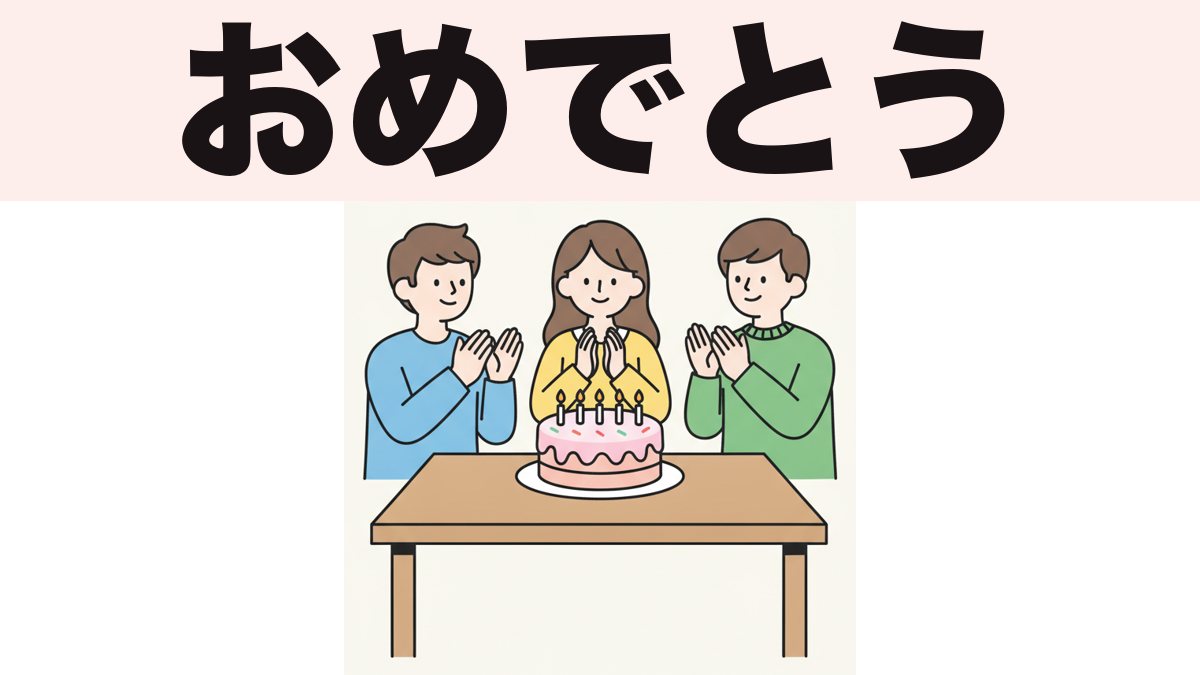
おめでとうございます is the all-purpose congratulation, and it takes whatever you are congratulating in front of it: 誕生日おめでとう, 結婚おめでとう, 合格おめでとう. The one place it does not go is a hospital room — recovery gets お大事に, not congratulations.
「おめでとうございます」は、どんなお祝いにも使えます。前に用事をつけるだけです。誕生日おめでとう、結婚おめでとう、合格おめでとう。使えないのは、病気が治った時です。そこは「お大事に」です。
This is a small, high-frequency piece of Japanese that you will need at predictable moments: a birthday message, a colleague's wedding, New Year, someone passing an exam. The pattern is simple enough to learn once and reuse for life.
The basics
The two registers
おめでとうございます。 — Congratulations. (polite; anyone) おめでとう。 — Congrats. (casual; friends, family, children)
That is the whole ladder. There is no formal third tier you need — おめでとうございます is already appropriate for a boss, a client or a wedding.
Building it for any occasion
Put the occasion in front, with no particle:
| Occasion | Phrase |
|---|---|
| Birthday | お誕生日おめでとうございます |
| New Year | あけましておめでとうございます |
| Wedding | ご結婚おめでとうございます |
| Graduation | ご卒業おめでとうございます |
| Passing an exam | 合格おめでとうございます |
| A new job | ご就職おめでとうございます |
| A new baby | ご出産おめでとうございます |
お誕生日おめでとうございます。 — Happy birthday. (polite) 誕生日おめでとう! — Happy birthday! (casual; the お usually drops too)
Notice the お / ご prefix on the occasion in the polite versions — お誕生日, ご結婚, ご卒業. That prefix is doing honorific work on the other person's event, the same mechanism that runs through family words and keigo generally.
New Year is its own thing
あけましておめでとうございます is said only after midnight on January 1st — never before. In late December you say よいお年を ("have a good year"), which is the parting phrase for the end of the year.
よいお年を。 — Have a good new year. (polite; said in late December, before the year ends) あけましておめでとうございます。今年もよろしくお願いします。 — Happy New Year. Looking forward to another year together. (polite; the standard January greeting, both halves)
今年もよろしくお願いします is the required second half. Saying only the first sounds unfinished.
Beyond the basics
Where おめでとう is wrong
Illness, injury and recovery. Someone leaving hospital has not achieved anything — they were unwell. The word is お大事に ("take care"), covered in how to talk about being sick.
Funerals and condolences, obviously — there, the set phrase is ご愁傷様です (ごしゅうしょうさまです), and it is one to recognise rather than improvise around.
Retirement is a genuine judgement call. お疲れ様でした ("thank you for your hard work") is the safer choice than おめでとう, unless the retirement is clearly a celebration the person is looking forward to.
What do you say back?
ありがとうございます。 — Thank you. (polite; the whole answer) ありがとう! — Thanks! (casual)
There is no special reply. A modest addition is common — 皆さんのおかげです ("it's thanks to everyone") — which uses the same おかげ as in thank-yous.
祝う and お祝い
- 祝う (いわう) — to celebrate. 誕生日を祝う.
- お祝い (おいわい) — a celebration, and also a congratulatory gift or money.
- お祝いする — to celebrate (someone/something).
みんなでお祝いしましょう。 — Let's celebrate together. (polite)
お祝い as a gift matters practically: weddings, births and graduations in Japan often involve money given in a special envelope, and the amount and the envelope both follow conventions. As a guest you will usually be told what is expected.
Birthday messages
The standard written message is short:
お誕生日おめでとうございます。素敵な一年になりますように。 — Happy birthday. I hope you have a wonderful year. (polite; 〜ますように = "may it be that...") 合格おめでとう!来年から大学生だね。 — Congrats on passing! You start university next year. (casual)
〜ますように is the wishing form, and it is the one piece of grammar worth taking from this page: it turns any verb into a wish. 元気になりますように (may you get well), うまくいきますように (may it go well).
頑張って and its limits
おめでとう is for something achieved. 頑張って ("do your best") is for something upcoming — and it comes with a caveat: said to someone already working extremely hard, it can land as pressure rather than support.
The gentler alternatives are 応援しています ("I'm cheering for you") and 無理しないでね ("don't push yourself"). Choosing between them is a genuinely useful piece of social Japanese.
Common mistakes
- Saying おめでとう to someone recovering from illness. Use お大事に.
- Saying あけましておめでとう in December. It is for January 1st onward. Before that, よいお年を.
- Dropping 今年もよろしくお願いします. The New Year greeting has two halves.
- Adding a particle before おめでとう. 誕生日おめでとう, not 誕生日がおめでとう.
- Forgetting お / ご on the occasion in polite use. ご結婚おめでとうございます, not 結婚おめでとうございます to a superior.
- Using 頑張って on someone who is already exhausted. 無理しないで is the kinder choice.
Practice
Say each answer out loud first. Questions 4 and 5 are a pair: two dates, two completely different phrases.
1. Wish a colleague a happy birthday, politely.
Show answer
お誕生日おめでとうございます — occasion in front, no particle.
2. Congratulate a friend on passing an exam, casually.
Show answer
合格おめでとう! — same pattern, casual form.
3. Congratulate someone on their wedding, politely.
Show answer
ご結婚おめでとうございます — note the ご on the other person's event.
4. It is December 30th. What do you say as you part?
Show answer
よいお年を — the end-of-year parting phrase. あけまして… would be too early.
5. It is January 2nd. What do you say?
Show answer
あけましておめでとうございます。今年もよろしくお願いします。 — both halves. The second is not optional.
6. A colleague is leaving hospital after being ill. What do you say?
Show answer
お大事に — not おめでとう. Recovery is not an achievement.
7. Someone congratulates you. What do you reply?
Show answer
ありがとうございます — that is the whole thing. 皆さんのおかげです is a nice modest addition.
8. What does 〜ますように mean?
Show answer
"May it be that..." — the wishing form. 素敵な一年になりますように, 元気になりますように.
9. What is お祝い, besides "celebration"?
Show answer
A congratulatory gift, often money in a special envelope — standard for weddings, births and graduations.
10. Your friend is already exhausted before a big exam. 頑張って or something else?
Show answer
無理しないでね or 応援しています — 頑張って to someone already at their limit can land as pressure.
FAQ
Is おめでとうございます formal enough for a boss? Yes. There is no higher everyday tier you need. For a written message you can add a line, but the phrase itself is already appropriate.
Do I need to say お誕生日, or is 誕生日 fine? Both work. お誕生日おめでとうございます is the polite version; 誕生日おめでとう is the casual one, and the お usually disappears along with the ございます.
What do people actually do for birthdays in Japan? Much the same as elsewhere — a cake, a meal, a message. The formal gift-giving conventions attach to weddings, births and funerals rather than to birthdays.
Is ハッピーバースデー used? Yes, especially on cards and in the song. It is a loanword and sits comfortably in casual contexts alongside おめでとう.
How do I congratulate someone on a promotion? ご昇進おめでとうございます. The same pattern with 昇進 (しょうしん, promotion), and the ご because it is their event.
What is the reply to よいお年を? よいお年を right back. It is a mutual parting phrase, like exchanging "have a good one" at the end of the year.
Vocabulary from this article
Tap the block to select all of it, then copy. In Anki: File → Import, note type Basic, separator Tab — the first column becomes the front, the second the back.
おめでとう	おめでとう — congratulations
誕生日	たんじょうび — birthday
結婚	けっこん — marriage
卒業	そつぎょう — graduation
合格	ごうかく — passing (an exam)
就職	しゅうしょく — getting a job
出産	しゅっさん — childbirth
昇進	しょうしん — promotion
祝う	いわう — to celebrate
お祝い	おいわい — celebration; congratulatory gift
今年	ことし — this year
来年	らいねん — next year
素敵	すてき — lovely, wonderful
応援	おうえん — support, cheering on
頑張る	がんばる — to do one's best
無理	むり — overdoing it
お大事に	おだいじに — take care (when ill)
一年	いちねん — one year
I'm Yuuki, a Japanese teacher based in Tokyo. I've taught on italki as a Top 1% teacher and watched over 1,500 anime. The New Year pair — よいお年を before, あけましておめでとう after — is the one students get wrong most, and it is also the one that people notice you getting right.
Sources: the author's own lessons and standard reference grammars.
小さいけれど、よく使うことばです。誕生日のメッセージ、同僚の結婚、お正月、試験の合格。1回おぼえれば、ずっと使えます。
基本
2つの形
おめでとうございます。 — Congratulations. (polite; anyone) おめでとう。 — Congrats. (casual; friends, family)
これだけです。上司にもお客さんにも、「おめでとうございます」で大丈夫です。
用事を前につける
助詞はいりません。
| 場面 | 言い方 |
|---|---|
| 誕生日 | お誕生日おめでとうございます |
| お正月 | あけましておめでとうございます |
| 結婚 | ご結婚おめでとうございます |
| 卒業 | ご卒業おめでとうございます |
| 合格 | 合格おめでとうございます |
| 就職 | ご就職おめでとうございます |
| 出産 | ご出産おめでとうございます |
お誕生日おめでとうございます。 — Happy birthday. (polite) 誕生日おめでとう! — Happy birthday! (casual; the お also drops)
ていねいな形では「お」「ご」がつきます。相手の出来事だからです(家族のことばと同じしくみです)。
お正月は特別
「あけましておめでとうございます」は、1月1日の午前0時より後だけです。12月には使いません。12月は「よいお年を」です。
よいお年を。 — Have a good new year. (said in late December) あけましておめでとうございます。今年もよろしくお願いします。 — Happy New Year. Looking forward to another year together. (the standard January greeting)
「今年もよろしくお願いします」は、後ろの半分です。これがないと、終わっていない感じになります。
もう少し先へ
「おめでとう」を使わない場面
病気・けが・退院。 何かをやりとげたのではありません。「お大事に」です(具合が悪い時のことば)。
お葬式。 決まったことばは「ご愁傷様です(ごしゅうしょうさまです)」です。
定年退職。 むずかしいところです。「お疲れ様でした」のほうが安全です。
言われたら何と答える?
ありがとうございます。 — Thank you. (polite) ありがとう! — Thanks! (casual)
特別な返事はありません。「皆さんのおかげです」と足すと、ひかえめでいい感じです(お礼の言い方の「おかげ」です)。
「祝う」と「お祝い」
- 祝う(いわう) — 祝うこと。「誕生日を祝う」。
- お祝い(おいわい) — お祝いの会、そしてお祝いのお金やプレゼント。
- お祝いする — お祝いをする。
みんなでお祝いしましょう。 — Let's celebrate together. (polite)
日本では、結婚・出産・卒業に、専用のふうとうでお金をわたすことがあります。金額もだいたい決まっています。
誕生日のメッセージ
お誕生日おめでとうございます。素敵な一年になりますように。 — Happy birthday. I hope you have a wonderful year. (polite)
「〜ますように」は、ねがいの形です。「元気になりますように」「うまくいきますように」。このページでいちばん役に立つ文法です。
「頑張って」の注意
「おめでとう」は終わったこと、「頑張って」はこれからのことです。でも、もうがんばっている人に言うと、プレッシャーになります。
その時は「応援しています」「無理しないでね」のほうがいいです。
よくあるまちがい
- 退院した人に「おめでとう」。 「お大事に」です。
- 12月に「あけましておめでとう」。 「よいお年を」です。
- 「今年もよろしくお願いします」を言わない。 お正月のあいさつは2つで1つです。
- 「誕生日がおめでとう」。 助詞はいりません。
- ていねいな時に「お」「ご」を忘れる。 「ご結婚おめでとうございます」。
- つかれている人に「頑張って」。 「無理しないで」のほうがやさしいです。
練習
まず声に出してから、答えを見てください。4番と5番はペアです。
1. 同僚に、ていねいに誕生日を言ってください。
答えを見る
お誕生日おめでとうございます — 用事を前に、助詞なしです。
2. 友だちの合格を、カジュアルに祝ってください。
答えを見る
合格おめでとう!
3. 結婚を、ていねいに祝ってください。
答えを見る
ご結婚おめでとうございます — 相手の出来事なので「ご」がつきます。
4. 12月30日、別れる時に何と言いますか。
答えを見る
よいお年を — 年が明ける前のあいさつです。
5. 1月2日、何と言いますか。
答えを見る
あけましておめでとうございます。今年もよろしくお願いします。 — 2つで1つです。
6. 同僚が退院しました。
答えを見る
お大事に — 「おめでとう」ではありません。
7. 「おめでとう」と言われました。
答えを見る
ありがとうございます — 「皆さんのおかげです」も いい形です。
8. 「〜ますように」の意味は?
答えを見る
〜になりますように=ねがい — 「素敵な一年になりますように」。
9. 「お祝い」には、「お祝いの会」のほかに どんな意味がありますか。
答えを見る
お祝いのお金・プレゼント — 結婚・出産・卒業では、専用のふうとうを使います。
10. 試験の前、もうつかれている友だちに何と言いますか。
答えを見る
無理しないでね/応援しています — 「頑張って」はプレッシャーになることがあります。
よくある質問
上司に「おめでとうございます」で足りますか。 足ります。これより上の形は、ふだんは必要ありません。
「お誕生日」と「誕生日」、どちらですか。 ていねいな時は「お誕生日」、カジュアルは「誕生日」です。
日本の誕生日は何をしますか。 ケーキ、食事、メッセージ。ほかの国とあまり変わりません。お金のお祝いは、結婚・出産などです。
「ハッピーバースデー」は使いますか。 使います。カードや歌でよく見ます。
昇進のお祝いは? 「ご昇進おめでとうございます」。同じ形です。
「よいお年を」と言われたら? 「よいお年を」と返します。おたがいに言うあいさつです。
この記事に出た単語
下のブロックをタップして全部えらび、コピーしてください。Anki では ファイル → 読み込み、ノートの種類は 基本、区切りは タブ です。
おめでとう	おめでとう — congratulations
誕生日	たんじょうび — birthday
結婚	けっこん — marriage
卒業	そつぎょう — graduation
合格	ごうかく — passing (an exam)
就職	しゅうしょく — getting a job
出産	しゅっさん — childbirth
昇進	しょうしん — promotion
祝う	いわう — to celebrate
お祝い	おいわい — celebration; congratulatory gift
今年	ことし — this year
来年	らいねん — next year
素敵	すてき — lovely, wonderful
応援	おうえん — support, cheering on
頑張る	がんばる — to do one's best
無理	むり — overdoing it
お大事に	おだいじに — take care (when ill)
一年	いちねん — one year
私はユウキです。東京で日本語を教えています。 italki の Top 1% の先生で、アニメは1,500本以上見ました。お正月の2つ——前は「よいお年を」、後は「あけましておめでとう」——は、生徒がいちばんまちがえる所で、正しく言えると いちばん気づいてもらえる所です。
More drills like the ones above, plus a timed JLPT-style mock test: Practice · N5上のような練習問題と、時間つきのJLPT形式のもぎ試験: 練習ページ · N5
Want to try this in a real conversation?
本当の会話で、ためしてみませんか?
30-minute trial lesson, $13. Times shown in your own timezone.
30分の体験レッスン、$13。時間はあなたのタイムゾーンで表示されます。
Book a trial lesson · $13